

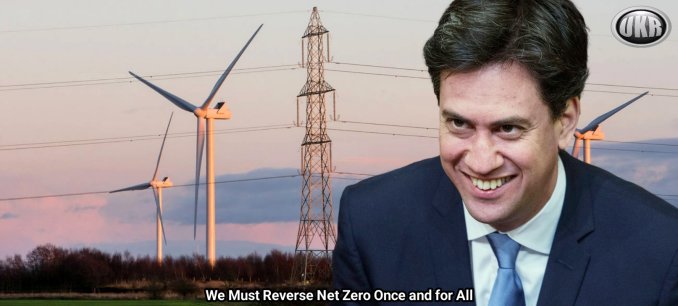
We must reverse Net Zero once and for all
RUPERT DARWALL
Last week, the Government announced the results of Allocation Round 7 (AR7) – record-breaking subsidies for renewable energy stretching 20 years into the future. ‘Clean, homegrown, power is the right choice for this country to bring down bills for good’, chimed Ed Miliband, the Net Zero Secretary, claiming that AR7 prices were 40% cheaper than gas.
Britain already pays more for electricity than virtually anywhere else in the developed world. What Miliband won’t tell you is that stealth carbon taxes, in the form of the Emissions Trading Scheme (ETS) and the Carbon Price Support (CPS) are currently a 45.5% tax on gas-generated electricity, raising its cost from £55 per megawatt hour (MWh) to around £80 per MWh. Only in the scrambled logic of Net Zero fanatics does imposing a tax on something make it cheaper.
Blaming Vladimir Putin and gas prices for Britain’s spiralling energy costs turns out to be a classic false flag. In October, Chris Norbury, chief executive of E.ON, shocked MPs on the energy select committee when he told them that even if gas prices fell to zero in 2030, energy bills wouldn’t fall because of the rising cost of renewables and the additional network costs they incur. Net Zero advocates assume that businesses can absorb higher energy costs without affecting their competitiveness and profitability in the same way as Rachel Reeves assumed businesses would absorb her hike in employer National Insurance Contributions. As the director-general of the CBI, Rain Newton-Smith, whose organisation is perversely campaigning for higher carbon taxes by pushing Britain back into the EU’s ETS, recently told the Financial Times, ‘You cannot just add costs to businesses and expect them to grow’.
As the economist Herb Stein quipped, ‘if something cannot go on forever, it will stop’. We are at that stage now with British energy policy. Fortunately, the cross-party consensus supporting Net Zero has collapsed. Both right-of-centre opposition parties would drop Net Zero in government and last October, Claire Coutinho of the Conservatives pledged to abolish the ETS and CPS. Energy policy, specifically what has been inflicted on the electricity sector, represents the biggest policy fiasco since 1945, one for which the three main parties share responsibility. By the time of the next election, it will have been running for just over two decades and is deeply entrenched within the industry, where billions of pounds of subsidies paid for by businesses and households became a permanent part of the renewable industry’s business model.
To get out of here, you need to know how we got here, as I argue in my new energy policy report ‘It’s Broke, Fix It’, published by the Prosperity Institute. Since 1990, there have been two phases of British energy policy. The first phase saw privatisation and liberalisation, begun under Thatcher lasting through two-and-a-half terms of New Labour. It ended in 2007, when Tony Blair committed Britain to the EU’s 20% renewable energy target, signalling the start of Phase Two. Having a renewables target reverses the main point of privatisation, which is that private investors – not politicians and bureaucrats – decide both the quantum and type of generating technology, thereby transferring investment risk from customers and taxpayers to investors.
Privatisation had achieved what its proponents said it would do. Even Ed Davey, energy secretary in the coalition government, wrote in the November 2012 ‘Electricity Market Review: Policy Overview’ White Paper: ‘Since electricity privatisation, the current market electricity market has worked well, delivering reliable and affordable power. Yet the current market will not deliver the huge investment necessary to meet new challenges.’ Therefore, according to Davey, the state had to take back control. The Cameron-Clegg coalition opted for what the Brown government had rejected two years earlier on the grounds that government bureaucrats ‘may not be as well placed as suppliers in a competitive market’, a criticism that has proven well-founded.
Britain had entered Phase Two in good shape. In 2010, our dispatchable generating capacity – nuclear, gas, and coal-fired power stations – peaked at 90.4 gigawatts (GW), 17.1 GW higher than in 1996. The coalition government and its Conservative successor then took a wrecking ball to it. Britain, they declared, would power past coal, so 23.7 GW of coal-fired came off the grid. But the new gas-fired capacity that Davey and his Tory successor, Amber Rudd, said was necessary, didn’t materialise. Instead, there was a massive influx of highly subsidised wind and solar totalling 44.9 GW between 2010 and 2024.
Weather-dependent renewables are not a substitute for having enough dispatchable capacity. As a result, imports of electricity soared – from 2% of demand in 2009 to 16% in 2024. The only reason the lights stayed on is because demand fell by 17% thanks to deindustrialisation and higher electricity prices.
In addition to making Britain less energy secure, having more wind and solar destroys the productivity of the grid. In 2009, 87.4 GW of generating capacity with only 5.1% of wind and solar produced 356.5 terawatt hours (TWh) of electricity. In 2024, 105.5 GW of capacity, with wind and solar accounting for 47.9% of capacity, produced only 270.1TWh of electricity. In other words, a 20.3% increase in capacity produced 24.2% less electricity – a decline of 37.1% of output per unit of capacity. Producing less with more is the fundamental economic fact about mass deployment of wind and solar. It is why every extra wind turbine and solar panel drives up the cost of electricity.
The original sin of Phase Two was the subordination of energy policy to climate policy. If you must have a climate policy, it should be economy-wide, not sector-specific, which gave the green light to rampant predation by green vested interests. Then you need to be very clear as to what your policy objective is and the principal means of achieving it. The single biggest lesson of energy policy since 1990 is that markets worked and the state failed. Finally, the next government must grasp the nettle of the dire state of Britain’s generating capacity. Keeping the lights on and getting electricity prices down requires investment in new dispatchable capacity to make up for the hole left by coal. Decontaminating the toxic mess left by two decades of bad policy is a vast undertaking, requiring strong policy skills and a good dose of political courage. It is a task that is essential for Britain’s future security and prosperity.
Click here to subscribe to our daily briefing – the best pieces from CapX and across the web.
CapX depends on the generosity of its readers. If you value what we do, please consider making a donation.
This article (We must reverse Net Zero once and for all) was created and published by CapX and is republished here under “Fair Use” with attribution to the author Rupert Darwall

••••
The Liberty Beacon Project is now expanding at a near exponential rate, and for this we are grateful and excited! But we must also be practical. For 7 years we have not asked for any donations, and have built this project with our own funds as we grew. We are now experiencing ever increasing growing pains due to the large number of websites and projects we represent. So we have just installed donation buttons on our websites and ask that you consider this when you visit them. Nothing is too small. We thank you for all your support and your considerations … (TLB)
••••
Comment Policy: As a privately owned web site, we reserve the right to remove comments that contain spam, advertising, vulgarity, threats of violence, racism, or personal/abusive attacks on other users. This also applies to trolling, the use of more than one alias, or just intentional mischief. Enforcement of this policy is at the discretion of this websites administrators. Repeat offenders may be blocked or permanently banned without prior warning.
••••
Disclaimer: TLB websites contain copyrighted material the use of which has not always been specifically authorized by the copyright owner. We are making such material available to our readers under the provisions of “fair use” in an effort to advance a better understanding of political, health, economic and social issues. The material on this site is distributed without profit to those who have expressed a prior interest in receiving it for research and educational purposes. If you wish to use copyrighted material for purposes other than “fair use” you must request permission from the copyright owner.
••••
Disclaimer: The information and opinions shared are for informational purposes only including, but not limited to, text, graphics, images and other material are not intended as medical advice or instruction. Nothing mentioned is intended to be a substitute for professional medical advice, diagnosis or treatment.
Disclaimer: The views and opinions expressed in this article are those of the author and do not necessarily reflect the official policy or position of The Liberty Beacon Project.


Leave a Reply