

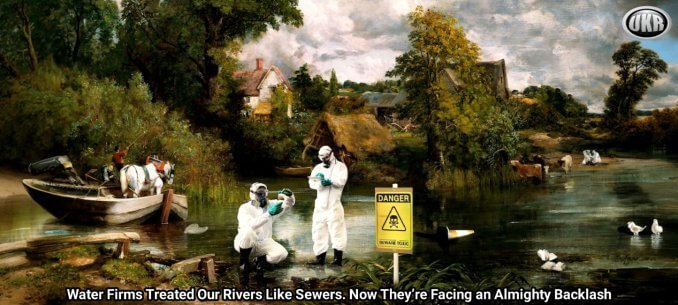
Water firms treated our rivers like sewers. Now they’re facing an almighty – and deserved – backlash
Pollution in Britain’s waterways is at appalling levels, yet those responsible are getting filthy rich. Now campaigners are demanding action
PATRICK GILBRAITH, ERIC WILLIAMS
In the 1980s, the letters pages in The Telegraph received a remarkable amount of correspondence about the call of the cuckoo and seasons changing. In the 1990s, readers wrote in regularly about split infinitives. But currently, and far less happily, the dire state of Britain’s water industry is one of our readers’ chief topics of concern.
Last week, Peter Little from Kent wrote in to brand Britain’s water supply and sewage treatment systems “a national disgrace”; there were a number of letters about bills (last year, Thames customers found their bills rising by more than 30 per cent); and Neil Ewart in Langholm, Scotland, suggested that “water bosses’ bonuses should be reduced by £1,000 for every sewage spill by their company”. Brian Farmer, from Carmarthenshire, captured the spirit of the nation with a short letter noting that he now distrusts utility companies so much that he has stopped putting water in his whisky.
Anger over the state of the industry has reached fever pitch – and with good reason. In December of last year, 24,000 homes in the South East went without drinkable water for nearly two weeks. Thames Water, which has sought permission to be allowed to continue breaching pollution limits, is on the brink of collapse, and lately water companies have been sending bailiffs to people’s homes to collect unpaid bills. The bitter irony, of course, is that the service water bosses are forcing on us – and “forced” is the right word, given you can’t change your provider – is simply not worth the money.
Indeed, the Consumer Council for Water, which has been tracking the views of households in England and Wales for the past 14 years, said trust in firms hit an all-time low last year.
There is nothing glamorous about the water industry – the bosses, in spite of being paid fat salaries, look and sound distinctly civil service. When Dave Hinton, the chief executive of South East Water, finally broke cover to answer questions about his handling, or indeed mishandling, of the water outage in the South East, his performance was lacklustre. He blamed the shortages on people working from home using too much water and claimed the crisis was not foreseeable. Marcus Rink, of the Drinking Water Inspectorate, who had also been called to Parliament to give evidence, rejected Hinton’s claim entirely.
[…]
Feargal Sharkey, the singer and veteran water campaigner, says: “The water scandal is of the magnitude of the British Post Office scandal. Indirectly, there are 62 million people living in England and Wales who have been fleeced by water companies. We have been robbed.”
[…]
Between 2006 and 2007, when Thames Water was owned by the Australian investment giant Macquarie, its debt tripled from £3.4bn to £10.8bn. Sharkey describes what has gone on as our water industry being “ram-raided for cash”.
This money should have been spent on upgrading infrastructure, such as sewage treatment plants and sewer overflows. Sharkey, as an angler, is well acquainted with the consequences of failing to make these upgrades. He says: “Most of the rivers within the M25 are nothing more than drainage ditches for sewage. They would have been full of salmon and sea trout at one point in history. Currently there is not a river in this country that isn’t polluted, 100 per cent polluted.”
Our relationship with water itself has changed. As an island nation, our history, politics and culture have been shaped by our closeness to the rivers and the sea that surrounds us. But what defined us as a source of prosperity is now something we fear.
There was a record 3.6 million hours of sewage spills in 2024, and at bathing points in places such as the coast near Seaton in Cornwall, sewage was up from 3,145 hours of spillages in 2023 to 3,559 hours in 2024.
The Telegraph: continue reading
Featured image: The Telegraph (modified)

••••
The Liberty Beacon Project is now expanding at a near exponential rate, and for this we are grateful and excited! But we must also be practical. For 7 years we have not asked for any donations, and have built this project with our own funds as we grew. We are now experiencing ever increasing growing pains due to the large number of websites and projects we represent. So we have just installed donation buttons on our websites and ask that you consider this when you visit them. Nothing is too small. We thank you for all your support and your considerations … (TLB)
••••
Comment Policy: As a privately owned web site, we reserve the right to remove comments that contain spam, advertising, vulgarity, threats of violence, racism, or personal/abusive attacks on other users. This also applies to trolling, the use of more than one alias, or just intentional mischief. Enforcement of this policy is at the discretion of this websites administrators. Repeat offenders may be blocked or permanently banned without prior warning.
••••
Disclaimer: TLB websites contain copyrighted material the use of which has not always been specifically authorized by the copyright owner. We are making such material available to our readers under the provisions of “fair use” in an effort to advance a better understanding of political, health, economic and social issues. The material on this site is distributed without profit to those who have expressed a prior interest in receiving it for research and educational purposes. If you wish to use copyrighted material for purposes other than “fair use” you must request permission from the copyright owner.
••••
Disclaimer: The information and opinions shared are for informational purposes only including, but not limited to, text, graphics, images and other material are not intended as medical advice or instruction. Nothing mentioned is intended to be a substitute for professional medical advice, diagnosis or treatment.
Disclaimer: The views and opinions expressed in this article are those of the author and do not necessarily reflect the official policy or position of The Liberty Beacon Project.


Leave a Reply