

A ban meant to shield children from extremism could instead redefine the very idea of privacy in a connected world.
KEN MACON
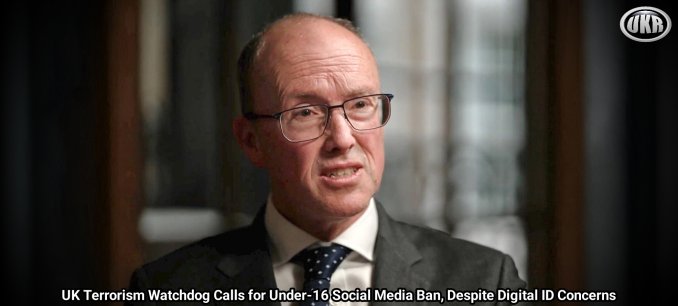
Britain’s independent reviewer of terrorism laws, Jonathan Hall KC, has urged the government to copy Australia’s recent decision to ban under-16s from social media.
He argues such a restriction could prevent radicalization and the spread of extremist material, particularly through artificial intelligence tools.
But privacy advocates say the cost of enforcing such bans would be the loss of anonymity online, a principle that has long protected political dissent, personal safety, and free expression.
Writing in The Telegraph, Hall said the UK must “take back control” from major technology companies and stop “troubled young people” from being drawn into violence through AI-driven interactions.
“Terrorist chatbots or avatars of celebrated mass killers, always present and eager to please, are precisely the wrong companions for disturbed teenagers like Axel Rudakubana and Nicholas Prosper,” he warned.
Australia recently introduced a world-first law requiring strict age checks to block those under sixteen from accessing social media platforms such as Facebook, X, Instagram, TikTok, and Snapchat.
Communications Minister Anika Wells has defended the plan, saying her government “will not be swayed by legal threats.”
The policy has faced immediate legal and ethical challenges. Two 15-year-olds, Noah Jones and Macy Neyland, have taken the case to the High Court, arguing that the restriction deprives them of “their right to free communication.”
Reddit has also launched a legal challenge, warning that the requirement undermines privacy and political freedoms.
To verify the age of every user, social media companies would need to implement dystopian identity checks.
That would mean no one could open an account or access most online spaces without proving exactly who they are, typically through passports, driver’s licences, or facial recognition systems.
Such mechanisms would not just exclude children. They would eliminate anonymous browsing for everyone.
This would transform the internet from an open environment into a monitored identity system, allowing both governments and corporations to link every post, search, and private message to a verified individual.
For many who value privacy, that represents a fundamental change in the structure of digital life.
Anonymity online has long protected journalists, activists, and ordinary citizens who speak out about sensitive issues. Once identification becomes mandatory, those protections vanish.
The UK’s Online Safety Act (OSA), passed last year, already forces adult sites to use strict age checks and makes social media companies legally responsible for shielding minors from “harmful” content.
But unlike Australia’s law, the OSA does not require full identity verification for all users, nor does it grant the state power to remove posts directly.
Hall has described this as a weakness. He says the OSA “does not grant authorities the ability to take down content,” leaving regulators powerless when American firms refuse to comply.
Ofcom, the regulator enforcing the act, is currently facing a lawsuit from 4chan, which claims that the law violates the US First Amendment’s free-speech protections.
Hall believes AI has transformed the threat landscape, describing 2025 as the most demanding year of his tenure. He warned that online radicalization is now “central to national security” and compared Australia’s ban to landmark public safety reforms such as seat-belt laws and smoking bans.
Once anonymity is gone, it cannot easily be restored, and it has greater implications in a nation where citizens are being arrested for social media posts.
And for a generation raised in digital spaces, that loss would mark a new era: one where being online no longer means being free to speak without fear of being watched.
This article (UK Terrorism Watchdog Calls for Under-16 Social Media Ban, Despite Digital ID Concerns) was created and published by Reclaim the Net and is republished here under “Fair Use” with attribution to the author Ken Macon

••••
The Liberty Beacon Project is now expanding at a near exponential rate, and for this we are grateful and excited! But we must also be practical. For 7 years we have not asked for any donations, and have built this project with our own funds as we grew. We are now experiencing ever increasing growing pains due to the large number of websites and projects we represent. So we have just installed donation buttons on our websites and ask that you consider this when you visit them. Nothing is too small. We thank you for all your support and your considerations … (TLB)
••••
Comment Policy: As a privately owned web site, we reserve the right to remove comments that contain spam, advertising, vulgarity, threats of violence, racism, or personal/abusive attacks on other users. This also applies to trolling, the use of more than one alias, or just intentional mischief. Enforcement of this policy is at the discretion of this websites administrators. Repeat offenders may be blocked or permanently banned without prior warning.
••••
Disclaimer: TLB websites contain copyrighted material the use of which has not always been specifically authorized by the copyright owner. We are making such material available to our readers under the provisions of “fair use” in an effort to advance a better understanding of political, health, economic and social issues. The material on this site is distributed without profit to those who have expressed a prior interest in receiving it for research and educational purposes. If you wish to use copyrighted material for purposes other than “fair use” you must request permission from the copyright owner.
••••
Disclaimer: The information and opinions shared are for informational purposes only including, but not limited to, text, graphics, images and other material are not intended as medical advice or instruction. Nothing mentioned is intended to be a substitute for professional medical advice, diagnosis or treatment.
Disclaimer: The views and opinions expressed in this article are those of the author and do not necessarily reflect the official policy or position of The Liberty Beacon Project.



Leave a Reply