

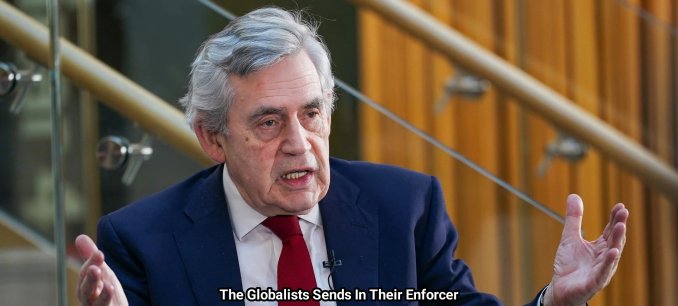
The Real Reason Why Gordon Brown Returned

.
STEVEN BARNES
In the aftermath of Labour’s humiliating drubbing in the 2026 local elections, where the party haemorrhaged seats to Reform UK amid widespread voter fury over open borders, stagnant wages, and net zero zealotry, Keir Starmer did what embattled establishment figures do: he reached for the old guard. Gordon Brown, the former Chancellor and Prime Minister whose tenure did so much to saddle Britain with debt, demographic strain, and diminished sovereignty, has been brought back as special envoy on global finance. Starmer’s spin doctors frame this as pragmatic expertise. The reality is more sinister and self-serving. Brown was not recalled merely to steady the wobbling throne of the expendable Starmer. He was brought back—or was told to return—to reinforce the transnational networks that view national democracy as an irritant to be managed, not a sovereign will to be obeyed.
The local elections delivered a clear verdict. Labour lost control of dozens of councils and over 1,400 seats. Reform UK surged in traditional heartlands, capitalising on rage against mass immigration, sky-high energy costs, and a political class deaf to ordinary Britons. Voters rejected the globalist consensus: endless fiscal largesse, supranational entanglements, and cultural transformation. Yet rather than pivot, Starmer doubled down by summoning one of its chief architects. This was never about saving Starmer alone. It was about buttressing the broader globalist project after the polling booth delivered its unambiguous rebuke.
Gordon Brown enters this role not as a neutral technocrat but as a man with form. A champion of the very agenda that has hollowed out British industry, inflated public debt, and eroded borders, Brown embodies the post-national elite’s disdain for the nation state. His return signals continuity for the Davos set—the WEF fellow travellers who preach climate alarmism and mass migration while ordinary families struggle with the consequences. In an era when voters across the West are rejecting this model, from Brexit to Trump to European populist gains, the establishment calls in reinforcements to keep the project alive.
Brown’s record as Chancellor (1997-2007) and Prime Minister (2007-2010) reads like a manifesto for the globalist agenda. Far from prudent stewardship, his policies accelerated Britain’s vulnerabilities in ways that aligned neatly with supranational ideals over national interest.
First, the notorious sale of Britain’s gold reserves between 1999 and 2002. Brown dumped around 395 tonnes at rock-bottom prices, averaging roughly $275 per ounce. The proceeds were diversified into foreign currencies—precisely the sort of move that weakens a nation’s independent monetary defences. Gold later soared; the lost opportunity cost runs into tens of billions. Critics rightly call it one of the worst financial decisions in modern British history. It symbolised a willingness to liquidate national assets at the altar of fashionable economic globalisation.
Second, Brown’s expansion of the Private Finance Initiative (PFI) saddled future generations with exorbitant long-term payments for hospitals and infrastructure. Promising off-balance-sheet wizardry, it enriched private consortia while taxpayers footed inflated bills for decades. This corporatist model—blending state power with favoured business interests—prefigured today’s so-called “stakeholder capitalism” beloved by Davos.
Third, his handling of the financial sector. As Chancellor, Brown championed “light-touch” regulation and celebrated the City of London as a global hub. The creation of the Financial Services Authority contributed to a regulatory environment that failed to curb the excesses preceding the 2008 crash. When crisis hit, Brown coordinated international bailouts and stimulus, nationalising chunks of banks like RBS. Necessary short-term action, perhaps, but it exploded public debt and entrenched moral hazard. Britain emerged with one of the highest debt burdens among major economies, a legacy that still constrains fiscal options. His boast of ending “boom and bust” became a mocking epitaph.
Fourth, Brown oversaw and encouraged the dramatic rise in net migration following EU enlargement. Combined with his government’s reluctance to impose transitional controls, this accelerated demographic change and pressures on housing, the NHS, and social cohesion—issues that still dominate voter anger today. His broader enthusiasm for European integration and international institutions dovetailed with a worldview that prioritises multilateralism over parliamentary sovereignty.
Fifth, massive increases in public spending, funded by borrowing and optimistic growth assumptions. Billions poured into the NHS and education, with some short-term gains in waiting lists and school results. Yet this fuelled a client state, ballooned the welfare bill, and left the public finances exposed when the music stopped. Tax credits and redistributionist measures expanded dependency. The abolition of the 10p tax rate in 2007-08, which hit the poorest hardest before a humiliating U-turn, revealed the clumsiness beneath the spreadsheets.
As Prime Minister, Brown continued the trajectory: moralising on the world stage about global poverty and climate while Britain’s own productivity stagnated and energy policy tilted towards unreliable renewables. His government’s role in pushing supranational responses to crises set templates for later WEF-style coordination on everything from pandemics to “sustainable development.”
These were not random errors. They conformed to a consistent globalist pattern: erode national fiscal and monetary autonomy, entangle the economy in international finance, liberalise borders and labour markets, expand the administrative state, and frame dissent as regressive. Brown’s post-office advocacy—for reformed global institutions, more aid, climate finance, and closer EU ties—further confirms the worldview. He has addressed WEF gatherings, as have so many in the revolving door between Westminster, Brussels, and Davos. Engagement itself is not conspiracy, but the consistent policy direction across parties suggests an ideological capture that voters increasingly resent.
Starmer’s decision to elevate him now is telling. Facing leadership speculation and backbench grumbling after the local elections rout, the Prime Minister needed ballast. Yet choosing Brown for “global finance” and international partnerships—explicitly including EU relations and defence investment via multilateral channels—reveals priorities. It is not domestic reset on immigration or energy costs. It is outreach to the very networks that many voters believe have failed them. The message to the British public is clear: your ballot box rejection changes nothing at the top. The transnational consensus must prevail.
This is the deeper purpose. Starmer, himself a product of the international legal and NGO world, inherits a Labour Party long comfortable with supranationalism. Brown provides institutional memory and credibility with global markets and institutions. In an uncertain world of defence spending pressures and economic headwinds, the temptation is to lean on familiar forums rather than bold national reassertion.
Britain faces real challenges—sluggish growth, demographic imbalance, energy insecurity, and strained public services. Solutions lie in prioritising British workers, prudent finances, secure borders, and realistic energy policy. Instead, the return of Brown risks entrenching the mindset that caused the problems: that salvation comes from more global coordination, more borrowing capacity unlocked through international partnerships, and more managerialism from above.
The voters who rejected Labour were not demanding more of the same. They sought accountability and course correction. By turning to a figure synonymous with the pre-2016 consensus, Starmer signals contempt for that mandate. Whether Brown’s unpaid, part-time role yields tangible results or serves as political theatre matters less than the symbolism. It reassures markets, NGOs, and foreign interlocutors that the Davos-aligned centre holds, even as the electorate pulls away.
Britain deserves better than recycled architects of its past woes. True national renewal requires rejecting the failed globalist catechism—not recalling its high priests. The local elections were a warning shot. If the establishment response is Gordon Brown redux, they risk proving the populist critique correct: that power resides not in the ballot box, but in the enduring networks that transcend it. The coming years will test whether Britain can reclaim agency or remains tethered to the very forces that diminished it.
This article (The Globalists Sends In Their Enforcer) was created and published by Free Speech Backlash and is republished here under “Fair Use” with attribution to the author Steven Barnes
Featured image: The Telegraph


Leave a Reply