

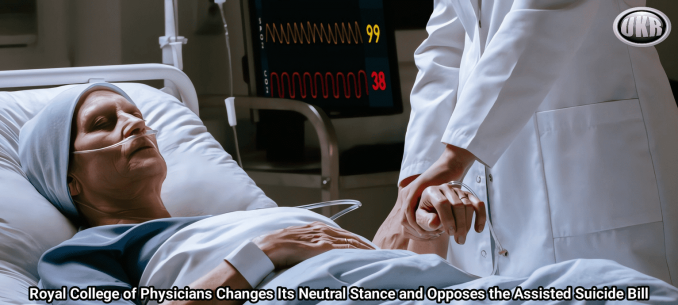
Royal College of Physicians changes its neutral stance and opposes the assisted suicide bill
Kim Leadbeater’s euthanasia bill, officially known as the Terminally Ill Adults (End of Life) Bill, will have its Third Reading in the House of Commons tomorrow.
On the eve of the vote, the Royal College of Physicians has stated it does not support the Bill. A group of leading social care organisations also raised serious concerns. These statements follow the withdrawal of support for the Bill by the Royal College of Psychiatrists.
The “death by doctor” bill is becoming the “death by politician” bill.
Earlier today, The Standard reported that another leading medical body has raised concerns about the risks of the euthanasia Bill “failing to protect vulnerable patients,” on the eve of its return to Parliament. The Royal College of Physicians (“RCP”) said it believes there are “concerning deficiencies” with the proposed legislation as it stands.
The RCP said that despite changes to the Bill in recent months which supporters argue have strengthened it, the college believes “there currently remain deficiencies that would need addressing to achieve adequate protection of patients and professionals.”
Its statement follows one earlier this week from the Royal College of Psychiatrists (“RCPsych”), which said it has “serious concerns” and cannot support the Bill in its current form.
As Sky News noted, “The announcement from the Royal College of Psychiatrists is a blow to supporters of the bill because under an amendment, a psychiatrist would be on the expert panel to assess assisted dying cases.”
Today, a group of leading social care organisations also raised concerns over the proposed euthanasia bill, flagging worries about coercion. A partnership of the country’s leading social care and end-of-life organisations told Sky News of their deep frustration at being excluded from important discussions around the assisted dying debate, describing the proposed change to the law as “unworkable, unaffordable and naïve.”
Earlier this month, the Bishop of London said the government’s impact assessment of the assisted dying bill “makes for chilling reading.”
Bishop Sarah Mullaly said: “The impact assessment of the Terminally Ill Adults (End of Life) Bill makes for chilling reading as it highlights particular groups who would be put at risk by a change in the law, including those who are subject to health inequalities, and those vulnerable to domestic abuse.”
On the financial estimates, she said: “It is crude to see these cost savings set out in this way, and it is easy to see how numbers of this nature could contribute to someone feeling that they should pursue an assisted death rather than receive care.”
She reiterated the church’s resolve to oppose “any change in the law that puts the vulnerable at risk rather than working to improve access to desperately needed palliative care services.”
Keir Starmer, who has proved he is incapable of doing right by Britons since taking office, voted for the Bill last year and on the eve of its Third Reading has indicated he remains supportive of the euthanasia bill.
For its second reading, it was voted through by a reasonably narrow margin of 330 MPs in favour to 275 against. The Bill was passed with a majority of 55, meaning only 28 MPs need to change their minds or abstain from voting for it to fail.
Yesterday, The Telegraph reported that “As the Bill winds its way back to the Commons on 16 May – when all MPs will have the opportunity to propose and vote on further changes – there is a sense that it is on increasingly shaky ground. Critics have raised concerns that key safeguards have been removed from the legislation since the last time it was debated.”
A recent poll conducted by Whitestone Insight on behalf of the campaign group Care Not Killing suggested that more parliamentarians now oppose the Bill than support it, The Telegraph said.
Don’t leave it up to chance; contact your MP tonight and let them know you want them to vote against Death Leadbeater’s euthanasia bill.
This article (Royal College of Physicians changes its neutral stance and opposes the assisted suicide bill) was created and published by The Expose and is republished here under “Fair Use” with attribution to the author Rhoda Wilson
See Related Article Below
Danny Kruger: The major problem with the Assisted Dying Bill is not just assisting suicide – it’s the Bill itself
DANNY KRUGER MP
This article (Danny Kruger: The major problem with the Assisted Dying Bill is not just assisting suicide – it’s the Bill itself) was created and published by Conservative Home and is republished here under “Fair Use” with attribution to the author Danny Kruger MP
Featured image: Deposit Photos

••••
The Liberty Beacon Project is now expanding at a near exponential rate, and for this we are grateful and excited! But we must also be practical. For 7 years we have not asked for any donations, and have built this project with our own funds as we grew. We are now experiencing ever increasing growing pains due to the large number of websites and projects we represent. So we have just installed donation buttons on our websites and ask that you consider this when you visit them. Nothing is too small. We thank you for all your support and your considerations … (TLB)
••••
Comment Policy: As a privately owned web site, we reserve the right to remove comments that contain spam, advertising, vulgarity, threats of violence, racism, or personal/abusive attacks on other users. This also applies to trolling, the use of more than one alias, or just intentional mischief. Enforcement of this policy is at the discretion of this websites administrators. Repeat offenders may be blocked or permanently banned without prior warning.
••••
Disclaimer: TLB websites contain copyrighted material the use of which has not always been specifically authorized by the copyright owner. We are making such material available to our readers under the provisions of “fair use” in an effort to advance a better understanding of political, health, economic and social issues. The material on this site is distributed without profit to those who have expressed a prior interest in receiving it for research and educational purposes. If you wish to use copyrighted material for purposes other than “fair use” you must request permission from the copyright owner.
••••
Disclaimer: The information and opinions shared are for informational purposes only including, but not limited to, text, graphics, images and other material are not intended as medical advice or instruction. Nothing mentioned is intended to be a substitute for professional medical advice, diagnosis or treatment.
Disclaimer: The views and opinions expressed in this article are those of the author and do not necessarily reflect the official policy or position of The Liberty Beacon Project.


Danny Kruger is MP for East Wiltshire and shadow welfare minister.
Two moments stick in my memory from the Assisted Suicide Bill committee, which I sat through with two dozen colleages for six long weeks earlier this year.
The first is when Kim Leadbeater MP – after repeated pressing – confirmed that under her Bill someone could get an ‘assisted death’ for no other reason than feeling a burden on others. Later, Kim and her hand-picked committee rejected an amendment that would require the doctor to ask the simple question to the patient requesting assisted suicide: ‘why?’
This admission goes to the heart of the danger of this Bill.
We can all understand the benefit it could bring to people at the very end of their lives to avoid a terrible final few days (albeit the number of patients that good palliative care – or in extremis, deep sedation – cannot help is close to zero). But this Bill would offer state-administered suicide to anyone with a condition they might reasonably die of within six months (that’s a lot of disabled and frail people) who feel they’d be better off dead.
It sends a clear signal to those people – it effectively requires them to consider – that the right thing to do may be to accept the offered service.
The second memorable moment was when Kim introduced an amendment to the Bill giving ministers the power to change the founding principles of the National Health Service itself.
This amendment (like the scrapping of the High Court judge, a safeguard much touted during the Second Reading debate) was not introduced when MPs as a whole were voting on the Bill, but only in a committee packed by Kim with a majority of supporters.
It authorises ministers to declare that Section 1 of the Act establishing the NHS, which currently simply says the service is there to secure improvement in the health of the people, now includes the power to end life. And thus the NHS becomes the National Health and Suicide Assistance Service.
The Bill would institutionalise a profound change in our society and alter the basis of the NHS. And the detail is no less distressing.
It would allow doctors to raise Assisted Suicide (AS) with patients who hadn’t raised it themselves; it would allow them suggest it to children. It requires no specialist assessment of the patient’s condition, or mental state, before approval by doctors. The only input from a psychiatrist comes at the end, after approval, when a panel of experts simply confirms the process has been properly followed.
This panel can approve a death, and then the death happens.
If it declines, a new czar, the Assisted Death Commissioner, can overturn the decision, and then the death happens. There is no appeal against approvals.
The panel is not required to ask questions of the approving doctors, nor to meet the patient, let alone to hear from their family or others who may fear coercion or issues with mental capacity. Indeed there is no provision for your family to even know you are going through the process; the first they may hear – if anyone tells them – is that the deed is done, and please collect the body.
The mental capacity test is notoriously easy to pass. There is nothing to stop someone with depression or anorexia being approved for assisted suicide, as happens in other countries where it is legal.
As for coercion, not only does the proposed regime not have adequate safeguards against abusive partners or family members pressuring someone to die, but it lacks any recognition of the danger of ‘internal’ coercion, the sense that the right thing to do is to save others the expense and distress of caring for you.
I oppose Assisted Suicide for practical reasons.
I don’t think any AS regime could ever protect the vulnerable from the cultural changes which are already at work in our society and which it would accelerate: indifference or contempt for older and disabled people; domestic abuse; a culture that sees people’s value in their utility and cost, rather than in their intrinsic humanity.
But even if you support AS this Bill is the wrong one.
It is too wide in its eligibility; the process of pushing it through Parliament has been chaotic, bordering on anti-democratic; it will have a severely detrimental effect on the NHS.
If we’re to do this, let’s draw the terms of access much more tightly; do it outside the NHS; and most of all, have a proper public consultation on end-of-life care and a proper plan to boost palliative care services before AS is ever legal.