

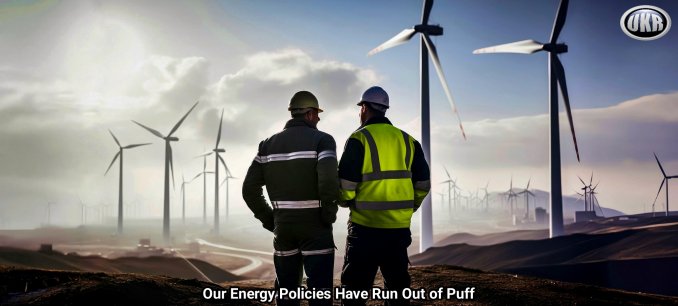
Our energy policies have run out of puff
The government’s £1.8bn windfall for wind farms is a storm of stupidity
MAXWELL MARLOW
The data is clear, stark, and damning. Priced in kilowatt hours per cent(¢), if the UK were a US state, it would be the most expensive state in which to buy electricity. This means it is more expensive than Hawaii, which relies entirely on geothermal energy.
That is not an achievement — no longer can we say “thank God for Mississippi” for our rankings. It is, instead, a catastrophe of energy policy driven by an obsessive and costly adherence to unreliable and expensive energy sources.
The government’s claim that its vast subsidising of wind farms is essential rings hollow when considering the painful realities on the ground. UK industrial energy prices are now the highest in Europe, having tripled in nominal terms since 2004. For households and factories alike, energy bills are a debilitating burden. This price surge is a direct result of government policy: a premature, ideological limitation on reliable fossil fuel supply, without the robust, reliable, and cost-effective green infrastructure to replace it.
Our comprehensive “Growth Agenda”, which outlines five key recommendations for the energy sector, demonstrates that sensible, pro-market reforms could boost sector-specific growth by a staggering 4.25 per cent. Central to this agenda is one non-negotiable demand: end the subsidies for wind energy.
The romance of wind power collapses under the weight of reality. Wind energy is inherently unreliable, entering into Dunkelflaute periods when the wind isn’t blowing. The more we rely on it, the greater the stress we place on the entire energy market. This system requires gas to act as a crucial, on-demand backup. However, as wind energy’s share grows, the operating periods for gas operators shrink. These companies must then recover their substantial fixed costs from an ever-smaller number of operating hours, leading inexorably to higher consumer prices.
Furthermore, recent Adam Smith Institute research reveals that continued subsidies for wind energy do not stabilise the market — they actively increase price volatility and cement our reliance on gas power. They inflate system and network costs, which already accounted for over 20 per cent of electricity bills in 2024 and are projected to exceed a massive £8 billion by 2030 through constraint payments and transmission inefficiencies.
The fragility of this system was laid bare earlier this month when gas prices surged, with US wholesale prices increasing by 75 per cent and European gas prices increasing by more than 40 per cent. This volatility is the price we pay for betting the house on intermittency while stifling stable, affordable alternatives.
The UK has been trapped in a single, uncompetitive wholesale market for electricity. It is a lumbering behemoth of a market that serves neither consumers nor businesses. Contrast this with the dynamic, competitive success of markets across the pond. In Texas, the nodal pricing system used in the ERCOT market provides over 17,000 price points. The result? Fierce competition, high reliability, and low prices.
This brings me to the second crucial demand from the ASI: the UK must switch to a nodal pricing system. It is a market-driven reform that rewards efficiency and punishes the inertia of our current system.
We must stop treating the wind sector like an infant that needs constant public handouts
The government has a choice: continue to squander billions on ideological vanity projects that drive up energy bills, or embrace the free-market solutions that have proven to deliver reliable, affordable power for our American cousins over the Atlantic.
We must stop treating the wind sector like an infant that needs constant public handouts. The time for costly subsidies is over. If the UK is to shed its status as the most expensive “state” for electricity, the Energy Secretary must drop the pipe dreams and adopt the practical, pro-growth policies of the Adam Smith Institute.

••••
The Liberty Beacon Project is now expanding at a near exponential rate, and for this we are grateful and excited! But we must also be practical. For 7 years we have not asked for any donations, and have built this project with our own funds as we grew. We are now experiencing ever increasing growing pains due to the large number of websites and projects we represent. So we have just installed donation buttons on our websites and ask that you consider this when you visit them. Nothing is too small. We thank you for all your support and your considerations … (TLB)
••••
Comment Policy: As a privately owned web site, we reserve the right to remove comments that contain spam, advertising, vulgarity, threats of violence, racism, or personal/abusive attacks on other users. This also applies to trolling, the use of more than one alias, or just intentional mischief. Enforcement of this policy is at the discretion of this websites administrators. Repeat offenders may be blocked or permanently banned without prior warning.
••••
Disclaimer: TLB websites contain copyrighted material the use of which has not always been specifically authorized by the copyright owner. We are making such material available to our readers under the provisions of “fair use” in an effort to advance a better understanding of political, health, economic and social issues. The material on this site is distributed without profit to those who have expressed a prior interest in receiving it for research and educational purposes. If you wish to use copyrighted material for purposes other than “fair use” you must request permission from the copyright owner.
••••
Disclaimer: The information and opinions shared are for informational purposes only including, but not limited to, text, graphics, images and other material are not intended as medical advice or instruction. Nothing mentioned is intended to be a substitute for professional medical advice, diagnosis or treatment.
Disclaimer: The views and opinions expressed in this article are those of the author and do not necessarily reflect the official policy or position of The Liberty Beacon Project.


Leave a Reply