

No Cash for Savages
The coming politicisation of programmable currency
DAVID MCGROGAN
The savage is, despite it all and even though it has to be admitted that he has done a few bad things and has a few faults, always the noble savage.
Michel Foucault
I am living proof that the heart of social mobility is the owning of assets. Both sides of my family are of impoverished Irish immigrant stock, one branch in Glasgow and the other in Liverpool. My parents both grew up in local authority accommodation and played as children in bombed out buildings. But in 1971 they were able to get a mortgage and buy a small house (for £7,000, I believe) and by virtue of that fact were able to retire decades later in relative comfort by the standards of the past, and to give their children modest opportunities which their own parents would not have thought possible.
This kind of striving, though, is bad news for two sets of people. It is bad news for state bureaucracies and the political parties they have captured, which are increasingly reliant on the distribution of welfare to buy votes. And it is bad news for established middle-middle-class people who would like to pull the drawbridge up behind them in order to keep out aspirational riff-raff. The result is the erection of barriers to asset ownership among the poor – not generally done overtly, or even consciously, but merely through the making of political choices rather than others. Most of the uniparties which have governed advanced democracies in recent decades are essentially a fusion of welfarism and middle-class protectionism, and this is simply a product of the pressures from the two voting blocs they represent. These cobbled-together coalitions have been surprisingly effective at maintaining power and keeping the riff-raff as far from nice things as it is possible to get. If you are a member of the riff-raff you are supposed to be a welfare recipient and be happy about it, and otherwise be both unseen and unheard. And much of our political economy is really designed to realise that outcome: no assets for riff-raff.
Regular readers may be reminded at this juncture of Michel Foucault’s observation that ‘politics is the continuation of war by other means’. Foucault described human societies as being characterised by implacable conflict between two forces: the civilised and the barbarian. The civilised has his hands on the levers of power and possesses wealth and status; the barbarian does not, but is bent on changing that fact. These are archetypes: what Foucault really meant is that there is always an in-group and and an out-group; the in-group largely justifies its dominant status by casting the out-group as undeserving, deviant, ignorant, immoral, undisciplined, and so on, and defining itself as the opposite; the out-group defines itself as comprising outsiders struggling to force their way in.
But Foucault went on to say that there is a third archetype which, as it were, stands outside this conflict – and this he called the savage. While the barbarian is hostile, disorderly, and bent on plunder, the savage is tranquil and benign. The savage is content to live in a state of savagery, meaning a state of acceptance of the natural order of things. He accepts his own social inferiority and implicitly recognises it as justified. Unlike the barbarian, who makes life difficult for the civilised – the barbarian wants always to break into the city walls and seize whatever he can lay his hands on – the savage does not rock the boat and lives in peace.
The civilised in any society always therefore sees the savage as noble, with his nobility deriving from the fact that he is reconciled to his tragic fate. The savage is above all manageable. He is not going to threaten anything. It is the barbarian who is going to cause trouble and the barbarian who needs to be stomped on.
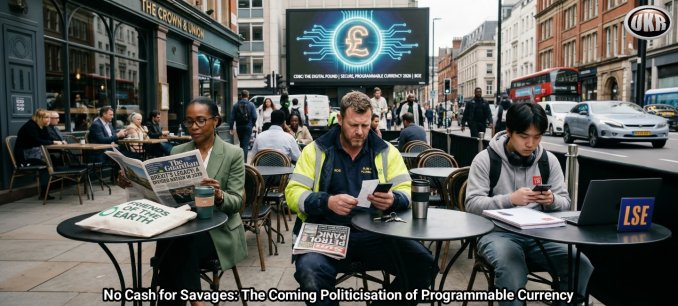
Readers will recognise these archetypes. The civilised in Britain in 2026 is that class of person who reads The Guardian or The Times, voted Remain, worries about things like plastic straws, and often works in the public sector. The barbarian is the enemy of the civilised – a reader of the Mail or the ‘Murdoch press’, who owns a small business, perhaps as a tradesman or farmer (or, especially, a publican or bookmaker), voted Leave, and worries about things like the price of petrol. The former is good and pure; the latter, who is a threat to the political and social dominance of the former, is the lowest of the low. And standing to one side is the savage – the permanent welfare recipient, the asylum-seeker, also perhaps the undergraduate student – who accepts passivity and irrelevance and poses no threat to the established order (at least as the civilised see it).
In other societies the composition of the three groups – civilised, barbarian, and savage – will be a little different, even very different, but the basic pattern will stay the same. And it follows from that pattern that the goal of the civilised is generally to arrange the political economy such that savages remain where they are and those with barbaric instincts are pushed into savagery. The civilised are perfectly happy with savages being savages, where they aren’t bothering anybody. And, ideally, of course, the class of savages will be large, and growing, as barbarians are denuded of threat and forced to accept savage status in increasing number.
One means by which this has happened in Britain, as in many other advanced economies, is the inflation of asset prices beyond the reach of ordinary people, such that it is increasingly difficult for barbarians to manoeuvre themselves into a position where they can think about penetrating into the established order and gaining economic, social and political influence, and therefore fall back into savagery. But new battle fronts are opening all of the time, and an important fresh campaign theatre is programmable currency, and particularly programmable Central Bank Digital Currencies (CBDCs).
People are rightly concerned about CBDCs, for all sorts of reasons, and I have written about many of these concerns in the past (for example, here and here). But an under-appreciated issue is the capacity this technology has for what it seems appropriate to call ‘asset exclusion’, and hence the entrenchment and expansion of a sort of Foucauldian savagery along the lines I have described it.
Let’s deal with the basics first. A CBDC is digital cash, which unlike private bank money does not just sit as figures on the bank’s list of assets and liabilities, but is a discrete digital object – each digital pound, or digital euro, or digital dollar, or whatever, is a unique string of data the title over which can be transferred from one party to another (in the same way as cryptocurrency). Each sits on a ledger owned by the central bank, and is accessed by users (it is not I think correct to refer to them as ‘owners’) through software generally referred to as a ‘digital wallet’. If I want to pay you a digital pound for something, I tell the central bank ledger, through my digital wallet, to record that digital pound as no longer ‘belonging’ to me, and belonging to you instead, and thus I have paid for it and the digital pound has nominally changed hands.
There may be some uses for wholesale CBDCs for interbank settlements, but the important thing to know about retail CBDCs (i.e., in the form which you or I would use them) is that they have no free market use case. Nobody wants them. Wherever they have been introduced – Nigeria, the Bahamas, Jamaica – they have crashed and burned. There is no public demand and businesses outside of the financial services sector have no interest in them. They exist (whether as plans or reality) really for two reasons only: the first is that central banks are paranoid about people switching to use cryptocurrencies and private stablecoins and therefore weakening the levers of central bank control over monetary policy; the second is that CBDCs, as digital currency, would be programmable and useful for social control, whether at the macroeconomic level (through, for example, helicopter money and other means of manipulating the money supply for economic stimulus) or the microeconomic. The microeconomy is what I am interested in for this post – i.e., how CBDC’s would function in the market.
Here, the main distinction between CBDCs and other forms of money is that the former are in principle programmable. CBDCs, as data objects, can be encoded or programmed with certain conditions. Three are particularly salient for our purposes. These are:
- They can be ‘commodity binding’, meaning only spendable on certain categories of goods or services;
- They can be ‘merchant binding’, meaning only spendable with certain approved outlets;
- They can be ‘time bound’, meaning only spendable within a certain timeframe, after which they lose their value (either immediately or gradually).
And they can, of course, be all three.
Now, you are likely reading this and thinking, ‘Who in their right mind would consider this superior to ordinary private bank money?’ The great thing about private bank money is that you can spend it on what you want, where you want, whenever you want. And you can also, if you want, program payments in that form already – that’s what a direct debit is. A programmable CBDC is in every respect inferior for the private individual, unless perhaps they are a parent who wants to exert control over how, and where, Little Johnny is able to dispense of his pocket money – a use case hardly sufficient to introduce an entirely new currency onto the landscape.
I leave it to the psychiatrists among you to debate whether proponents of CBDCs are in their right minds. But, of course, there are some people in the world who think that state-owned programmable digital currency is superior to private bank money, and among them is the Government of India, which has just launched a pilot of what it calls ‘CBDC-based digital food coupons’ as a means of dispensing welfare in the state of Gujarat.
The idea here is simply stated. Welfare recipients in India, as in most places, are given cash. But the problem with cash is that recipients of it have this annoying habit of spending it on what they want to spend it on, rather than what it is supposed to be for. And cash can also go astray – it might not end up with who it is supposed to end up with. It is felt to be important, then, that some method be found by which, as the piece I linked to above puts it, welfare payments are used for their ‘intended purpose’ – i.e., buying food. And what better means could there be of achieving this than through programmable digital rupees, which can only be used to buy approved foodstuffs (rice, wheat, pulses, chickpeas) at approved retailers who have been properly ‘onboarded’, and which are set to expire and lose all value within a certain timeframe so as to help identify ‘ghost beneficiaries’?
I am used to reading this sort of bollocks, sorry, ‘policy speak’, so I have become slightly numbed to the Orwellian phraseology that gets used, but even I found myself chuckling at the way in which this pilot project is presented. We are told that the programmable digital rupee is a great way for government to ‘monitor transactions’, through a ‘digital trail’, because that way it can ‘address discrepancies’. (Read: we know what you are spending every last digital rupee on, so don’t get any ideas.) We are told that the currency maintains all the ‘security and trust associated with traditional fiat currency’ (the trust which the State has in the user being so complete that it must be able to record and control every single transaction to ensure it is happening in line with the ‘intended use’). We hear the wonders of the system’s ‘inclusive design’ (for which we must read: ‘there is no escape’). And – a particular favourite of mine, which appears everywhere in the CBDC literature – the fact that the digital rupee can be made time-bound is celebrated for the fact that it will prevent ‘hoarding’, by which they mean keeping money and not spending it, or in other words ‘saving’.
The prize for doublespeak, though, comes in the assertion that through the use of programmable digital rupees the Government of India is ‘creating a system where leak-proof delivery of benefits is guaranteed by code and technology rather than bureaucratic discretion [emphasis added]’ – a more perfect example of the capacity for human beings to delude themselves with technocratic fantasies being almost impossible to imagine. Did it truly not occur to the author of the piece that the whole point is that ‘code and technology’ are being put in the service of bureaucratic discretion – namely to determine where the digital rupee can be spent, what it can be spent on, how long it retains its value, what its ‘intended purpose’ is, and even whether it should exist in the first place?
What is underlying this move, however, should not be overlooked, because this is serious business. CBDCs are everywhere – the overwhelming majority of governments are either investigating implementation, or have already begun implementation. And there is no society in which people actually want them. The only plausible way in which they will be utilised is if people are forced to adopt them. And the only way this can happen is where there are captive audiences – i.e., recipients of welfare.
This, it seems overwhelmingly likely, is where we will see them appearing, not just in places like India, but in developed states like the UK: you read it here first, but if a retail version of the digital pound comes online, you can bet it will be through distribution to people on benefits. And you can also bet that when this happens, the currency that is distributed will be programmed to only be spendable on ‘intended purposes’, with the intentions of the recipient being irrelevant, and the intentions of government being dispositive.
That means, on the one hand, that people on the dole will no longer be able to spend money on special brew or cigarettes, of course, and probably not on Wotsits or Mars bars either; it will be quinoa, kale and sparkling water, with a bit of pasta if one is lucky. But it is not difficult to see a future emerging (particularly as unemployment grows) in which more and more people are pushed into using digital currency through the welfare system, not so much in order for the State to track and control individual expenditure, but in order to prevent ‘hoarding’ – which is to say, the saving of money in order to purchase assets – and spending on ‘unintended purposes’.
And in this regard, I found it very interesting that late last year the IMF circulated a research paper on the the use of retail CBDCs for improving the ‘delivery of social safety nets’. The paper is full of the usual guff, but it also includes this fascinating chart, which – as is often the case – reveals far more than it is meant:

What you will notice about this ‘Social Security Net Payment Delivery Chain’ is how everything flows downwards: Identify, Select, Pay, Administer, Use. Potential recipients are identified, and then from within that list beneficiaries are selected. These are then paid, ‘depending on Treasury instructions’, appropriately managed, and then finally given entitlement to use funds.
What you will also have therefore noticed is that those who are using the funds (that is, the recipients) are at the bottom of the pile when it comes to decision-making, and those who get to identify potential recipients and select them who call the shots. If you can identify and select the recipients of payments, then in the brave new world of CBDC welfare payments, you in effect exercise discretion over who has to survive on digital currency and who does not – who gets to own real money that retains value and can be freely spent, and who gets the Monopoly version which loses value over time and can only be spent within defined parameters.
This immediately gives the lie, as we saw earlier, to the idea that this CBDC welfarism is all just technocratic application of ‘code and technology rather than bureaucratic discretion’. Actually, bureaucratic discretion is at the heart of the enterprise, since it is bureaucratic discretion which identifies and selects recipients (and also, it goes without saying, sets the parameters within which the currency may be spent).
But it also provides a foretaste of things to come, in that it implicitly sets out a future scenario in which the identification and selection of recipients of CBDC welfare payments becomes politicised. Questions such as how big is the range of potential recipients, who those potential recipients are, how beneficiaries are to be selected and on what grounds, and, at the end of the day, what they are allowed to spend their digital cash on and within what timeframe, will become important subjects of public debate, and important matters for legislators to govern as they see fit.
This in turn means that we are likely heading for a future in which the use of ordinary currency, which can be spent as desired, as opposed to CBDCs, which are programmed in various ways, is a marker of status. And this of course directly concerns the relationship between the civilised, barbarian and savage as I earlier described them. What could be more civilised than to exercise discretion over how one dispenses of one’s own income and assets, and what could be more barbaric than to seek to assert the same set of privileges when one is a member of the out-group? But at the same time, what could be more savage than to reconcile oneself to one’s fate, and one’s inferior status, and to be excluded forever from owning the assets that might allow one to aspire to civilisation?
Since being in that class of person who has been identified and selected for distribution of programmable currency is, to all intents and purposes, to be a marginalised savage, and since expanding the scope of savagery and diminishing the scope of independent barbarism is the aim of the civilised, we can expect the range of persons who are elbowed into compulsory or quasi-compulsory CBDC use to gradually increase, at least to the upper limit of an optimal range.
It will begin, as it is beginning in India, with a benign-seeming set of initiatives for the very poor. But it will grow, and in time it can be expected to comprise one in an increasingly large arsenal of policy weapons that are designed to tame barbarism through the complete elimination of aspiration and the soft prohibition of the capacity to establish personal financial security and autonomy. I speak of course at a certain level of abstraction – we do not yet know the details of how this will pan out. But we can forecast the direction of travel, derived from what we know about the vehicle we are being driven around in, and the civilised people who are driving it.
This article (No Cash for Savages) was created and published by News from Uncibal and is republished here under “Fair Use”

••••
The Liberty Beacon Project is now expanding at a near exponential rate, and for this we are grateful and excited! But we must also be practical. For 7 years we have not asked for any donations, and have built this project with our own funds as we grew. We are now experiencing ever increasing growing pains due to the large number of websites and projects we represent. So we have just installed donation buttons on our websites and ask that you consider this when you visit them. Nothing is too small. We thank you for all your support and your considerations … (TLB)
••••
Comment Policy: As a privately owned web site, we reserve the right to remove comments that contain spam, advertising, vulgarity, threats of violence, racism, or personal/abusive attacks on other users. This also applies to trolling, the use of more than one alias, or just intentional mischief. Enforcement of this policy is at the discretion of this websites administrators. Repeat offenders may be blocked or permanently banned without prior warning.
••••
Disclaimer: TLB websites contain copyrighted material the use of which has not always been specifically authorized by the copyright owner. We are making such material available to our readers under the provisions of “fair use” in an effort to advance a better understanding of political, health, economic and social issues. The material on this site is distributed without profit to those who have expressed a prior interest in receiving it for research and educational purposes. If you wish to use copyrighted material for purposes other than “fair use” you must request permission from the copyright owner.
••••
Disclaimer: The information and opinions shared are for informational purposes only including, but not limited to, text, graphics, images and other material are not intended as medical advice or instruction. Nothing mentioned is intended to be a substitute for professional medical advice, diagnosis or treatment.
Disclaimer: The views and opinions expressed in this article are those of the author and do not necessarily reflect the official policy or position of The Liberty Beacon Project.


Leave a Reply