

THE HULLIGANS
Hull City Council has approved the next phase of its district heating network, a low-carbon vision involving miles of pipes, years of roadworks, and a touching faith in the idea that everything will somehow work out in the end. Phase 1B has been waved through before Phase 1A is even up and running, which suggests either heroic confidence or the sort of institutional arrogance that makes stopping to ask awkward questions forbidden.
The plan, we are told, will save an estimated 110,000 tonnes of carbon dioxide over 40 years (that is equivalent to 22,000 elephants for those who think visually). This figure, like all such figures, arrives fully formed and curiously immune to interrogation. Meanwhile the people of Hull brace themselves for trenches, partial closures, narrowed footways, and the gentle suggestion that motorists, pedestrians, and cyclists may experience ‘delay’. If those delays are anything like the ones we are experiencing under the current phase, then ‘gridlock’ would be a more appropriate word. The low carbon project takes place over and above copious roadwork projects to ‘improve’ traffic flow, keep the water flowing in our drainage system and assorted transport related fuckaboutery.
Phase 1B alone will see roads across large swathes of the city dug up: Ferensway, Prospect Street, Lowgate, Carr Lane, Myton Street, and even Drypool Bridge (you have to live here to know how significant these roads are). Anyone familiar with Hull’s geography, or its weather, may reasonably wonder whether turning the city centre into a network of excavations is quite the bold stroke of climate leadership it is being sold as.
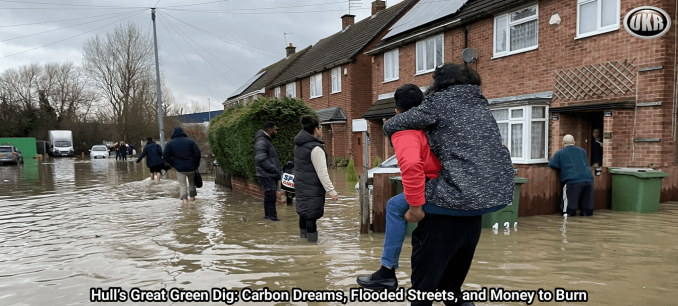
What makes this exercise especially reassuring is that the Environment Agency itself objected. Its concern was not ideological but practical: digging near the River Hull and its flood defences risks compromising their integrity and increasing flood risk. In a city already intimately acquainted with flooding, this might have merited some pause for thought.
Hull floods. Hull has flood defences. Therefore, Hull City Council should dig next to them extensively. Perhaps any flooding will be described as a low-carbon alternative: hydroelectric.
Then there is the question of land use. One of the project’s showpieces is a prime city-centre site, adjacent to Hull College, once part of the lively suburb of Trippett. After over-enthusiastic slum clearance, it became, like so much of Hull – an underused car park. Here, much-needed housing could have been built, for local people, or even for the council’s own overflow accommodation needs; created by the massive influx of migrants, refugees and other scroungers who currently inhabit the massive hotel next to the station – about as near to the centre of the city as it is possible to get. Instead, this land has been commandeered for a power station: still, as of today, an incomplete skeleton of girders.
The sequencing of all this remains baffling. Is it normal to approve later phases of a major infrastructure project before earlier ones have demonstrated that they work? Perhaps this is merely the modern way: implementation first, evaluation later, accountability never.
Equally intriguing is the energy source. The network relies on waste, including incineration, to generate heat; a detail that sits awkwardly alongside relentless exhortations to recycle more, waste less, and aspire to a near-zero-waste future. It is also not clear how the waste we plebians generate at household level will end up in the incinerator. Presumably, the waste we fill the growing range of multicoloured bins that festoon our streets with, will have to be transported to a sorting plant and then the stuff that burns transported back to the incinerator. Hardly a low-carbon process, given the number of lorries that will be required.
Meanwhile, the city’s finances are treated with the same breezy optimism. The revamp of nearby Queen’s Gardens has drifted past £24 million and counting. What was once a well-loved green oasis has been repeatedly dug up to accommodate elements of the still incomplete and untested heating network.
Curiously, this network is not available to the many residential conversions in the city centre or Old Town. Instead, it appears to primarily serve Hull City Council’s own offices.
None of this is to say that low-carbon heating projects are inherently foolish. They can work, but only under specific conditions: suitable buildings, high-quality installation, realistic costings and informed users.
Hull’s scheme bears the hallmarks of the opposite approach. The benefits are long-term and theoretical; the costs are immediate and physical. Roads are dug up now. Businesses lose footfall now. Residents endure noise, dust, diversions, and uncertainty… now.
The Hulligans are two local residents – and TNC columnists – who wish to remain anonymous. We live under the watchful eye of Humberside Police, famous for introducing the oxymoron ‘non-crime hate incident’ into the lexicon.
If you enjoy The New Conservative and would like to support our work, please consider buying us a coffee – it would really help to keep us going. Thank you!
This article (Hull’s Great Green Dig: Carbon Dreams, Flooded Streets, and Money to Burn ) was created and published by The New Conservative and is republished here under “Fair Use” with attribution to the author The Hulligans
Featured image: standard.co.uk

••••
The Liberty Beacon Project is now expanding at a near exponential rate, and for this we are grateful and excited! But we must also be practical. For 7 years we have not asked for any donations, and have built this project with our own funds as we grew. We are now experiencing ever increasing growing pains due to the large number of websites and projects we represent. So we have just installed donation buttons on our websites and ask that you consider this when you visit them. Nothing is too small. We thank you for all your support and your considerations … (TLB)
••••
Comment Policy: As a privately owned web site, we reserve the right to remove comments that contain spam, advertising, vulgarity, threats of violence, racism, or personal/abusive attacks on other users. This also applies to trolling, the use of more than one alias, or just intentional mischief. Enforcement of this policy is at the discretion of this websites administrators. Repeat offenders may be blocked or permanently banned without prior warning.
••••
Disclaimer: TLB websites contain copyrighted material the use of which has not always been specifically authorized by the copyright owner. We are making such material available to our readers under the provisions of “fair use” in an effort to advance a better understanding of political, health, economic and social issues. The material on this site is distributed without profit to those who have expressed a prior interest in receiving it for research and educational purposes. If you wish to use copyrighted material for purposes other than “fair use” you must request permission from the copyright owner.
••••
Disclaimer: The information and opinions shared are for informational purposes only including, but not limited to, text, graphics, images and other material are not intended as medical advice or instruction. Nothing mentioned is intended to be a substitute for professional medical advice, diagnosis or treatment.
Disclaimer: The views and opinions expressed in this article are those of the author and do not necessarily reflect the official policy or position of The Liberty Beacon Project.


Leave a Reply