


JOSEPH DINNAGE
The Green Party’s victory in last week’s Gorton and Denton by-election was a grim indicator of where British politics could be heading. With 40% of the vote, Hannah Spencer won her campaign by stirring the pot of local sectarianism; releasing campaign videos in Urdu and Bengali, accusing the Government of funding ‘genocide’ in Gaza, and – most absurdly – claiming that ‘people like’ the Reform UK candidate Matthew Goodwin caused the Manchester arena bombing by ‘dividing people’.
You’ll notice that none of these strategies have anything to do with the environment. Under Zack Polanski’s leadership, the Greens have shifted from environmentalism to what French conservatives have termed Islamo-gauchisme – a fusion of traditional Leftism with the imported communal grievances of a growing Muslim population. Polanski has branded this the politics of ‘hope’, but of course this menacing ideology of economic self-destruction and social division is nothing of the sort.
This is not a political formula that thrives when a country’s economy is performing well and its citizens are getting along. So it’s no surprise that after years bobbing along on single-digits in the polls, the Greens are now building meaningful electoral momentum across Britain.
Following their success in Gorton and Denton, the Greens are now polling above the Labour Party. You might well gulp, but the spike isn’t a shock – especially among the young. Polling published in January showed that 18- to 24-year-olds (particularly young women) were disproportionately likely to vote Green. After all, almost a quarter (23%) of 18- to 24-year-old women voted Green at the last election, compared to just 6.7% of the general population.
You can’t blame young people for feeling sufficiently disenchanted to vote for a man nicknamed ‘hypnotits’.
The failure of both the Conservatives and now Labour to build enough homes has left young people facing a prohibitively expensive housing market, with many forced to remain in rental accommodation indefinitely as the prospect of homeownership becomes financially implausible. In 2023, 28% of Britons aged 25-34 owned their own home, down from 51% in 1989. This has translated to couples not feeling secure enough to have as many children as they’d like, with one study attributing a 10% rise in house prices to a 1.3% reduction in the birth rate. Our declining birth rate has in turn created a gerontocracy, where the benefits for growing numbers of retirees are paid for by diminishing pools of working-age young people. The cost borne by these young workers to fund the state pension is projected to rise by £80 billion by the 2070s – with over half of this increase being due to the triple lock.
Add to this cauldron an increasingly inaccessible graduate labour market – which is only going to be fuelled further by the Government’s job-killing employment legislation – and it’s remarkable that more young people aren’t giving up on Britain entirely.
If Polanski is to become the vanguard of the young, and increasingly the middle-aged, then it’s worth taking his plan seriously.
The central economic plank of Polanski’s plan to rescue young people is wealth redistribution. This will be achieved with a 1% wealth tax on all assets above £10 million and 2% on assets over £2 billion. Yet wherever they have been tried, wealth taxes have failed to raise any meaningful revenue and forced the wealthy abroad.The Greens might not like it, but almost 30% of income tax receipts come from the top 1% of earners.
His approach to housing would prove similarly effective. Rather than deregulate the planning system to unleash a housebuilding revolution, Polanski would laden developers with all manner of environmental requirements and impose rent controls on landlords. The former has already clogged up our planning system and the latter – like wealth taxes – is a fool’s idea of clever policy that has pushed up rental costs everywhere it has been tried.
Other policies on offer include the legalisation of all drugs – even heroin. Although it would turn our already declining high streets into residential shooting galleries, I suppose it might also numb the pain of having to live under Green Party rule. And of course there’s the conflict in Gaza, which the Greens would apparently solve by reinstating funding for UNRWA (an agency that provided antisemitic textbooks to Palestinian schools) and ending all arms sales to Israel.
The pied piper of national ruin, Polanski is seeking to exploit the desperation of Britain’s young people and lead them down a path of economic and social misery.
There is another way.
This week, the Centre for Policy Studies (CapX’s parent organisation) hosted the leader of the Canadian Conservatives Pierre Poilievre to deliver its Margaret Thatcher lecture. Ultimately scuppered by Donald Trump’s threats to make Canada the US’s 51st state, it looked for a while like Poilievre would become the nation’s prime minister.
While Mark Carney won, Poilievre achieved something extraordinary during his campaign. He – a conservative – managed to galvanise young people in a way that for us often feels impossible. Polling released just before Canada’s general election last year showed support for the Conservatives outpacing the Liberals by 44% to 31.2% among 18- to 34- year-olds.
Starting from first principles, Poilievre laid out a comprehensive plan that would provide his country’s youth with the opportunity to own a home, allow workers to keep more of their earnings, crack down on crime, reduce energy bills and repair the damage caused to the Canadian labour market by mass migration.
No appeals to conflicts happening thousands of miles away, no stoking communal tensions for votes, no economic illiteracy; Poilievre gave young people an honest plan for a brighter future.
Britain’s young people deserve so much better than Polanski and his band of snake-oil salesmen. But the data increasingly shows that if a credible, well-articulated alternative isn’t offered soon, we could lose them entirely. To stop this, the British Right needs to go Canadian.
Click here to subscribe to our daily briefing – the best pieces from CapX and across the web.
CapX depends on the generosity of its readers. If you value what we do, please consider making a donation.
This article (How to beat Zack Polanski) was created and published by CapX and is republished here under “Fair Use” with attribution to the author Joseph Dinnage
See Related Article Below
The real reason Greens are gaining ground
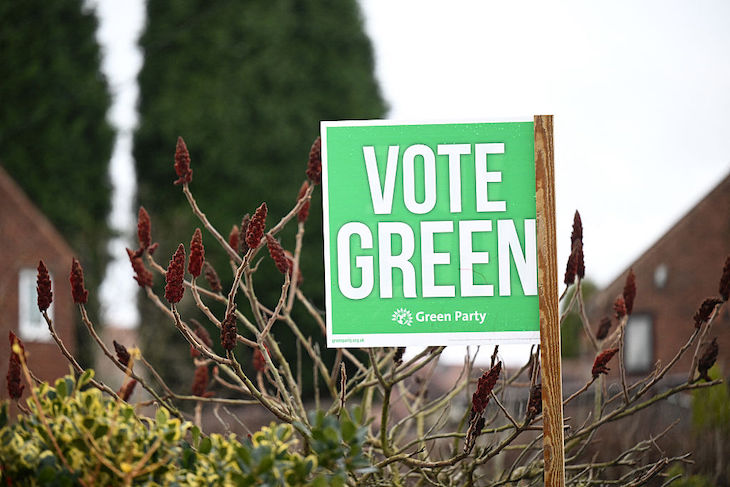 A poster promoting Britain’s Green party is pictured outside a house in Denton, Greater Manchester (Getty images)
PATRICK WEST
t was only a matter of time before an ultra-progressive, hard-left party with a fondness for voguish identity politics, enthusiasm for multiculturalism and morbid obsession with Israel came to preeminence in this country. This inevitability is the consequence of a demographic time-bomb just waiting to make its effects known.
It’s no surprise that the Greens offer hope to that portion of a generation
As a YouGov survey has revealed this week, the Green Party has now overtaken both Labour and the Conservatives to take second place in the polls, two points behind Reform UK. Their support now stands at 21 per cent, up four points in the week since their historic win in the Gorton and Denton by-election. The polls also show that the Greens are the most popular party among voters under 50, especially those aged between 18 and 24. It was also the most popular among women, backed by 23 per cent of female voters.
That last statistic is telling. It’s well attested that young, middle-class women are the section of society most inclined to hold hyper-liberal opinions, while generations Y and Z are overall more likely to support trans rights, display allyship with immigrants and refugees, and voice solidarity with the people of Palestine and Gaza.
Ten years ago, this was the demographic who were being instructed in ultra-progressive dogma at school, or who were entering academia, where their skewered view of the world and fantastical take on the human condition became further entrenched. It was at university where they learnt about the evils of Western ‘civilisation’ – those contemptuous inverted commas being mandatory – the unconscious racism built into the minds of white people, and the unique European crime of colonisation, with Israel now standing as the epitome of that villainy.
Those school children and students of ten years ago, with their highly moralistic, Manichean politics and otherworldly theories on gender and race, are now the voters of today. They are also our first post-literate generation, a demographic which doesn’t read newspapers, which doesn’t read books willingly, who instead get their politics on their smartphones from emotive TikTok videos devoid of nuance, depth and context. This is the demographic with a reduced attention span that doesn’t even listen to radio bulletins or watch the news from reputed broadcasting organisations.
A generation which has been taught that all knowledge is relative has got what it wanted: news with no pretence at impartiality, propaganda masquerading as reportage from partisan activists and bad faith actors. All of this depthless and dubious content, delivered with breathless hyperbole, reinforces the notion that the world can be clearly divided into good and bad people and forces.
It’s no surprise that the Greens offer hope to that portion of a generation who believe they are on the side of the angels against the forces of evil and hate. This is a party that relies on emoting, slogans and the repetitious focus on its enemies befitting any low-grade demagogic outfit from history, one which appeals to base instincts and the lowest common denominator. By inveighing against ‘apartheid’, ‘Zionism’ and ‘billionaires’ they draw on those inclinations forever found on the hard left: envy, resentment and the thirst for vengeance.
Only since the party has raised its profile under Zack Polanski has it been subject to greater scrutiny. As a consequence, many people, especially those who read newspapers, are now attuned to the nastiness that dwells within. Yet at the same, much of the post-literate generation still thinks, like Polanski and their new MP Hannah Spencer, that this is the outfit which represents niceness and ‘hope not hate’, as they endlessly reminded everyone before last week’s by-election.
Spencer’s victory speech exposed the vacuity of their ‘kind politics’, and indeed the entire babyish belief that the world would be perfect if only everyone would stop being so horrid. There she spoke, with bottom lip trembling, of the ‘hope and a chance to do things differently’, that ‘everybody should get a nice life’, exhorting repeatedly the imperative to be ‘nice’.
The Spectator: continue reading

••••
The Liberty Beacon Project is now expanding at a near exponential rate, and for this we are grateful and excited! But we must also be practical. For 7 years we have not asked for any donations, and have built this project with our own funds as we grew. We are now experiencing ever increasing growing pains due to the large number of websites and projects we represent. So we have just installed donation buttons on our websites and ask that you consider this when you visit them. Nothing is too small. We thank you for all your support and your considerations … (TLB)
••••
Comment Policy: As a privately owned web site, we reserve the right to remove comments that contain spam, advertising, vulgarity, threats of violence, racism, or personal/abusive attacks on other users. This also applies to trolling, the use of more than one alias, or just intentional mischief. Enforcement of this policy is at the discretion of this websites administrators. Repeat offenders may be blocked or permanently banned without prior warning.
••••
Disclaimer: TLB websites contain copyrighted material the use of which has not always been specifically authorized by the copyright owner. We are making such material available to our readers under the provisions of “fair use” in an effort to advance a better understanding of political, health, economic and social issues. The material on this site is distributed without profit to those who have expressed a prior interest in receiving it for research and educational purposes. If you wish to use copyrighted material for purposes other than “fair use” you must request permission from the copyright owner.
••••
Disclaimer: The information and opinions shared are for informational purposes only including, but not limited to, text, graphics, images and other material are not intended as medical advice or instruction. Nothing mentioned is intended to be a substitute for professional medical advice, diagnosis or treatment.
Disclaimer: The views and opinions expressed in this article are those of the author and do not necessarily reflect the official policy or position of The Liberty Beacon Project.


Leave a Reply