

CP
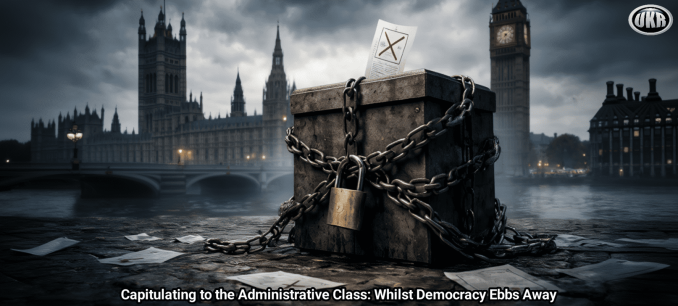
It is a shocking fact that in 2025 nine councils had their elections postponed and a total of 5,667,000 people on the electoral register were denied an opportunity to vote.
This is due to be repeated in 2026, with 29 councils out of 63 councils involved in local government reorganisation so far requesting to postpone their May 2026 elections until 2027.
There have been yet further electoral postponements in areas where mayoral authorities are being established.
Have we become so inured to the whining arguments of administrative bureaucrats that we have forgotten the fundamental principles of democracy? Are we so content with our political status that we are willing to accept postponement for administrative expediency when in effect it is cancellation? Can we continue to defend the legitimacy of councillors who were elected to hold office for four years but may be approaching six or seven year terms?
Nigel Farage of Reform UK has stated that ‘only dictators cancel elections’ and his party is committed to taking legal action against the Ministry of Housing, Communities and Local Government for the postponements. A two day hearing of the legal challenge is expected to begin on February 19th. Kemi Badenoch, leader of the Conservative Party, called it a ‘scandal that Labour has postponed the local elections, yet again’.
Local democratic governance has deep roots in British constitutional history for valid reasons, ones which we should not gloss over to enable an administrative behind the scenes reorganisation to take place. The Municipal Corporations Act 1835 marked the first modern attempt to create democratically elected local authorities. This reform was driven by the same democratic impulses that led to the Great Reform Act of 1832, recognising that those who paid for local services deserved a say in how they were administered. Throughout the 20th century, reorganisations in 1965, 1974, and the 1990s reshaped local government boundaries, but the principle remained consistent: local authorities must be accountable to local people through regular elections. The political reforms of the Victorian and Edwardian eras established the principle that government, at every level, derives its legitimacy from the consent of the governed.
The Electoral Commission, in their 2004 report on political engagement, stated that ‘the most important factor in improving participation is persuading voters that the election, and the political process more generally, is relevant to them and that their vote matters. That is the responsibility of politicians, of all parties, and at all levels of governance, and arguably the media.’ Therefore maintaining a regular cycle of elections, whether they be local or general, is vital to maintaining engagement and participation and to giving politicians a valid mandate. This seems to have passed the Labour government by.
Democratic accountability concerns not just the moment of voting, but the ongoing relationship between the governed and their governors. Regular polling ensures representation and engagement. Without a cycle of elections, not only is there a risk that politicians become lazy and unaccountable, the electorate is likely to dissolve into anarchy or rebellion, or become steadily disengaged and disenfranchised.
In 2024, Jim McMahon, Minister of State for Local Government and English Devolution in the Labour government, wrote to all councils in two tier areas inviting them to join the Devolution Priority Programme and offering them the option to postpone their May 2025 elections. I doubt that the case for electoral engagement was made. The argument was all about administrative opportunism. There can be no doubt that the rise of Reform UK in the polls and the loss of support for Labour will have influenced the government’s willingness to capitulate to their administrative standard bearers yet further now. The rhetoric which belies the truth can be summed up in Jim McMahon’s words: ‘If reorganisation is a genuine proposal, and the bar has to be high for that test, it is nonsense to have elections to bodies that simply will not exist. It is far better that we move at pace and create the new unitary councils and then hold elections at the earliest opportunity.’
I wonder how the bar is set. Is the bar set at the level where local government can both deliver services and enable democracy? It seems not. Apparently the business of reorganisation is far more of a priority than democracy. The logic may sound reasonable, it is a statement of change management that could emerge from the mouth of a medium sized business owner who is merging or acquiring another business asset. But this is not that. If we believe that democracy is all that our history tells us it is, we cannot and should not let administrative expedience and reorganisation in local government be the excuse to deny our citizens their chance to vote.
Local elections are enshrined in statute as mandatory obligations that can only be suspended under exceptional circumstances. The legal power to cancel elections under reorganisation provisions was intended for brief transitional periods in exceptional circumstances, not as a mechanism to avoid elections during administrative changes that could take years to complete.
Britain lacks a codified constitution, but certain principles form the bedrock of our constitutional settlement. Regular, free, and fair elections stand foremost amongst these. The rule of law requires that those who exercise power over citizens do so with legitimate authority. In a democracy, that legitimacy comes from electoral consent. Our unwritten constitution depends on conventions and principles that limit arbitrary power. The Magna Carta established principles around taxation and consent. Whilst evolved significantly, councils collect council tax and exercise statutory powers whilst councillors continue to wield significant powers, including compulsory purchase and regulatory enforcement that affect residents’ daily lives. Without regular elections, this becomes governance without a current electoral mandate: taxation without representation.
Section 16 of the Local Government Act 1972 states that “the term of office of a councillor shall be four years” and that elections shall be held at times prescribed by law. This represents a statutory obligation that creates a democratic contract between councils and their residents. With the cancelled elections that we have seen over the last year, by 2027 or 28 some councillors will have served far longer than their prescribed four years, some close to seven years.
Democracy requires public confidence that electoral systems are fair, regular, and free from political manipulation. When elections are cancelled on timescales that appear to align with changing political circumstances, or disputable administrative reasons, questions arise about motivations. The historical development of local democratic governance in Britain reflects a long established principle: those who exercise power over citizens must be accountable to them through regular elections. The legal framework enshrining electoral cycles represents more than administrative convenience, it embodies constitutional commitments to democratic governance.
If Labour is intent on the reorganisation of local government, perhaps it should examine how resources can be funnelled into the council department which maintains local political governance, electoral services, if necessary by cutting and culling other departments to ensure democratic processes are not undermined. Its inability to reorganise whilst maintaining democracy embodies the problem in a nutshell, and not doing so is malign at best and may be unlawful at worst.
By Wendy Whittaker-Large


Leave a Reply