

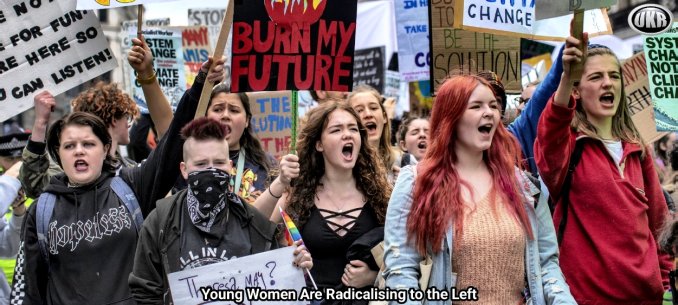
Young women are radicalising to the left
The battle of the sexes.
LAURA PERRINS
A survey was carried out on the youth of Britain. It can now be scientifically proven that being conservative, religious and living in London makes you more optimistic a more pleasant person to be around. Not shocking.
The survey featured in the New Statesman who reported that ‘young women are radicalising.’ This is more evidence that women were voting hard to the left or voting hard left. Either, either. The New Statesman would have us believe that this is a much underreported fact, something I could believe if you were living in a cave. Pretty much everyone else knows that the young women are voting left and the men right and never the twain shall meet.
It is raining conservative men.
Laura Perrins · 5 April 2024
According to all sources, and the Times: it’s raining conservative men. Leave those umbrellas at home ladies and go out and get absolutely soaking wet.
When young men vote left, this is seen as a very bad thing. But young women voting left is seen as normal. It isn’t. But there were other interesting numbers in there.
First I should say that I generally read surveys with caution for the key reason that it involves humans telling other humans stuff about them – and humans tend to lie. They often lie if they want to ingratiate themselves to another person, especially if that other person is a member of the opposite sex. I mean if you send in some little hottie armed with just a smile and a clipboard to ask a few men some questions – well they will just tell her whatever they think she wants to hear. This is why Chandler couldn’t quit the gym. It’s why Ross ended up with a joint bank account.
Or take those ‘why I’m childless’ surveys. The childfree will usually say it’s because they can’t afford children. This sounds better than I want to spend my money on holidays, fast cars and women. But deep down, deep down in the place you don’t talk about at parties or to researchers or maybe even to yourself, that’s the real reason. People lie, we lie to ourselves and we lie to others. Now, these surveys are done by AI. I still think people lie to the computers.
However, parking all those reservations, this Youth Poll was interesting. For context, despite the doom loop in the UK right now the youth are quite optimistic with 63% of respondent declaring they were either very optimistic (28%) or somewhat optimistic (35%) against only 20% who said they were either somewhat pessimistic (13%) or very pessimistic (7%).
Living in London and being religious also made you more optimistic. “Londoners were the most optimistic of all while young people in the North East declared the lowest levels of optimism. Men and women were broadly as optimistic as each other, as were the different age cohorts. Those who professed a religious affiliation were also more optimistic than those without one: 72% of non-affiliated Christians, 68% of Roman Catholics and 67% of Muslims said they were optimistic compared to 56% of those with no religion.”
Being right wing and religious is also much better for your mental health, in that you feel much more connected to your local neighbourhood and your nation. “Those with a religious belief felt much more connected to their neighbourhood than those with no religion. Those young people on the right had a much higher sense of connection to their nation than those on the left: by 74% to 56%. On connection to the UK, the figures were 76% to 52%.”
Despite what the media tell you, the Rising Generation are not materialistic. They place a very high value on family and friends. Good for them.
And overall 81% of respondents strongly or somewhat agreed that if they needed help, there would be people there for them. Only 15% somewhat or strongly disagreed. “I’ll be there for you…”
There was also a question, how much do you agree that so-called toxic masculinity is becoming more common among young British men? I found it shocking that only 11% of men strongly disagreed with this statement and a mere 3% of women.
Indeed, 74% of women agreed with this statement overall and 61% of men agreed overall. Within these numbers a full 23% of men strongly agreed with the statement that toxic masculinity is becoming more common among young British men. A full 37% of women strongly agreed.
Interesting. How very interesting. I think this is entirely media driven, with programmes such as Adolescence painting young men as a threat in need of anti-misogyny classes.
So a full 23% of men are sell-outs that strongly agree with the idea that toxic masculinity is becoming more common among their own sex. I wonder if they thought they themselves were guilty of ‘toxic masculinity’ or if it was just other men out there.
Not me mind, just the others. Next they will be asking the researcher back to their place to discuss what are the best ways to tackle this awful toxic masculinity that is everywhere, all around them.
It is worth noting that toxic femininity is not a thing, nor is toxic feminism. Impressing the researcher however, always is.
This article (Young women are radicalising to the left) was created and published by Laura Perrins and is republished here under “Fair Use”
See Related Article Below
Young women are radicalising
Britain’s young women are sad, alienated and increasingly left-wing
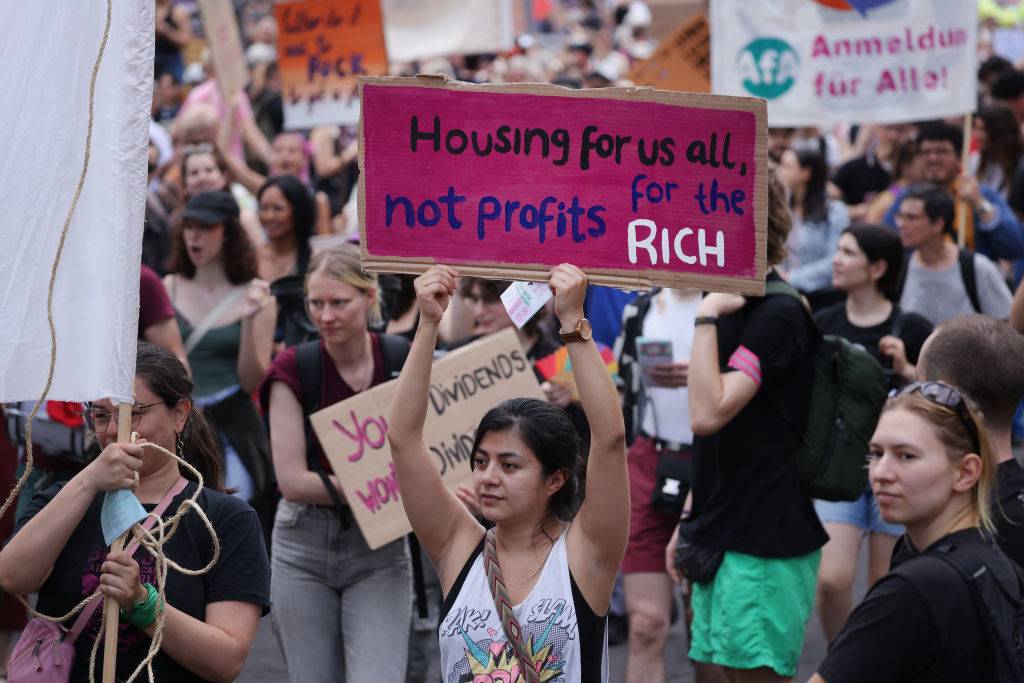 (Photo by Sean Gallup/Getty Images)
SCARLET MAGUIRE
Over the past decade we have had countless opinion pieces, documentaries and dramas about dangerously disenfranchised young men, with much discussion about why they’re moving to the populist right. Frustrated and overly online young men are widely seen to be the drivers of a quiet revolution that has been taking place in youth politics: the widening gender gap. Yet not enough thought has been given to young women’s much greater movement in the opposite direction. It might not be too surprising that women’s political preferences get less attention than men’s, but that does not mean they are any less significant.
Many have noted that at the last general election young (18- to 24-year-old) men were twice as likely as young women to vote Reform, while young women were twice as likely to vote Green as young men. There was also extensive coverage given to the signs of Gen Z men backing Nigel Farage. What these observations fail to take into account is that, in fact, a smaller percentage of young men voted for Reform (12 per cent) than the general population (14.3 per cent). Actually, 18- to 24-year-old men were far less likely to have voted for Farage than every other age cohort of men, and young men were still overwhelmingly more likely to vote for left-wing or liberal parties (68 per cent voted Labour, Lib Dem or Green) than they were for a right-wing party (22 per cent voted Conservative or Reform). If voting for a populist right party is indicative of a more radical mindset, then by this metric young men were some of the least radical demographic groups of the whole country.
The 2024 voting patterns of young women tell a very different story. Nearly one in four (23 per cent) of 18- to 24-year-old women voted for the Green Party at the last general election, compared to just 6.7 per cent of the general population (12 per cent of young men voted for the Greens). Greens performed far better with young women than with any other key demographic (just 10 per cent of 25- to 49-year-old women voted Green, and only 4 per cent of 50- to 64-year-olds). In last year’s general election, young women moved to the populist left considerably more than young men moved to the populist right.
Current voting intention polls show these trends not only persisting but becoming more pronounced. Recent data from More In Common shows that one in three (33 per cent) of young women now say they will vote for the Green Party. Meanwhile, young men, far from being more right wing than the population as a whole, are as likely to vote Green as they are Reform (20 per cent) with Reform still significantly underperforming with under 25 males relative to other age groups.
In fact, the UK is not alone in seeing young women move increasingly to the left. Recent elections in the US, Germany and Portugal all show similar movements between the sexes.
In previous decades young women were actually more likely to vote Conservative than men. However, this trend started reversing in 2015, primarily driven by the younger end of the electorate. In 2019, 18- to 25-year-old women voted for Jeremy Corbyn at more than double the rate of the general population (65 per cent to 32.1 per cent), dwarfing the still considerable 46 per cent of young men who did the same. What over the past decade has caused young women to lurch so dramatically to the left?
I recently recorded a documentary for Radio 4 with Gaby Hinsliffe exploring some potential explanations as to why women are moving dramatically to the left. We discussed the idea that there might be more to the change than conventional party politics. Strikingly, the majority of young people do not identify as either right- or left-wing. Instead, young women see their politics as flowing from their deeply held progressive personal values, which they increasingly think are at odds with the country they see around them.
Britain’s young women seem to feel more alienated from their country than their male peers, and are more likely to think that the country is treating them unfairly compared to older generations (men marginally disagree with the statement, women agree 55 per cent to 37 per cent). Young women feel less connected to their country than young men and are 21 points more likely to think that the country is racist than young men (58 per cent to 37 per cent). Only a minority (31 per cent) say they take pride in being British (compared to 51 per cent of men the same age) and only 38 per cent believe Britain is a tolerant nation (56 per cent of young men think the same).
In fact, young women are not just pessimistic about the country’s culture, but the country’s economy too. It makes sense, with sky-high rental prices, a hardening graduates job market, and years of stagnated living standards, that Gen Z would feel worse about the economy than average. What is less clear is why young women are the most pessimistic group when it comes to the UK economy, with an astonishingly low net economic optimism score of -57 (18 points worse than men of that age group). Perhaps this is why younger women are much more likely to place prices for food and energy bills and housing affordability in their top issues than young men, although it does not fully explain their political priorities. One in three (31 cent) of 16- to 25-year-old women say the conflict in Gaza is in their top three issues, placing it above things like taxes and immigration (just 22 per cent of young men say the same).
Again, it is not immediately obvious why young women would report feeling more isolated than their male peers, but there does seem to be a loneliness epidemic among young women. A majority (53 per cent) saying they feel lonely, substantially more than the proportion of young men saying the same.
The amount of time spent online is also surprisingly skewed across the gender divide. It is well known that the “Covid generation” were kept off school and forced to live out their social lives on the internet, and that algorithms mean young men and women live increasingly parallel lives online. What is less well known is that Covid generation women self-report as being more online, or at least more worried about it, than their male peers. Eighty-four per cent of women this age say they use TikTok regularly compared to 67 per cent men. Young men are more likely than women to use X, but in much smaller numbers than women use TikTok (46 per cent to 26 per cent). Online media consumption seems to be worrying young women more than men, with far more likely to say they spend “far too much time on social media” (49 per cent of 18- to 24-year-old women compared to 36 per cent of men the same age).
Behavioural differences, as well as personal values, could be significantly shaping the gender divide. Online media consumption, higher education (the gender divide is starkest between women with university degrees and men without them, with 56 per cent of university students now women) and even relationship status all seem to drive the increasingly different political outlooks from young men and young women. The political gap between those that are single is even more pronounced than between those who are married.
But whatever the reasons, the extent to which young women feel alienated from the rest of the country matters. There is still a prevailing sense that whatever young women are thinking or feeling, it doesn’t matter very much. Political trends among this cohort are generally seen more like a questionable fashion choice that they’ll probably soon grow out of, rather than anything meaningful or significant. But the extent to which young women are moving to the populist left is dramatic and doesn’t show signs of changing anytime soon. This crucial gender divide will not only continue to shape our politics but could also alter our social fabric as women increasingly feel they have less in common with older generations and men their own age. The consequences of an increasingly radical generation of young women could be dramatic and long-lasting.
This article (Young women are radicalising) was created and published by The New Statesman and is republished here under “Fair Use” with attribution to the author Scarlet Maguire

••••
The Liberty Beacon Project is now expanding at a near exponential rate, and for this we are grateful and excited! But we must also be practical. For 7 years we have not asked for any donations, and have built this project with our own funds as we grew. We are now experiencing ever increasing growing pains due to the large number of websites and projects we represent. So we have just installed donation buttons on our websites and ask that you consider this when you visit them. Nothing is too small. We thank you for all your support and your considerations … (TLB)
••••
Comment Policy: As a privately owned web site, we reserve the right to remove comments that contain spam, advertising, vulgarity, threats of violence, racism, or personal/abusive attacks on other users. This also applies to trolling, the use of more than one alias, or just intentional mischief. Enforcement of this policy is at the discretion of this websites administrators. Repeat offenders may be blocked or permanently banned without prior warning.
••••
Disclaimer: TLB websites contain copyrighted material the use of which has not always been specifically authorized by the copyright owner. We are making such material available to our readers under the provisions of “fair use” in an effort to advance a better understanding of political, health, economic and social issues. The material on this site is distributed without profit to those who have expressed a prior interest in receiving it for research and educational purposes. If you wish to use copyrighted material for purposes other than “fair use” you must request permission from the copyright owner.
••••
Disclaimer: The information and opinions shared are for informational purposes only including, but not limited to, text, graphics, images and other material are not intended as medical advice or instruction. Nothing mentioned is intended to be a substitute for professional medical advice, diagnosis or treatment.
Disclaimer: The views and opinions expressed in this article are those of the author and do not necessarily reflect the official policy or position of The Liberty Beacon Project.


Leave a Reply