

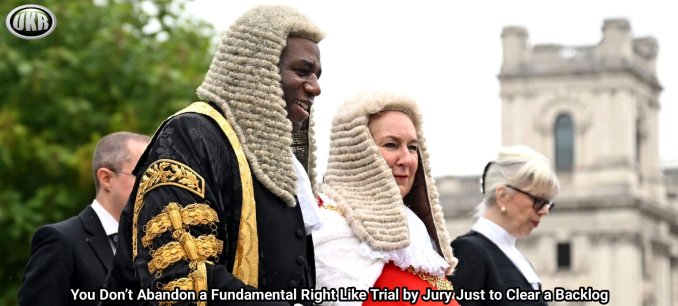
John Oxley: You don’t abandon a fundamental right like trial by jury just to clear a backlog
JOHN OXLEY
John Oxley is a consultant, writer, and broadcaster. His SubStack is Joxley Writes.
There are few institutions with a greater pedigree than trial by jury.
The concept of being judged by your peers has its roots in pre-Conquest England and was well established by the 13th century, when it was bolstered by Magna Carta. Now it faces its biggest threat in a millennium or so, with David Lammy proposing to restrict the right to trial by jury to the most serious of offences.
Outside of these, defendants would be tried by a judge alone.
The reduction of juries is a significant change that will dramatically alter how justice is administered in this country. The proposal goes beyond the recommendations from the government’s review of the practice. It risks a rushed abolition of one of our most fundamental and historic rights – and removing one of the key features that holds up public trust in the judicial system.
Jury trials are not a perfect system. There are, at times, concerning acquittals and wrongful convictions. Jurors and juries can be swayed by their own prejudices. They sometimes struggle with cases with highly technical elements. On aggregate, however, they work. Almost every juror engages with the system with seriousness and a level head. Defendants and victims receive a procedure that, on the whole, feels fair.
For the rest of us, there is a further benefit. The existence of juries draws ordinary people into the court system, a dozen at a time. This demystifies it and makes it accessible to the average person. Even if you are never called to serve, you will know someone who has been. While the rest of our institutions can feel remote and exclusive, the jury never does. It is your friends and neighbours who sit in judgment, and who get a feel for how the criminal justice system actually works.
Moving to judge-only trials threatens all of this. Institutions always develop their own cultures and biases. In juries, these are balanced out by the number of jurors and the fact that they are drawn at random. People who are sceptical of The Establishment, or reluctant to convict, are mixed with those who might think “there’s no smoke without fire”. Jurors can deploy their own expertise and experience in interpreting evidence. The jury room debates hammer out these differences.
For a single judge, the dynamic is different. There is no one to push against them in the same way. While the judiciary strives to be neutral, true neutrality is hard – especially when organisational selection and pressures can skew things one way or another. It won’t be long before single judges get a reputation for being soft or hard (as they already do for sentencing) or come under political pressure when conviction rates are seen as too high or too low. Despite everyone’s best intentions, such pressures are hard to escape.
More than that, ending public participation in most criminal trials will undermine the public’s understanding of the system. This, in turn, will undermine trust. Already, the rest of our system seems to operate with little public input, and as a result, it appears mysterious and elitist to many. This is obvious in our politics, and true of our courts too. Immigration tribunals, human rights cases, and criminal sentencing are often subject to public criticism, in part because they appear opaque and exclusive. The involvement of juries is a safeguard against this. Remove it, and faith in our justice system is likely to fall further.
The worst thing about Labour’s plans, however, is their attempt to circumscribe the debate. There are genuine arguments about the shortcomings of the jury system. Most of our European nations do not use juries to the same extent as England and Wales does. “Diplock” trials have worked in Northern Ireland for offences where it was hard to convene a fair jury safely. The same is true in England and Wales, where jury tampering is an issue. Yet the government is not looking to engage in these debates.
The restriction of jury trials is being pushed not as a measure of fairness, but as a measure of fiscal efficiency. The radical changes are presented as a tool for clearing the backlog in the criminal courts. It is a very real issue – a system that was already struggling before 2020 had every issue compounded by COVID closures. There are now nearly 80,000 cases awaiting trial, with current cases scheduled for court dates in 2030. Such delays bring further problems, as memories fade and witnesses lose interest, undermining our ability to prosecute effectively.
These delays are not, however, the fault of juries. It is primarily driven by a productivity slump across the criminal justice system. The administration of justice has fallen into crisis, primarily due to spending cuts under the last Conservative government. As a result, cases move more slowly through the system, courts often sit empty, and trials are frequently aborted because preparation is not completed in time. Hearings can be further disrupted by the failings of the prison system, including delays in delivering defendants to court. It is unclear how reducing jury use will address any of this, when the system needs more funding and a targeted strategy for widespread improvement.
The process of shifting to a single-judge system could potentially worsen this system. It would mean a massive change of systems and processes within organisations that are already struggling. For years, there would likely be too many parallel routes, depending on the cutoff for the new approach. The early iterations of jury-less trials are also likely to throw up more appeals, as lawyers and judges work through the complexities of a new way of hearing cases.
The government’s approach feels like it is missing the point. Reducing the use of juries and clearing the backlog are two separate issues. On the former, there is an opportunity to debate which system delivers the best, most trusted outcomes. There are many good reasons for preserving our historic system – but also arguments about its shortcomings. Driving through a significant change predicated on the latter issue, however, is misguided. It is unclear whether it would work, and it does not seem to weigh up the costs appropriately.
Our right to a jury trial is one of the longstanding parts of the English constitution. It is arguably older than parliament itself, stretching back so far that documentary evidence is barely extant. As a system, it has generally served us well and commands public trust. Yet even if it is not fit for the modern day, or could be improved upon, the debate shouldn’t be circumscribed.
If judge-only trials are a better option, it should be a debate framed by justice and trust – not a hurried attempt at backlog cutting that is unlikely to work.
See Related Article Below
In defence of jury trials
David Lammy’s proposal to abolish trial by jury in all but the most serious cases is wicked and irrational
JAMES PRICE
A wise and noble scholar of jurisprudence once wrote: “Jury trials are a fundamental part of our democratic settlement. Criminal trials without juries are a bad idea.” That was the sage of Tottenham, David Lammy, back in 2020. This week though, out of nowhere, the hapless Lord Chancellor has decided to ignore his own sage advice and announce, with no manifesto pledge to back it, to abolish jury trials for all but the most heinous crimes.
This is such a wicked and irrational idea that it is hard to know where to start in criticising it. So let us start with a potted history of the jury trial. Aeschylus’ great play, The Eumenides, concludes his epic Oresteia with a jury trial. Orestes is judged by a panel of Athenian citizens. The result is a tie, and Athena casts a deciding vote to acquit, establishing “a bulwark for your land and your salvation, such as no other people possesses”.
This sets the precedent that has been followed through to Western history, specifically the history of English-speaking peoples. Dr Alex Burghart MP has pointed out that the “earliest reference to jury trial comes from the third law code of Æthelred the Unready in 997: “Let there be a meeting in each wapentake; and let the 12 senior thegns go out and swear on the relics”.
This was reiterated in magna carta, with the famous line: “No free man shall be … imprisoned … or outlawed … except by the lawful judgment of his peers or by the law of the land.” And the tradition has been carried across the Atlantic with the other treasures of their Anglo inheritance, and is enshrined in the US Constitution and the Bill of Rights, as it is in the other jurisdictions of the Anglosphere.
On the flipside, almost literally every mad, bad and evil regime abolishes juries as one of the first acts of consolidation of tyrannical power. Obviously the Nazis and Bolsheviks did this immediately upon their seizing power. So too the who’s who of dictatorships: the Khmer Rouge, the Chinese Communist Party, Cuba under Castro, Chavez in Venezuela, and Salazar and Franco in Portugal and Spain, as well as Turkey 9 years ago.
This brings us up to the present day, and this wicked new proposal, that has managed to unite everyone from Jeremy Corbyn and the Secret Barrister to the indefatigable Shadow Lord Chancellor Robert Jenrick, and most right-thinking people in between.
There are two major problems with this announcement. The first is the political. This tawdry Labour government jumps when some piddly international tribunal with no actual legal power demands that we get rid of British territory in the Chagos Islands. Likewise they snivel and prostrate themselves before the European Court of Human Rights most mad demands that we keep foreign paedophile rapists here.
But our most sacred ancient liberties? Swept aside without ceremony or mercy. The waffle about “human rights” and their protection by foreign courts smells particularly strongly of the floor of the cowshed when you realise that the precious ECHR does not enshrine the right to a jury trial any more than it allows us to protect our borders.
The stated reasons for doing away with juries are to save costs and cut down on waiting times. These are things that could be solved by appointing competent people to run His Majesty’s Courts and Tribunal Service, putting some more money into the system (it is genuinely one of the few areas which is underfunded), and by having much longer sentences for the sorts of ghastly people who commit hundreds of offences but yoyo in and out of the system.
The second, and substantive, reason why this is such a bad idea is because jury trials fulfil an incredibly important set of roles in our civic life.
This is a system that has been justified by what Edmund Burke calls “the wisdom of the ages”
My friend, the barrister Harry Gillow, put it succinctly to me as thus: “The right to a jury trial is something that exists because we recognise that things can easily go wrong in any trial, and jury trial provides a safeguard for when the jury feel like the result is in some way not fair; twelve random people provide greater security there than a single judge would (recognising that any individual judge may be very different in temperament and attitude to another, with all the possibility for inconsistent results that leads to; a random selection of people — at least in theory — reduces the likelihood of that sort of randomness)”.
This is a system that has been justified by what Edmund Burke calls “the wisdom of the ages”, often guided by what is often called (again by Burke) “the wisdom of unlettered men”. The presumption of innocence until the proving of guilt has taken a beating in recent years, with exhortations to believe people based on their sex or race. But it is nevertheless a fundamental liberty to have the chance to explain yourself before your fellows before being judged. Especially given the threat of false accusations that are made.
As an evil “hanging’s too good for ‘em” right winger, you might expect me to take succour in the likelihood that more people will be found guilty under this new system. I could point to Lee Kuan Yew’s banning of jury trials because the different ethnic groups in Singapore would always vote to acquit their race over others. Or that as a fiscal hawk, I should cheer at the thought of some savings to the public purse.
The price of liberty is one that is worth paying whether in money, or in time
But to quote Team America: World Police; “freedom isn’t free”. The price of liberty is one that is worth paying whether in money, or in time. And this is my last reason to want to defend jury trials. They are one of the last areas where an individual is forced to do something for this nation. There should be more, not less, of this civic participation.
My own two weeks on jury service were painful in some ways, but I knew at least that I was contributing to justice and to the health of my nation. That is not something that can be said of David Lammy.


Leave a Reply