

When are circumstances exceptional?
DAVID MCGROGAN
By every path we come round to the same conclusion, that Parliamentary sovereignty has favoured the rule of law, and that the supremacy of the law of the land both calls forth the exertion of Parliamentary sovereignty, and leads to its being exercised in a spirit of legality.
AV Dicey
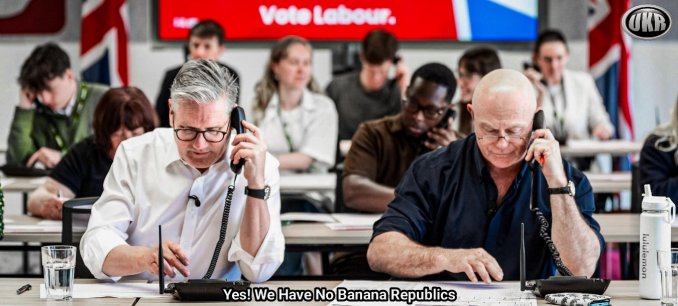
Last week, Nigel Farage, leader of Reform UK, took to the airwaves to describe Britain as a ‘Banana Republic’. This was, of course, a completely outrageous, inflammatory comment – the weather is nowhere near nice enough to grow bananas. If Britain is anything, it is a Cox’s Pippin republic. A Conference Pear republic. A Granny Smith republic. I’d even give you gooseberry republic.
Otherwise, his complaint was a fair one. The current Labour government is a shambles and its popularity is in free-fall. Sir Keir Starmer may be the least popular Prime Minister in history, and is in any case simply abysmally bad at politics. Big local government elections, timetabled for May 2026, have been widely touted as the watershed moment; Labour will almost certainly do so badly that Starmer’s own position will become untenable and the wheels will fall off. I have it on good authority from contacts in the Labour Party that they are even finding it difficult to find people to stand as Labour candidates in big parts of the country, given the level of hostility against the national government; people who might otherwise have stood are scared to take the reputational damage among friends and neighbours.
But somebody in Starmer’s inner circle – it is difficult to look beyond the pound shop Svengali Morgan McSweeney, though if Mr McSweeney’s lawyer’s are reading I must make clear I have no concrete evidence of this – has had a bright idea: disastrous local election results are only disastrous if the elections actually happen in the first place. So why not just cancel – or, nudge-nudge, wink-wink, ‘postpone’ – the ones in the parts of the country in which Labour are likely to do especially badly?
The ruse is transparent. The government has been trying to reform local government in any case, in some areas abolishing particular local authorities where there is currently one overlapping another, so there is a ready-made excuse for postponement. It will, the argument goes, be operationally difficult to organise and run elections in May 2026 alongside all the reorganisation going on. Hence electoral postponements are necessary to give councils time to focus on the important administrative tasks of deciding exactly which authority is supposed to collect the bins on this street or that and on which day of the week, and which authority is supposed to deflect criticism from which local newspaper about which set of potholes on what stretch of road.
And whoever is responsible for this strategy has come up with an even better additional wheeze: they have dressed everything up in the language of ‘requests’ – the idea being that if local councils are finding it terribly difficult to face voters, sorry, hold an election in the midst of a reorganisation, they can then ask the government to postpone. Hence, according to the official line:
These are exceptional circumstances where councils have told us they’re struggling to prepare for resource-intensive elections to councils that will shortly be abolished, while also reorganising into more efficient authorities that can better serve local residents.
The government is hereby portrayed as undertaking an act of generosity rather than naked self-preservation – it is simply responding, you see, to a wave of anxiety among the poor beleaguered local councillors of the land, fretting that they might not be able to handle the logistical nightmare that has suddenly blindsided them (as though reorganisation of local government was a freak weather event rather than the consequence of a decision which Starmer and his cronies had themselves made). And there is also here an implication that all this fuss about voting is just getting in the way of good governance in any case; note how elections are cast here as ‘resource-intensive’ while their cancellation is all taking place in the interests of ‘efficiency’ and ‘better service’. One begins to wonder if we might be better off indeed just returning to the days of the Long Parliament and abandon pesky, expensive, inefficient electoral democracy altogether.
In any case, some 29 councils, it appears, will now have their elections postponed (in some cases this will now have happened twice in two years) at least until 2027, affecting in the order of 4.5 million voters. It has not gone unnoticed that these are all elections that Reform UK was predicted to do very well in. And there has naturally been something of a press brouhaha – as well as a judicial review, launched by Reform UK, to challenge the legality of the decision (the full hearing will take place in mid-February).
But there has been little effort made in the press, as far as I can see, to actually explain the legal basis for all of this, or spell out the constitutional implications. So I thought I would take the opportunity to do that here. This will also give us the opportunity to speculate about the direction in which things are going in British politics in the round – and particularly in respect of the subject of lawfare, which I have discussed here before on several occasions.
Let’s begin with the legal framework, then. How is it that the government can simply postpone local elections apparently at the drop of a hat? Well, British readers may not be all that surprised to discover that the power to do this was introduced under New Labour, in the form of s. 87 of the Local Government Act 2000. Before that time the Local Government Act 1972 had mandated that local elections were to be held on the first Thursday of May in regular cycles depending on the authority in question (and before that there were other, more ad hoc arrangements). The 2000 Act, however, made things more ‘flexible’ (a dreaded word that should always send shivers down your spine when used in a legal context) by granting to the relevant Secretary of State, currently the catchily-titled Minister of Housing, Communities and Local Government, Steve Reed MP, the power to change the year in which elections for any local authority are held. Here’s the relevant bit of s. 87:
87 Power to change years in which elections held
(1)The Secretary of State may by order make provision which changes the years in which the ordinary elections of councillors of any specified local authority are to be held but which does not change the scheme which prevails (whether by virtue of an order under section 86 or otherwise) for the ordinary elections of those councillors.
What I hope you will notice first about this is that it is a very broad power. No exceptions are listed, and nor are there any provisos other than that the Secretary of State may not change the ‘scheme which prevails’ (for instance, some councils have elections for a third of their seats each cycle, while for some it’s the whole lot). It does not say anything about changes being permissible only in ‘exceptional circumstances’ – a phrase which has been bandied about by journalists and politicians, possibly after the Electoral Commission set that particular hare running back in December. The power to change the year of a local council election appears in other words to be more or less unfettered.
Now, for a long time it has been the case, rightly or wrongly, that UK courts will manage to find fetters for apparently unfettered ministerial powers in various boxes of tricks which they label things like ‘basic rules and principles of the common law’ or ‘basic rights’. The idea here is that, as Lord Browne-Wilkinson put it in his judgment in the important case of R v Secretary of State for the Home Department, ex parte Pierson [1998] AC 539 (1997), ‘Parliament does not legislate in a vacuum’. Statutes are assumed to be drafted in accordance with an underlying common law framework which will naturally affect how they are interpreted. And this suggests that there are certain guardrails in place which mean that even when a statute appears to grant a minister very wide or infinite discretion, it rarely in practice does.
For instance, ministerial powers must be exercised in accordance with what lawyers call ‘natural justice’ (which usually means that the decision should not have been biased, and that it must have been otherwise ‘procedurally fair’). The exercise of a power must not have been irrational. The decision to exercise it must not have been based on irrelevant considerations. It must also not have failed to take into account relevant considerations. And so on. Sometimes these ‘constitutional principles’ are indeed quite esoteric and specific; in ex parte Pierson the power in question was that of the Home Secretary to make decisions about release dates for prisoners with mandatory life sentences. The then-Home Secretary, Michael Howard, had in effect by accident increased a prisoner’s sentence through using this power. The House of Lords found that this went against a common law principle against ‘aggravation of sentencing’ – i.e., that once a criminal has been sentenced, his sentence should not be subsequently increased without very good reason. So even though the statute which granted the Home Secretary the relevant power had mentioned no such restriction, it was ‘found’ in the common law.
The question of whether there are common law restrictions on the Minister of Housing, Communities and Local Government’s s. 87 power to change the year in which local council elections are held is a curious one. On the one hand, while courts have for a long time been willing to talk in a very loose and mealy-mouthed way about voting and democracy as being constitutionally important in some sense, they have always been unwilling to go so far as to say that there is a right to vote as such at common law. This happened most recently (I think) in Moohan v Lord Advocate [2014] UKSC 67, in which the Supreme Court found a ban on prisoners in Scotland from voting in the independence referendum of 2014, carried out through delegated legislation, to have been lawful.
The reason the majority gave in Moohan for holding there was no common law right to vote was that every single time the franchise has been expanded in British history it has been down to Parliament or royal charter – the right to vote is not a creature of the common law at all. So there would seem to be a strong case to be made that Parliament has in effect exclusive jurisdiction over the granting (and rescinding) of voting rights as such. And this in turn would indicate there are no common law restrictions on the s. 87 power whatsoever. The Secretary of State can use it however he wishes, because Parliament has so granted him that power through the Local Government Act 2000.
On the other hand, you never know. There is to my knowledge no case law on the interpretation of s. 87 at all, so we will be in uncharted waters when Reform’s legal challenge is heard. It is a power which has been used in the past – it was used to delay local elections for a month in 2001 during the foot and mouth crisis, for example. But none of the previous instances have been at all contentious, and therefore were not subject to legal challenge. So the result is impossible to predict.
One could see an argument emerging that the power is being used in a biased way, since it is clearly benefiting the Labour Party (most councils where delays are happening are Labour-run) and is transparently being deployed for that purpose. One could also see an argument being made – and this is what I have gleaned from the very small amount of commentary available from within Reform itself – that the decision frustrates certain ‘legitimate expectations’ that the elections would go ahead. This doctrine is founded in the idea that it is procedurally unfair for a public authority to lead somebody up the garden path – to use the technical legal term – and then suddenly change its mind near to the last minute or without warning or justification. The argument here would likely be that people have already spent a lot of time and money preparing for elections to take place, in the legitimate expectation that they will indeed take place, and that it is unfair to frustrate that expectation in the way that the Secretary of State has – especially given that reorganisation of local government is hardly a crisis or emergency of any kind.
We don’t know, however, and the judgment will make interesting reading for legal academics. On balance, I find it hard to believe that the court would find in favour of Reform UK; that just isn’t how our ‘impartial’ judiciary tends to operate. And anyway I find it hard to accept that the s. 87 power, as one granted to directly to the Secretary of State by Parliament, will be made subject to constraint. What is really important about the case, however, are its constitutional implications – particularly with respect, of course, to the role of the courts in politics.
The first thing to say on this point is that while scholars like to bang on a great deal about the constitution, separation of powers, rights, principles, procedure and so on, they tend to forget the most elemental matter of all, which is the relationship between the constituted power, the government, and the constituent power, which is the people. The people are part of the constitution, and they are in fact the biggest part of it – the ultimate ‘check and balance’ – because it is ultimately they who decide who governs. They generally decide this through elections, but if they really want to, they can decide it through revolution. And in this respect at least I am relatively sanguine about the cancelled local government votes. Starmer cannot run away forever, and when eventually people do get a chance to vote, whether at local or national level, they will show what happens to politicians, and political parties, who ‘get frit’.
The second thing to say is that, notwithstanding all this, it makes perfect sense in game theoretical terms for Reform to pursue their legal challenge. There is no downside – it is a situation of what Nassim Taleb calls ‘convexity’. If the court holds that the s. 87 power was exercised lawfully, Reform can make hay from having been frustrated by a crooked legal establishment. If, however, the court holds that the s. 87 power was exercised unlawfully, the elections will likely go ahead and the results will be an even bigger car crash for Labour than was previously expected. Either way, it will be worth the costs in legal fees.
The third thing to say is that lawfare is here to stay, and while I am saddened to see that things have deteriorated to the point at which it is felt necessary to litigate the dates of local governmental elections through judicial review, I am heartened to see that the right is now finally figuring out that it is in what I have previously referred to as a knife-fight. This is how I put things in that earlier post:
Conservative politicians, activists and donors remain for the most part stuck in a normal politics paradigm governed by polite, dinner party discussion rules. They do not like regime politics, they fear it, and they wish it would go away. And they don’t want to stoop to lawfare because they don’t understand it and because they don’t currently have the conceptual tools to engage with what a knife fight entails. They need, in short conclusion, to learn quickly that instead of bleating about left lawfare they can start themselves to play the same game – and think rigorously about how they can use the courts to ‘force through changes’ that they care about.
The point I wished to make at that time was that while it may be reassuring to take the high ground and declare oneself to be loftily above using the courts to achieve political objectives of whatever kind, that is simply a recipe for defeat when facing an opponent who has no such scruples. The left in the UK has artfully mastered the tactic of utilising the courts to circumvent both executive decision-making and democratic mechanisms. Ideally, there needs to be total reform of the way in which we train lawyers and appoint judges so as to prevent this from happening. But in the meantime, it is simply foolishness not to make use of judicial review as a political weapon in precisely the manner in which it is used by, for example, trade unions, open borders NGOs, climate change activists, and the human rights lobby in order to win political victories. It is gratifying to see that people associated with Reform finally appear to understand this.
The fourth thing to say, however, is less optimistic. A few weeks ago Dominic Cummings gave a very interesting, and very widely shared, two-part interview with The Spectator. In the second part, he speculated on what might happen in advance of a potential Reform victory in the next general election. The UK regime, in his view, and he put this quite plausibly, has learned its lesson over the past ten years. And the lesson it has learned is: Brexit happened because we gave people too much choice. Brexit was the Great Cataclysm. Therefore, it follows that choice is potentially cataclysmic – especially if there are undesired options on the table. And it follows from this that undesired options should be removed from view. Cummings therefore predicted that Reform simply somehow will not be allowed to be an option on the table for the next General Election – they will be removed.
Postponing local elections to indirectly prohibit the option of voting for Reform is therefore to be understood in its own way as a little trial balloon for further shenanigans. I have previously said I don’t think we would see a cancelled or postponed General Election – it would be too obvious and inflammatory – and, as I said earlier on, I simply cannot believe that people will not be able to vote Labour out entirely, sooner or later. But tactics for at-all-costs elimination are clearly being practiced and strategies dreamed up. We are moving away from what was once familiar, namely broad respect across the political spectrum for playing the game by the rules, to something alien: political war, defined by absolute victory and annihilation of opponents.
And in this respect it is ironic that people have been using the phrase ‘exceptional circumstances’ so much in relation to the s. 87 power which has been invoked. We are not living in exceptional circumstances justifying postponing elections, the thinking goes. We are in normal times. A bit of restructuring is not sufficient cause to change schedule; elections should go ahead.
But the truth of the matter is that we are in exceptional circumstances indeed: a sitting government is transparently conspiring to neuter local democracy in order to save the skin of the Prime Minister. This is exceptional in our recent political history. And we ought therefore to get used to thinking in these terms. The old way of doing things is dead. We are in a new, combative, conflictual, and dangerous era. And we have to confront this fact in order to properly orient our thinking, both at a political and a personal level. At a personal level, it seems obvious that instability is afoot, and one should prepare for that accordingly. At a political level, it seems ever more obvious that we are moving towards a point of crisis at which genuine no-holds-barred conflict – hopefully only of the metaphorical kind – breaks out. These are exceptional times and that is the way in which we need to be thinking, rather than imagining that normal service will at some point resume. Those are, sadly, simply not the circumstances in which we now live.
[I apologise to subscribers for having taken last week off due to work commitments. Normal service will now at least resume here!]
This article (Yes! We Have No Banana Republics) was created and published by News from Uncibal and is republished here under “Fair Use”


Leave a Reply