St George’s flags are being ripped down by Tower Hamlets council, sparking accusations of hypocrisy over Palestinian banners and fuelling a nationwide flag row. The Mail has the story.
Tower Hamlets previously prided itself on its displays of Palestine banners, but said any England flags attached to council property as part of an online movement called ‘Operation Raise the Colours’ would be promptly removed.
The initiative has spread to towns and cities including Bradford, Newcastle, Norwich and Swindon – with activists putting up England and UK flags in defiance of council bans. …
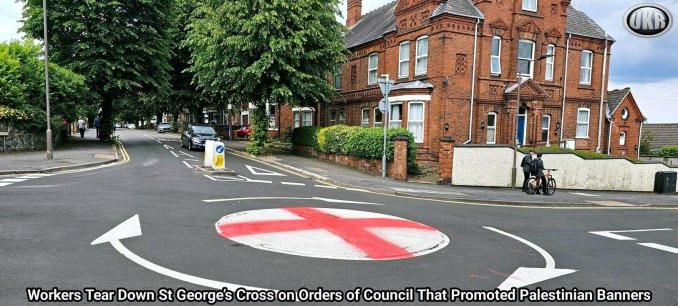
Campaigners were today seen painting roundabouts in Birmingham in England colours after officials sparked fury last week by tearing down St George’s Crosses in the south of the city over claims they posed a safety risk.
Operation Raise the Colours supporters filmed themselves putting up England flags in Tower Hamlets last night, but this morning workers from the local council were pictured removing them with metal poles.
The authority is led by Lutfur Rahman of the pro-Palestine Aspire Party, and previously refused to remove hundreds of Palestine flags that were hanging from lamp posts and council buildings in the borough so as not to “destabilise community cohesion”. Mr Rahman – who was previously found guilty of electoral fraud – finally ordered them to be removed last year after Jewish locals complained they were intimidating and divisive. …
Approximately 39.9% of people in the borough are Muslim, the largest proportion of any local authority area in the UK.
A number of St George’s flags have been put up across Tower Hamlets over recent days.
In response, a spokesman for the council vowed to remove them.
“We are aware members of the public have been putting up St George’s flags on various structures,” the spokesman said.
“While we recognise people wish to express their views, we have a responsibility to monitor and maintain council infrastructure.
“Where flags are attached to council-owned infrastructure without permission, they may be removed as part of routine maintenance.” …
Operation Raise the Colours began on Facebook and has spread across the country.
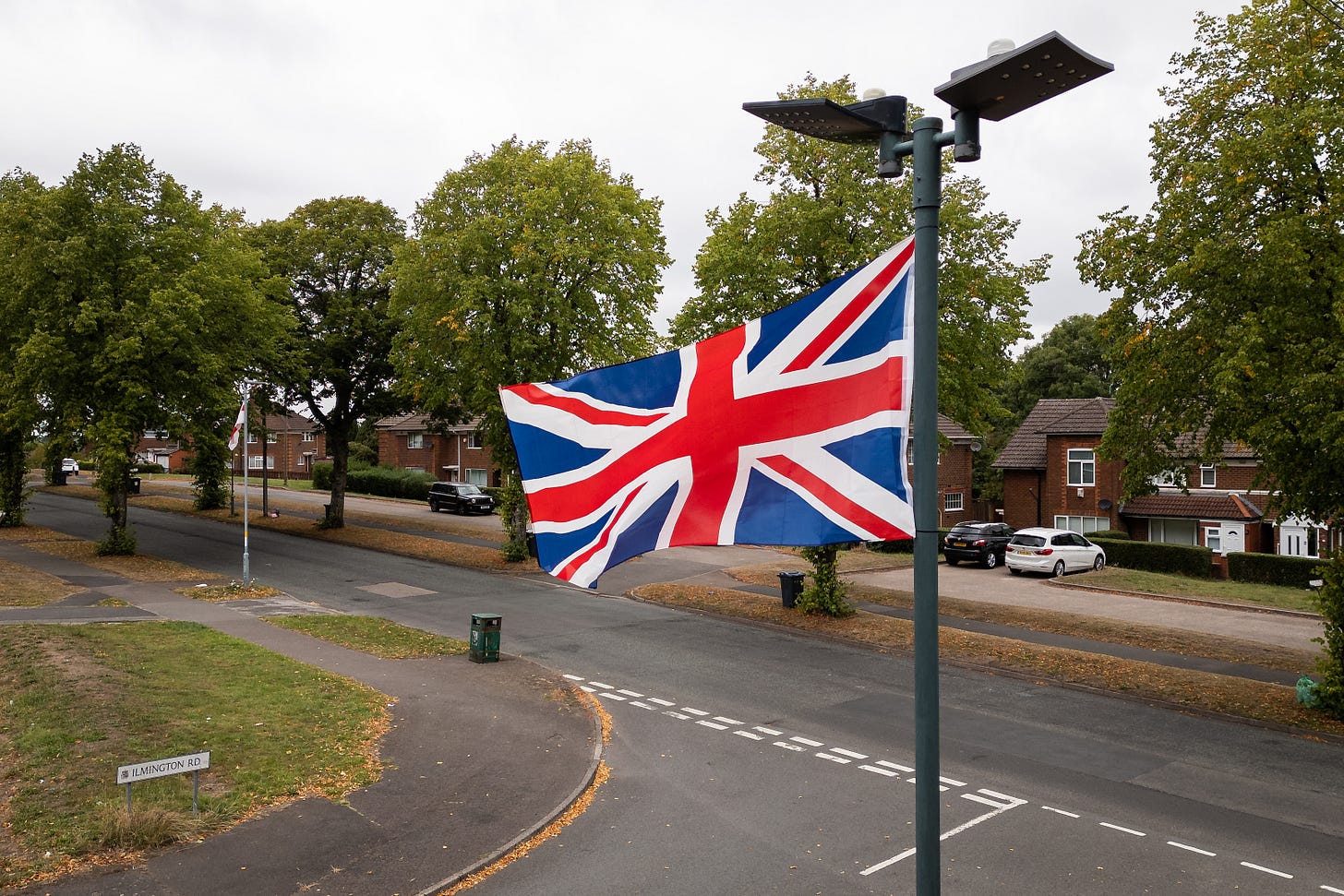
It appears to have its roots in Birmingham, where scores of British flags sprung up in the suburb of Northfield.
Birmingham City Council quickly confirmed it would begin ripping them down and claimed they posed a safety risk despite flying high above the traffic.
A backlash to the decision deepened further after officials privately admitted they were too scared to take down Palestine flags without extra security. …
Critics also pointed out that the city’s library was being lit up in the colours of the Pakistan flag to mark the anniversary of the country’s independence, followed by the Indian flag.
Has the national emblem of Britain become a weapon for culture warriors?
.
ANDREW DOYLE
One of the curious aspects of moving from the UK to the US is adjusting to the everyday cultural differences. There’s the tipping, the peculiar phrases (waiters often say ‘I appreciate you’ rather than ‘thank you’), and the kind of generalised politeness from strangers that in London I would naturally treat with suspicion. For me, one of the most notable variations has been the unabashed patriotism. The Stars and Stripes is a common sight, fluttering above public buildings, as bunting on shops, and from huge flagpoles erected along the highway. It’s almost as though these people are actually proud of their country.
In the UK, by contrast, the national flag has long been distrusted. Some view it as a symbol of racism and the legacy of empire, but more often it evokes a kind of embarrassment, as if patriotism itself were a form of bad manners. This week the Labour-run council in Birmingham ordered the removal of British and English flags from lamp posts, claiming that such ‘unauthorised attachments’ can be ‘dangerous’. At the same time, Palestinian flags are flown with impunity throughout the UK, and many suspect that the police are too frightened to take them down.
The backlash against Birmingham council has become an unexpected flashpoint in the culture wars, with locals in various towns and cities now hoisting the flags of the Union and St George in defiance. The movement has been dubbed ‘Operation Raise the Colours’, spreading rapidly to London, Bradford, Newcastle, Norwich, Swindon and beyond.
Inevitably, woke activists see the British flag as threatening and ‘unsafe’, a declaration of support for colonialism and slavery, as though a nation’s flag can only possibly represent the worst aspects of its history. These same activists do not seem to baulk at the raising of the Progress Pride flag in public, in spite of the fact that this design is associated with the mutilation of children, the destruction of women’s spaces and the rolling back of gay rights.
The hypocrisy has been particularly obvious in areas such as Tower Hamlets, a council that has consistently displayed the Palestine flag, but has now said that any UK equivalent will not be tolerated. But why should the national flag be considered controversial in any area of the country it represents? In military terms, it is unthinkable to allow a flag to fall, because that is to suggest surrender or defeat. But in places like Tower Hamlets, the concept of raising it in the first place seems anathema.
Of course, all of this comes down to what the flag signifies. To many, the Union flag serves as a rallying point, binding people to shared values within one nation. To others, it is a symbol of dominance and jingoistic supremacy. But the same could surely be said of the Palestinian flag. While some will argue that it is a show of solidarity for a cause, in many cases it appears to function less as a unifying symbol than as a political provocation, aimed at alienating those who dissent from its message.
Take for instance the example of Labour donor and entrepreneur Dale Vince, who is currently displaying an oversized 30-foot-long Palestinian flag outside his office in Stroud. He had previously hung the European Union flag at the same spot. For Vince, flags are not simply a means of declaring his political affiliations. They are also instruments for his culture war; a way to hammer home his point of view while goading his Cotswold neighbours in the process.
I have had some personal experience of how flags can be used to promote dissent rather than unity. When I was at university, my mother moved to a house in the Brandywell area of the city of Derry in Northern Ireland, not far from where she grew up. In the surrounding roads there were plenty of Irish Tricolours painted onto walls, and even some of the kerbstones were decorated in the green, white and gold. You could argue that this was all in celebration of Irish culture, but of course these were really territorial markings, a way to ensure that Unionists knew they were not welcome. In turn, the nearby Fountain Estate was plastered with the colours of the UK flag, and remains so to this day.
I recall one holiday break from university which happened to coincide with a World Cup, an event I had no interest in whatsoever. Directly outside my bedroom window, someone had attached a Brazilian flag to the lamp post. This was apparently because the English team were soon due to play Brazil, and so this was a relatively harmless – and quite humorous – means of expressing anti-English sentiment in this fiercely republican area of the city. But I do wonder what would have happened to me had I attempted to take it down?
This is perhaps why for a long while I have associated flags with division rather than unity, but my recent experiences in America have altered my view. Here, the flag is not an act of aggression but of fellowship, not a means of exclusion but a way to forge a common identity. That attitude has never taken root in Britain. These latest skirmishes will do little to persuade sceptics that the Union flag can stand for anything beyond white nationalism, even though many who fly it are not white.
One wonders where these latest flag wars will lead us, and whether there will be any arrests of people for raising them or tearing them down. I have never felt instinctively nationalistic, but I understand why these symbols matter to many people, and how each flag can be subject to wildly different interpretations. Perhaps one day we will reach a point where the national flag can simply be acknowledged for what it is: the emblem of the country we live in. But if the Union flag is ever to stand for unity again, Britain has to relearn what America already knows: that a flag can be a shared symbol, not just a tribal weapon.
This article (Flag wars!) was created and published by Andrew Doyle and is republished here under “Fair Use”
Featured image: The Daily Mail
••••
The Liberty Beacon Project is now expanding at a near exponential rate, and for this we are grateful and excited! But we must also be practical. For 7 years we have not asked for any donations, and have built this project with our own funds as we grew. We are now experiencing ever increasing growing pains due to the large number of websites and projects we represent. So we have just installed donation buttons on our websites and ask that you consider this when you visit them. Nothing is too small. We thank you for all your support and your considerations … (TLB)
••••
Comment Policy: As a privately owned web site, we reserve the right to remove comments that contain spam, advertising, vulgarity, threats of violence, racism, or personal/abusive attacks on other users. This also applies to trolling, the use of more than one alias, or just intentional mischief. Enforcement of this policy is at the discretion of this websites administrators. Repeat offenders may be blocked or permanently banned without prior warning.
••••
Disclaimer: TLB websites contain copyrighted material the use of which has not always been specifically authorized by the copyright owner. We are making such material available to our readers under the provisions of “fair use” in an effort to advance a better understanding of political, health, economic and social issues. The material on this site is distributed without profit to those who have expressed a prior interest in receiving it for research and educational purposes. If you wish to use copyrighted material for purposes other than “fair use” you must request permission from the copyright owner.
••••
Disclaimer: The information and opinions shared are for informational purposes only including, but not limited to, text, graphics, images and other material are not intended as medical advice or instruction. Nothing mentioned is intended to be a substitute for professional medical advice, diagnosis or treatment.
Disclaimer: The views and opinions expressed in this article are those of the author and do not necessarily reflect the official policy or position of The Liberty Beacon Project.







Leave a Reply