

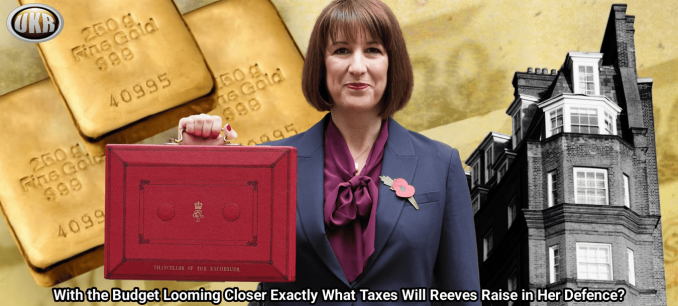
David Gauke: With the Budget looming closer exactly what taxes will Reeves raise in her defence?
DAVID GAUKE
David Gauke is a former Justice Secretary and was an independent candidate in South-West Hertfordshire at the 2019 general election.
This time last year, there was a sense of despondency about the prospects for tax rises, with endless speculation as to which taxes would be increased in the autumn budget.
The tax increases duly materialised – £40bn of them.
This was not the first government to come into office and increase taxes (I was part of the Treasury team that did precisely that in 2010), but the public was in no mood to give Keir Starmer and Rachel Reeves the benefit of the doubt. Reeves felt compelled to promise that the autumn budget of 2024 was very much a one off; that she would not need to repeat a big tax-raising budget again.
It is not working out that way.
The public finances were in a much worse mess before the 2024 General Election than any of the parties were prepared to admit. Nor was the autumn budget an example of strict fiscal discipline, as Reeves sought to portray it to be.
Yes, taxes went up but spending went up by more. Unusually for the first budget of a Parliament, it was a fiscal loosening not a fiscal tightening. There was much talk of adherence to the fiscal rules and fiscal framework, which still convinces some commentators to complain that the Chancellor has boxed herself in by describing them as “non-negotiable”, but these are very loose rules indeed.
The debate about fiscal rules can mask the real issue.
When it comes to the public finances, what really matters is the confidence of the bond markets. And here we know that we are in a precarious situation. The bond markets reacted nervously to the autumn budget and again when it looked as if Reeves was about to resign. When it comes to the next budget, the markets will want to reassurance that the Government is serious about the sustainability of the public finances. Meeting the loose but “non-negotiable” fiscal rules is the bare minimum of what will be necessary to provide this reassurance.
For this reason, we are back to a guessing game of how the “black hole” is going to be filled. We do not how big the black hole is, but we can assume that it is substantial. Most economic commentators think it will be in the region of £20-25bn, but the National Institute for Economic and Social Research think it might be twice that. Once the Office for Budget Responsibility produces its first round of estimates, we will get a better idea.
In any event, it is highly likely to require significant measures of fiscal consolidation. It is also unlikely that spending will play a large part in making the numbers add up. We have just had a spending review, and the Chancellor is unlikely to want to open up these numbers again. The two winners of the spending review – health and defence – would be very difficult to cut for different reasons, and the settlements for other departments were not particularly generous. The Government should want to find greater savings in the welfare budget but knows that its backbenchers will not allow them to do so.
So we are back to taxes. How will Reeves find the money?
Any Chancellor in these circumstances has to think both politically and economically. Reeves is not in a strong position politically within her own party which might drive her towards measures that minimise internal criticism. There are plenty of voices on the Left calling for a wealth tax but this has – rightly – been dismissed. Even on purely practical grounds, the State does not currently have the capacity to value all the assets of the wealthiest, and will not be in a position to build up that capacity for some time.
If looking to tax the wealthy more, there are other options. There is Government briefing that more could be raised from inheritance tax or capital gains tax. In recent days, the focus has turned to property taxes and ways in which more could be raised from high value properties.
There are three potential problems with these approaches, however.
First, many of these ideas are unlikely to raise that much revenue. IHT is forecast to raise £9bn this year, CGT just under £20bn. It would be surprising if one could introduce reforms that would raise vast amounts from relatively small taxes. On property taxes, one obvious idea is to introduce additional council tax bands at the top end. We looked at this in the Treasury in 2012 and the additional revenue would have been a 100s of millions, not billions. It would be more today, but not that much more.
Second, there would be plenty of political pushback from those adversely impacted. Look at the reforms of the Agricultural Property Relief which has – predictably enough – become the “farm tax”. There is plenty of political pain for not that much fiscal gain. A similar point would apply to applying CGT to primary residences in that this would involve raising a lot of money from a relatively small number of people, geographically concentrated in London and the South East. Every attempt to take out the politically hard cases reduces substantially the revenue that can be raised.
Third, there are credible reports that many wealthy people are already moving away from the UK. At a time when the UK should be making a real effort to attract wealthy Americans, for example, to our shores, tax reforms that give the impression that we are hostile to those with money would be an economic mistake and fiscally self-defeating.
The reality is that if you want to raise a lot of tax, you need to raise it from a lot of people. Given our predicament, one of the larger taxes is likely to be necessary.
There will likely to be a temptation to look to raise more from businesses. This is what Reeves did in October in putting up employers’ National Insurance Contributions (although ultimately this results in lower pay for employees). She could repeat that, but with the labour market looking fragile, there would be very strong opposition from small businesses and the retail and hospitality sectors in particular. There is a manifesto pledge not to increase the rate of corporation tax, and she may conclude that her least worst option politically is to break that pledge. Economically, however, this is a terrible signal to send when wanting to increase investment in the UK, which is a longstanding priority of Reeves.
She has also pledged not to increase the rates of income tax, employees NICs and VAT. She could raise revenue by broadening the base by continuing to freeze the income tax and NICs thresholds for another year (which she almost certainly will do, raising £9-10bn a year by the end of the Parliament) and by removing VAT exemptions (which she almost certainly will not do). There is much to be said for charging the full rate of VAT on everything and compensate those hit hardest elsewhere in the tax and benefit system, but – speaking from painful experience – base broadening of VAT is not politically straightforward.
This leaves the rates of the big three taxes – and an unambiguous breach of the manifesto commitment. It was a foolish commitment in the first place but one can see why Reeves is resistant to breaking it. The public will notice the breach and, given the public mood, will be unlikely to take any such announcement calmly in their stride. But if the sums that need to be raised exceed £20bn, there is no sensible way of finding this money without raising the rates of the main taxes.
The risk, at the moment, is that the Government seeks to raise large sums of money while eschewing the only realistic means to do so. That will inevitably end badly.
See Related Article Below
Britain on the brink of collapse, labour Maxists success
PETER HALLIGAN
Labour has been in power in the UK for 1 year, we are now stagflation the worst possible economic scenario the policies labour has introduced like increases in national insurrance, continuily drain the life blood of the economy and its people. Net 0 has turned into Net 1000 cost. Net 0 now costs every household an extra 1000 pounds in the Uk Per annum and the 2 remaining hammer blows to finish off the economy are the building of 300,000 new ‘affordable’ per annum for the next 4 years which will apparently double the UK’s housing capacity even though not a single home has been built yet. Next week be the property taxes on homes that a worth more than a million which will double with the inheritance taxes starting in 2 years time which will take a quarter of everybody’s wealth including famers, complying with trumps requests to double defence budget to 5% of GDP this is increased spending from 75 billion to 150 billion a year.
Once you add all of these up the policies of the labour government have succeeded in destroying wealth at the rate of 20 billion from national insurance, 40 billion a year from Net 0 (40 million homes spending an extra $1000 per year), 40 billion from increasing manufacturing and industrial energy costs and finally the 75 billion on defence. This is almost 200 billion in wealth destruction, the UK can not survive this in its current form while suffering already from stagflation…
Unless this is stopped the IMF will be called in to restructure the failed policies, abandon Net 0 and revert tax increases. These policies are formulated by nihilistic idiots who have no concept on how to manage an economy. If they were criminals that would be locked up for life for theft. Britain is Lost, reform UK must publish its policies to reverse these events.
The sad thing is similar policies are endemic throughout Europe and are sponsored by the united nations, WHO and IPCC. Only trump has showed any resolve in cancelling them.
Immigration is yet another issue, there are 1.3 million asylum seekers in the UK, 30,000 are being housed in hotels, 70,000 are being housed in HMOs. The numbers are growing not because of the illegal boat people but because those who have overstayed their visas are claiming asylum at a fastest rate that the migrating boat people. Prisoners should be emptied on a 1 out 3 illegals in basis to deal with the current problem.
Serious consideration needs to be had about building new cities for these migrants in Pakistan and Syria, remember out of the 1.3 million asylum seekers in the UK the vast majority are Pakistanis followed by Afghans and Israelis
A cynic might say that the only reason the number of asylum seekers in the UK is falling is because the home office employs similar ethnic groups to grant the asylum.
Onwards!!
Please subscribe ten dollars a month or annually for 100 bucks. You can also donate via Ko-fi – any amount from three dollars upwards. Ko-fi donations here: https://ko-fi.com/peterhalligan
This article (Britain on the brink of collapse, labour Maxists success) was created and published by Peter Halligan and is republished here under “Fair Use”

••••
The Liberty Beacon Project is now expanding at a near exponential rate, and for this we are grateful and excited! But we must also be practical. For 7 years we have not asked for any donations, and have built this project with our own funds as we grew. We are now experiencing ever increasing growing pains due to the large number of websites and projects we represent. So we have just installed donation buttons on our websites and ask that you consider this when you visit them. Nothing is too small. We thank you for all your support and your considerations … (TLB)
••••
Comment Policy: As a privately owned web site, we reserve the right to remove comments that contain spam, advertising, vulgarity, threats of violence, racism, or personal/abusive attacks on other users. This also applies to trolling, the use of more than one alias, or just intentional mischief. Enforcement of this policy is at the discretion of this websites administrators. Repeat offenders may be blocked or permanently banned without prior warning.
••••
Disclaimer: TLB websites contain copyrighted material the use of which has not always been specifically authorized by the copyright owner. We are making such material available to our readers under the provisions of “fair use” in an effort to advance a better understanding of political, health, economic and social issues. The material on this site is distributed without profit to those who have expressed a prior interest in receiving it for research and educational purposes. If you wish to use copyrighted material for purposes other than “fair use” you must request permission from the copyright owner.
••••
Disclaimer: The information and opinions shared are for informational purposes only including, but not limited to, text, graphics, images and other material are not intended as medical advice or instruction. Nothing mentioned is intended to be a substitute for professional medical advice, diagnosis or treatment.
Disclaimer: The views and opinions expressed in this article are those of the author and do not necessarily reflect the official policy or position of The Liberty Beacon Project.


Leave a Reply