

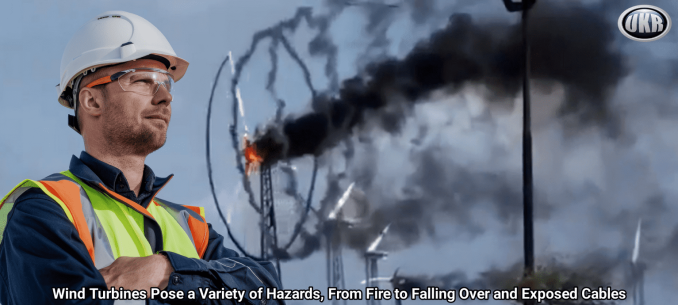
Wind turbines pose a variety of hazards, from fire to falling over and exposed cables
RHODA WILSON
Continuing from an article he wrote last week, Al Christie lists six hazards of wind turbines. As well as a fire hazard, they pose a risk of oil leaks, falling over and a hazard to coast guard radar systems.
And if cables for offshore wind farms are not buried deep enough in the seabed, they can become exposed by tide and storm activity, which, Christie says, could be a hazard for swimmers.
Wind Turbine Environmental Destruction Part 2: The Hazards of Wind Turbines
By Al Christie

After writing last week about the destructive practices of mining for rare earth elements needed for wind turbines and the deadly destruction of wildlife, I ran out of time before getting to the other hazards.
Read more: How Wind Turbines Are Destroying the Environment and Ecology of Planet Earth, Al Christie, 15 May 2025
I’m short of time again this week, so I will just hit a few issues without trying to cover the whole gamut. Some of the points are from an earlier post.
Thomas Shepstone shared a post from ‘MGUY Australia’ on the absurdity of pursuing building new wind farms. They are built way out in the middle of nowhere, creating the need for miles of access roads and miles of high-voltage distribution lines and towers. In his presentation on YouTube, MGUY Australia showed one of those giant wind turbine parts that got stuck under a bridge:

It takes a special truck to handle one of these turbine blades.

The blades made at LM Wind Power’s Cherbourg plant are 107 metres long (351 feet) and measure some 5.4 metres (almost 18 feet) in diameter at their wide end. They weigh about 55 tonnes, and there are 3 of them on each tower.
The towers are 984 feet high and weigh 2,550 tonnes. (That figure probably includes the concrete footing – not sure.) The 12 MW (megawatt) generator, gearbox and cover weigh 600 tonnes.
Imagine transporting such equipment from factory to dock to barge, and then having big enough cranes to hoist all of it up into position. Quite a challenge, and not cheap. But the difficulty of transporting wind turbine parts on existing highway systems is not the biggest hazard.
1. Security is a concern. Wind farms send their collectively generated electricity to land by undersea cables, which could be vulnerable to sabotage.
In addition, the Block Island offshore wind farm, a 30-megawatt facility off the coast of Rhode Island, found that its high voltage cables that carry electricity to land were not buried deep enough and were being exposed as the seabed was being worn away by tides and storms, making the exposed cables dangerous to swimmers.
2. Oil leak hazard. The turbine generators require maintenance every 6 to 12 months and a schedule for changing the 1,400 litres of lubricating oils, hydraulic fluid and gear oil for all the gears and bearings and yaw and drive mechanisms.
Sometimes the oil leaks. When oil leaks happen, they can cause a lot of environmental damage. Oil can contaminate farmlands and forests, and becomes particularly problematic when it spreads into groundwater or worse into the sea from offshore turbines.
3. Fire hazard. Sometimes they catch on fire, and they’re hard to put out because of the tower height and all the oil, so usually they are just allowed to burn themselves out, but flaming debris falling 500 feet to the ground, of course, can start an even larger fire disaster.

In an article explaining why dealing with the possibility of wind turbine fire is important, Wind Systems noted:
A wind-turbine fire can cost upwards of $8 million, according to insurance experts quoted in Firetrace’s recent report, “Reducing Fire Risk.” As most wind-turbine towers exceed 250 feet, they are often out-of-range for ground-based firefighting. Sending a team up to fight the fire presents a significant health and safety risk. Therefore, if no fire suppression system is in place, it will be left to burn out, irreparably damaging the turbine… Fire risk is not only a concern for the wind farm’s balance sheet. A wind-turbine fire can spread to the surrounding environment, sparking wildfires and potentially spreading into nearby communities.
Turbines and fire risk, Wind Systems, 15 July 2021
4. Falling over hazard.

In an article about the increase in wind turbine failures, including blades falling off and turbines collapsing, Popular Mechanics said:
The taller the wind turbine, the harder they fall. And they sure are falling.
Wind turbine failures are on the uptick, from Oklahoma to Sweden and Colorado to Germany, with all three of the major manufacturers admitting that the race to create bigger turbines has invited manufacturing issues, according to a report from Bloomberg.
Multiple turbines that are taller than 750 feet are collapsing across the world, with the tallest – 784 feet in stature – falling in Germany in September 2021. To put it in perspective, those turbines are taller than both the Space Needle in Seattle and the Washington Monument in Washington, D.C. Even smaller turbines that recently took a tumble in Oklahoma, Wisconsin, Wales and Colorado were about the height of the Statue of Liberty.
Giant Wind Turbines Keep Mysteriously Falling Over. This Shouldn’t Be Happening, Popular Mechanics, 23 January 2023

The article accompanying the image above stated:
PGE temporarily shuttered its Biglow Canyon wind farm last year after a massive blade from one of its towering turbines broke loose, launching the length of a football field and landing in a wheat field where workers had been delivering fertiliser hours earlier … The 135-foot piece of fibreglass, wood and metal weighs more than seven tonnes.
Industry research suggests that damaged blade bolts due to stress and metal fatigue is a frequent cause of turbine failure.
Amid scrutiny, PGE overhauls flagship wind farm to address safety and reliability problems, Oregon Live, 17 January 2023
We all heard the big news story about the turbine blade that crumbled off a wind turbine off the coast of Nantucket in July 2024. The fibreglass and foam debris from a failed Vineyard Wind turbine blade washed up on Nantucket beaches. The blade, part of the Vineyard Wind offshore wind project, broke and folded over while undergoing testing, causing debris to scatter into the ocean and then wash ashore. Nantucket Magazine reported that the incident left more than 6 cubic yards of foam and roughly 1.5 cubic yards of fibreglass on Nantucket beaches. CBS News reported that development of the wind farm has since been halted by the federal government.
5. Backup batteries hazard.

Because of the unreliability of wind, wind turbine installations need the addition of multiple 20-tonne container-sized backup battery assemblies. (Last week’s post mentioned the toxic mining of rare earth minerals needed for the special magnets in wind turbine generators. When the rare earth minerals for the backup batteries are added to those used in the turbines and generators themselves, onshore wind farms require eight times the amount of critical minerals as natural gas power plants do, and offshore wind farms require 13 times as much.)
But the hazard is fire and explosion. When one of these babies catches fire or explodes and burns, they’re so hot, it’s almost impossible to put the fire out, and the fumes are toxic. The Moss Landing fire in California in January 2025 was uncontrollable, and its impacts extended past the duration of the fire itself:
Initial air quality assessments by the U.S. Environmental Protection Agency (EPA) detected hydrogen fluoride and other combustion byproducts but concluded they did not pose immediate health risks. However, local officials remain concerned about the effects of long-term exposure, especially since past battery fires have been linked to the release of heavy metals.
Moss Landing Battery Fire: Fallout & Repercussions, Battery Technology, 30 January 2025
6. Coast Guard hazard. Offshore wind turbines can interfere with Coast Guard radar systems, potentially impacting search and rescue operations, navigation and even vessel safety. The rotating blades and large structures of wind turbines reflect radar signals, causing clutter and obscuring the radar view, particularly for smaller vessels and stationary objects like buoys. This can also be a national defence security risk.
About the Author
Al Christie self-describes as a former agnostic physics major in college, later a born-again Christian. He’s interested in science related to energy, microbiology, the danger of mRNA vaccines, and finance and investing, as well as keeping up on evidence for the Bible’s absolute truth. He publishes articles on a Substack page titled ‘My Two Cents’ which you can subscribe to and follow HERE.
Featured image: Controlled demolition of wind turbines. Source: The Loizeaus Group

Wind turbines pose a variety of hazards, from fire to falling over and exposed cables was created and published by The Expose and is republished here under “Fair Use” with attribution to the author Al Christie with intro by Rhoda Wilson

••••
The Liberty Beacon Project is now expanding at a near exponential rate, and for this we are grateful and excited! But we must also be practical. For 7 years we have not asked for any donations, and have built this project with our own funds as we grew. We are now experiencing ever increasing growing pains due to the large number of websites and projects we represent. So we have just installed donation buttons on our websites and ask that you consider this when you visit them. Nothing is too small. We thank you for all your support and your considerations … (TLB)
••••
Comment Policy: As a privately owned web site, we reserve the right to remove comments that contain spam, advertising, vulgarity, threats of violence, racism, or personal/abusive attacks on other users. This also applies to trolling, the use of more than one alias, or just intentional mischief. Enforcement of this policy is at the discretion of this websites administrators. Repeat offenders may be blocked or permanently banned without prior warning.
••••
Disclaimer: TLB websites contain copyrighted material the use of which has not always been specifically authorized by the copyright owner. We are making such material available to our readers under the provisions of “fair use” in an effort to advance a better understanding of political, health, economic and social issues. The material on this site is distributed without profit to those who have expressed a prior interest in receiving it for research and educational purposes. If you wish to use copyrighted material for purposes other than “fair use” you must request permission from the copyright owner.
••••
Disclaimer: The information and opinions shared are for informational purposes only including, but not limited to, text, graphics, images and other material are not intended as medical advice or instruction. Nothing mentioned is intended to be a substitute for professional medical advice, diagnosis or treatment.
Disclaimer: The views and opinions expressed in this article are those of the author and do not necessarily reflect the official policy or position of The Liberty Beacon Project.


Leave a Reply