


And what to do about it.
DAVID TURVER
Introduction
Eagle-eyed readers will have noticed the footnote at the bottom of recent articles announcing that I will be speaking at the Battle of Ideas on October 18th in the debate entitled “Why is my energy bill so high?”. This article summarises the facts and figures from other recent articles and covers what I would like to say in that debate. If you are interested in coming along, you can get 20% off any ticket price by clicking on this link.
Tol illustrate why our energy bills are so high we will examine the following areas:
- Role of Gas
- Carbon Taxes
- Renewables Subsidies
- Extra Costs of Renewables
- Other Policy Costs
We will then discuss what can be done to reduce energy bills.
Energy Prices in Context
The latest data from the IEA shows the UK had the highest industrial electricity prices in the world in 2024 and the second highest domestic electricity prices. Although our gas prices are competitive with continental Europe, they are still very high compared to key competitors like the USA and Canada. High energy prices represent an existential threat to the economy, so it is vital that we properly understand the causes of high prices so we can formulate the right policy responses.
Role of Gas
It is true that the cost of gas sets the wholesale electricity price most of the time. However, this is not the whole story. According to DUKES (Table 5.6A), in 2024 we used 178.8TWh of gas to produce electricity. According to TradingView, the average price of gas in 2024 was 89.67p/therm. Working through the arithmetic, this gas would have cost us £5.5bn. Remember that number when we start looking at the cost of renewables subsidies.
Carbon Taxes
The price of gas-fired electricity is inflated by the addition of carbon taxes in the form of the Carbon Price Support Mechanism (CPS) and the Emissions Trading Scheme (ETS), the latter is not strictly a Carbon Tax but nevertheless is an extra cost. As shown in Figure 1, Ember now produce an interesting chart breaking down the fuel costs and carbon costs of gas-fired electricity.
 Figure 1 –
In August 2025, they estimate fuel costs of £54.67/MWh and carbon costs of £25.77/MWh or 32% of the total. The CPS is a straightforward Carbon Tax levied at £18 per tonne of carbon dioxide. The ETS cost varies and has been increasing recently from about £30/tCO2 in January to about £55/tCO2 today. The increase is due to the Labour Government announcing that the UK ETS will align with the EU scheme.
Removing these carbon costs would immediately reduce the wholesale price of electricity and bring down bills. A welcome side effect is that the revenue for renewables generators funded by Renewables Obligation Certificates (ROCs) would also be cut as they receive the wholesale price plus their certificates on top. Moreover, wind and solar farms operating on a merchant basis would also see a reduction in revenue, leading to an even bigger reduction in bills.
According to DESNZ statistics, the UK power sector emitted about 37.5MtCO2e in 2024. The CPS cost £18/t and the average carbon cost in the ETS was about £38/t, so the total added to our bills from these costs was about £2.1bn. Emissions are falling but ETS costs are rising, so it is difficult to say quite how this cost would move in the future. For the average electricity bill of 2,700kWh, the annual saving would be about £70 at current carbon prices.
Renewables Subsidies
Renewables are subsidised by three subsidy schemes: Renewable Obligations Certificates (ROCs), Contracts for Difference (CfDs) and Feed-in-Tariffs (FiTs).
ROC-funded generators are awarded certificates for each unit of electricity generated in addition to the market price they receive for their output. Accordingly, electricity from these generators will always be more expensive than market rates, often set by gas. Even though this scheme is closed to new participants, the OBR (March 2025 detailed forecast tables: receipts) shows us the RO scheme cost £7.8bn in 2024-25 and the cost is forecast to rise to £8.5bn in 2026-27.
Feed-in-Tariffs (FiT) are paid mostly to small solar installations. FiT generators are paid a fixed amount to generate electricity plus a smaller amount for the power they export (or are deemed to export) to the grid. Again, this scheme is closed to new entrants, however analysis of Ofgem’s latest report into the FiT scheme shows it cost nearly £1.9bn in 2023-24, or around £221/MWh which is nearly three times higher than market rates today (13th October 2025) of about £82/MWh. We might expect the cost of the FiT scheme to continue to rise in line with inflation.
Finally we have the Contract for Difference (CfD) scheme used for the now annual renewables auctions. Here, generators receive a fixed amount for the power they generate. They receive the market value for their power and are then paid a top-up to the strike price of their contract. If market prices are above the strike price, they must pay back the difference. Analysis of data published by the Low Carbon Contract Company shows the CfD scheme cost a record £2.4bn in subsidies during calendar year 2024. The cost of this scheme is likely to rise, considering the high prices being offered on new 20-year index-linked contracts in the current Allocation Round 7 (AR7) auction of new capacity.
All prices are much higher than the current price of gas-fired electricity unencumbered by carbon costs.
The total cost of these subsidy schemes amounts to nearly £12bn per year or more than twice the amount spent on gas for electricity. In the latest Ofgem price cap, ROCs add over £89 to our electricity bills, CfDs more than £35 and FiTs over £19, for a total of almost £144 for a typical household using 2,700kWh of electricity per year. This amounts to about 17% of the ex-VAT total electricity bill of £840.
Extra Costs of Renewables
However, subsidies do not represent the full cost of renewables. First, because wind and solar are intermittent their output can fluctuate significantly so that sometimes they produce less than expected and at other times can produce more than demand or more than the grid can handle. At these times we pay wind farms to curtail their output. The grid needs to be always balanced so we also pay gas generators to fire up to compensate. NESO produce Monthly Balancing Services Summary reports and the data for 2024/25 shows the cost of this service was £2.7bn. In addition, we pay for backup through the capacity market and the OBR shows this cost us £1.3bn in 2024/25. Grid balancing adds about £54 to the typical electricity bill and the Capacity Market adds about £27.
NESO forecasts balancing costs to rise to £6.4-£8.3bn by 2030 and OBR forecasts Capacity Market costs to rise to £4bn per year in 2027/28. We can therefore expect these extra costs of renewables to rise to £10-12bn by 2030, again roughly twice the current cost of gas used for electricity.
In addition, because renewables are geographically dispersed, they need extra spending on transmission lines to connect them to the grid. Ofgem has recently approved an initial £8.9bn of spending on the high-voltage electricity network. They claim this is the first step of an £80bn programme to boost the electricity network capacity. They estimate this will add a further £74 to electricity bills.
Other Policy Costs
All these costs of renewables make electricity extremely expensive, particularly for the poorest households, so the Government has introduced schemes like the Warm Homes Discount (WHD) and the Energy Company Obligation (ECO) to try to help. WHD provides a £150 discount for the poorest households and ECO obliges energy companies to install insulation measures to some homes. The cost of these schemes is paid for by everyone else and together these add about £34 to electricity bills.
If electricity prices were lower, these schemes would be largely unnecessary and the cost of supporting the poorest would fall dramatically. The ECO has a 98% failure rate for external insulation so should be scrapped anyway.
How to Reduce Bills
As previously mentioned discussed, the high cost of energy means we face a version of the Trolley Problem. This is where you face a dilemma of whether to divert a runaway trolley bus to kill one person instead of five. In our version of the problem we must sacrifice either society or the green blob.

If we continue down the current Net Zero path, our economy and wider society faces an existential threat from high energy prices. We must face the unpalatable truth that moving onto the path to prosperity will require measures that will be painful for some, most notably what can be loosely termed the green blob.
The Reform Party has committed to end Net Zero and the Tories have recently pledged to repeal the Climate Change Act, disband the Climate Change Committee, eliminate carbon costs and end ROCs early. These new Tory policies reflect some of the ideas discussed in earlier articles. Reform have committed to striking down any contracts agreed in the current Allocation Round 7 (AR7) auction of new renewables capacity.
If the government has an epiphany about energy costs, they could also consider cutting VAT on energy bills, delivering an immediate cut of 5%. Other measures could be considered including cutting curtailment charges and ending the spending n grid expansion.
Taken together, these measures would reduce energy bills, meaning the WHD and ECO could also be cut, reducing bills further.
On the supply side, the Energy Profits Levy on oil and gas producers should be cut and the ban on offshore and onshore drilling should also be lifted. Increasing supply ought to reduce prices and of course we might also earn export revenues. In the medium term we need to build more gas-fired generators and massively expand out nuclear fleet after streamlining nuclear regulations.
Conclusions
We face an existential crisis from high energy prices. The Net Zero project should be abandoned and be replaced by a project with the sole aim of delivering cheap and abundant energy. There are many measures that could be taken in the short term to cut bills. Fixing the supply side will take longer and work on that should start now.
It is encouraging that opposition parties have started to challenge the Net Zero orthodoxy. The Green Blob should be left in no doubt that the trolley bus has been diverted and it is coming for them. Time to get out of the way.
This Substack now has over 4,700 subscribers and is growing fast. If you enjoyed this article, please share it with your family, friends and colleagues and sign up to receive more content.
I have been invited to speak at the Battle of Ideas Festival in October on the subject of “Why is my energy bill so high?” You can get 20% off any ticket price by clicking on this link.
This article (Why Is My Energy Bill So High?) was created and published by David Turver and is republished here under “Fair Use”
See Related Article Below
Electricity Bills Will Carry On Rising Due to Net Zero, Warn Energy Bosses
PAUL HOMEWOOD
Household energy bills are on course to rise by hundreds of pounds this decade because of ballooning green levies, the country’s biggest electricity and gas suppliers have warned. According to the Telegraph:
Senior executives from Octopus Energy, British Gas owner Centrica, E.On, EDF and Ovo urged Ministers to urgently address levies that pay for Net Zero-related costs, which they said are one of the main factors driving bills higher.
Speaking to MPs on a Parliamentary committee on Wednesday, Rachel Fletcher, Director for Regulation at Octopus Energy, said current trends suggest green levies could add around £300 to a typical household’s electricity bill by 2030.
Energy bosses warned that Net Zero levies were becoming so expensive that they threatened to push household bills higher, even if gas and power prices fell dramatically.
Ms Fletcher, of Octopus, said: “If we continue on the path that we’re on right now, in all likelihood, electricity prices for a typical customer are going to be 20% higher in four or five years’ time than they are now.
Ed Miliband has dismissed all of this as “speculation”, but this is not true. His own National Energy System Operator, NESO, told him that bills would rise substantially when it presented him with its ‘Clean Power 2030‘ report last November.
This was the report that looked into the feasibility of Labour’s plan to fully decarbonise the electricity system by 2030. Below is the relevant table from that report:
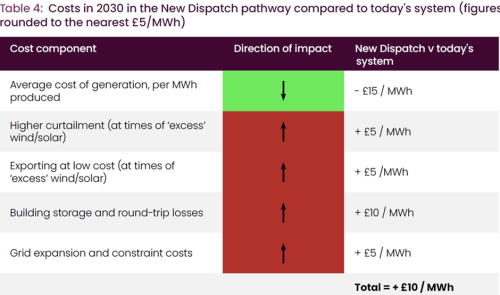
Ignore its claim that generation costs will fall – I’ll come to that next.
But it does say that all the other non-generation costs would rise by £25 per MWh, which is equivalent to a 10% increase on bills or £7.5 billion a year.
Much of this extra cost will go to constraint payments to wind and solar farms, paying them to switch off when there is too much wind and solar power on the grid.
Currently these payments only go to remote wind farms in Scotland, because the transmission capacity is not big enough there to bring all the electricity south on windy days. However, under Labour’s plan to triple wind and solar power, there will be many days when there will be more electricity generated than the country can consume as a whole.
NESO calculates that a fifth of all electricity produced will have to be either constrained or exported to the continent at a huge loss. The latter is unlikely because the Europeans will also have the same problem of too much wind.
On top of constraint payments, tens of billions will need to be spent building storage capacity and expanding the grid to bring power from Scotland and the North Sea to the parts of the country where the demand is. Ofgem has already put a cost of £80 billion on this, all of which is needed to cope with the massive expansion in renewable energy.
Returning to NESO’s claim that generation costs will fall, this was merely deceitful smoke and mirrors. It has assumed that higher carbon taxes will push up the cost of gas power, which in turn appears to make renewable energy cheaper:

.
Excluding carbon taxes, the current cost of gas power is around £50 per MWh, not the £123 per MWh it claims. Given its own admission that wind and solar costs between £71 and £83 per MWh, it is clear that generation costs will increase, not fall. (Its figure of £83 per MWh is already out of date, as Miliband has offered £117 per MWh for new offshore wind projects in the latest subsidy auction round.)
Miliband’s spokesman ignored these very real issues raised and instead commented:
Wholesale gas costs for households remain 75% higher than they were before Russia invaded Ukraine in 2022, and the main reason energy bills remain high.
The only way to bring down energy bills for good is by making Britain a clean energy superpower, which will get the UK off the rollercoaster of fossil fuel prices and onto clean, homegrown power that we control.
Gas prices are certainly 75% higher than a decade ago, but general inflation has also risen by a similar amount. In real terms, gas costs no more now than it used to. Green levies are the reason why electricity prices are so high, not the price of gas.

As Claire Coutinho neatly described in her conference speech last week, Ed Miliband wants to take out a fixed-rate mortgage at 11% interest, because he does not want a variable one at 4%!
Except that we will pay the bill, not him.
This article (Electricity Bills Will Carry On Rising Due to Net Zero, Warn Energy Bosses) was created and published by The Daily Sceptic and is republished here under “Fair Use” with attribution to the author Paul Homewood
*****
Electric bills ‘could soar 20 per cent in the next five years’, UK’s top energy supplier warns
CLAIRE ELLICOTT
Electricity prices will rise by 20 per cent within four or five years unless the Government changes course, the UK’s biggest energy supplier warned yesterday.
Rachel Fletcher, regulations director at Octopus, said the costs of Whitehall policies, including green levies to expand renewable power and nuclear, were increasing energy bills.
It comes two weeks after the energy price for a typical household rose by two per cent from £1,720 to £1,755 per year.
Appearing in front of the energy and net zero committee, Ms Fletcher said: ‘If we continue on the path we are on right now, in all likelihood electricity prices for a typical customer are going to be 20 per cent higher in four or five years’ time, and that’s even if wholesale prices halve.
‘The country as a whole at the moment is paying over £20billion a year on their electricity bills for policy costs. Now the projections are that is going to increase.’
The Mail: continue reading

••••
The Liberty Beacon Project is now expanding at a near exponential rate, and for this we are grateful and excited! But we must also be practical. For 7 years we have not asked for any donations, and have built this project with our own funds as we grew. We are now experiencing ever increasing growing pains due to the large number of websites and projects we represent. So we have just installed donation buttons on our websites and ask that you consider this when you visit them. Nothing is too small. We thank you for all your support and your considerations … (TLB)
••••
Comment Policy: As a privately owned web site, we reserve the right to remove comments that contain spam, advertising, vulgarity, threats of violence, racism, or personal/abusive attacks on other users. This also applies to trolling, the use of more than one alias, or just intentional mischief. Enforcement of this policy is at the discretion of this websites administrators. Repeat offenders may be blocked or permanently banned without prior warning.
••••
Disclaimer: TLB websites contain copyrighted material the use of which has not always been specifically authorized by the copyright owner. We are making such material available to our readers under the provisions of “fair use” in an effort to advance a better understanding of political, health, economic and social issues. The material on this site is distributed without profit to those who have expressed a prior interest in receiving it for research and educational purposes. If you wish to use copyrighted material for purposes other than “fair use” you must request permission from the copyright owner.
••••
Disclaimer: The information and opinions shared are for informational purposes only including, but not limited to, text, graphics, images and other material are not intended as medical advice or instruction. Nothing mentioned is intended to be a substitute for professional medical advice, diagnosis or treatment.
Disclaimer: The views and opinions expressed in this article are those of the author and do not necessarily reflect the official policy or position of The Liberty Beacon Project.


Leave a Reply