

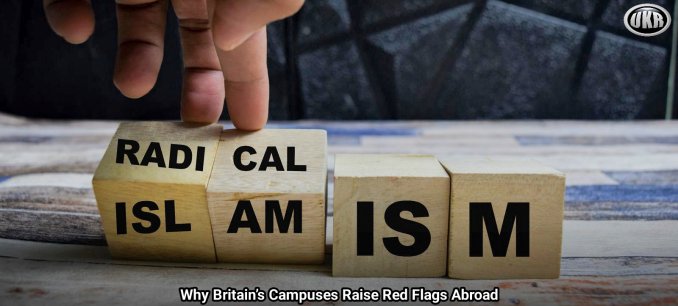
Radical Islam’s safest country isn’t in the Middle East
JOHN MAC GHLIONN
The United Arab Emirates doesn’t do half-measures when it comes to political Islam. It does not indulge euphemisms. It does not pretend that ideology dissolves when it crosses a border or dons a blazer. In Abu Dhabi, the Muslim Brotherhood is banned, branded, and broken up with administrative efficiency. Its literature is treated as toxic. Its networks are viewed as subversive. Its long game is understood for what it is: power, patiently acquired.
That is why the UAE has quietly and decisively cut state funding for students wishing to study in the United Kingdom. British universities, once a favoured destination for Emiratis, are now seen as exposure sites for dangerous ideas. The concern is not drunken undergraduates or fashionable radicalism, but Islamist incubation.
The Emirati position is blunt. They do not want their children radicalised on campus. British officials, predictably, responded with soothing talk of academic freedom. Two cultures passing in the night. One sees ideology as a weapon. The other insists it is a discussion topic.
This is where the British posture stops looking naïve and starts looking dangerous.
The Brotherhood is not banned in the UK. It is not proscribed. It is treated as a problematic debating society rather than what it has always been: a disciplined, hierarchical, mission-driven movement with an explicitly political theology. Its founder, Hassan al-Banna, was not confused about the objective. Society must be reordered. Law must submit. Faith must govern. The state comes last, after the mind is captured.
The Brotherhood has long pursued a patient, decade-spanning plan to embed itself within Western institutions, entrenching its influence inside the very systems meant to safeguard liberal democracy. The aim is not confrontation but corrosion, not revolution, but quiet replacement. It builds student groups, nurtures charities, and cultivates “community leaders”. It speaks the language of welfare, representation, and inclusion. It understands that liberal societies mistake patience for harmlessness and pluralism for neutrality. Over time, access becomes influence, influence becomes authority, and authority is exercised without ever having been formally granted.
The UAE understands something else. The Brotherhood’s brutality is not always loud, and not always explosive, but often bureaucratic. It is enforced through pressure, shame, and separation. Women coerced into conformity. Dissenters isolated. Children shaped early. A parallel moral order imposed over time.
This is why, in addition to the UAE, multiple other Muslim-majority states, including Egypt, Saudi Arabia, and Jordan have banned the Brotherhood outright. They have seen how civic engagement becomes leverage. They understand that the Brotherhood does not abandon its objectives when it enters democratic systems. Instead, it adapts its methods. The end point is not coexistence within plural societies, but authority over them. Britain’s refusal to draw the same conclusion is a refusal to learn from those who learned the hard way.
The 2015 UK government review concluded that the Brotherhood was not directly engaged in terrorism on British soil. A narrow finding, proudly clutched ever since. It ignored the more troubling evidence. Brotherhood-linked figures in Britain have openly expressed support for Hamas, refused to condemn suicide bombings, and continued to circulate the writings of Sayyid Qutb, one of the movement’s most influential ideologues. Qutb did not write poetry or theology in the abstract. He supplied a framework that sanctifies violence, divides the world into believers and enemies, and justifies savage acts in the name of moral purification.
On campuses, the picture has worsened. Islamist referrals under the Prevent programme have risen, but the numbers tell only part of the story. Student protests increasingly obliterate the line between activism and intimidation, turning lecture halls and libraries into pressure zones rather than places of learning. Jewish students are told to keep their heads down. Dissenting voices are shouted out or shut out. University administrators respond with statements about dialogue and wellbeing, while avoiding the harder task of enforcement. Everything is recast as passion, grievance, or youthful excess. Nothing is named for what it is.
The UAE watches all of this and draws its own conclusions.
The Brotherhood’s genius has always been procedural. It builds ecosystems rather than parties. Cradle-to-grave provision. Mosques with gyms. Charities with counselling services. Youth groups that teach sport and submission in the same breath. The aim is not recruitment in the crude sense, but insulation. A world within a world.
Sheikh Yusuf al-Qaradawi, the Brotherhood’s most influential cleric, once explained the goal plainly. Muslims in the West must form a small society within the larger one, lest they dissolve “like salt in water”. Britain nodded along while the subversion was declared outright.
The UAE’s scholarship ban is a damning verdict, delivered without press conferences or parliamentary theatrics. It carries a simple message: we have seen this before, and we know how it ends.
This article (WHY BRITAIN’S CAMPUSES RAISE RED FLAGS ABROAD) was created and published by Courage Media and is republished here under “Fair Use” with attribution to the author John Mac Ghlionn
Featured image: Courage Media

••••
The Liberty Beacon Project is now expanding at a near exponential rate, and for this we are grateful and excited! But we must also be practical. For 7 years we have not asked for any donations, and have built this project with our own funds as we grew. We are now experiencing ever increasing growing pains due to the large number of websites and projects we represent. So we have just installed donation buttons on our websites and ask that you consider this when you visit them. Nothing is too small. We thank you for all your support and your considerations … (TLB)
••••
Comment Policy: As a privately owned web site, we reserve the right to remove comments that contain spam, advertising, vulgarity, threats of violence, racism, or personal/abusive attacks on other users. This also applies to trolling, the use of more than one alias, or just intentional mischief. Enforcement of this policy is at the discretion of this websites administrators. Repeat offenders may be blocked or permanently banned without prior warning.
••••
Disclaimer: TLB websites contain copyrighted material the use of which has not always been specifically authorized by the copyright owner. We are making such material available to our readers under the provisions of “fair use” in an effort to advance a better understanding of political, health, economic and social issues. The material on this site is distributed without profit to those who have expressed a prior interest in receiving it for research and educational purposes. If you wish to use copyrighted material for purposes other than “fair use” you must request permission from the copyright owner.
••••
Disclaimer: The information and opinions shared are for informational purposes only including, but not limited to, text, graphics, images and other material are not intended as medical advice or instruction. Nothing mentioned is intended to be a substitute for professional medical advice, diagnosis or treatment.
Disclaimer: The views and opinions expressed in this article are those of the author and do not necessarily reflect the official policy or position of The Liberty Beacon Project.


Leave a Reply