

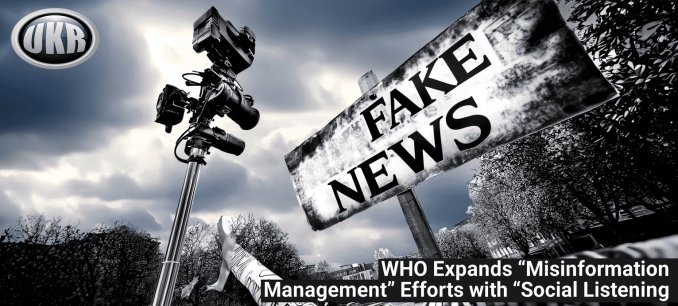
Social listening strategies and tailored misinformation frameworks aim to shape public narratives across 17 island nations.
DIDI RANKOVIC
The UN’s World Health Organization (WHO) is not the only entity engaging globally (the Gates Foundation comes to mind as another) that likes to turn to developing, or small and often functionally dependent states to “test” or “check” some of the key elements of its policies.
The pandemic put the WHO center-stage, and in many ways influenced the UN’s clear change of trajectory from its true purpose to assisting governments globally in policing speech and surveilling their populations.
The WHO is comfortable in conflating health-focused issues (its actual mandate), with what it presents as threats linked to “disinformation” and “AI.”
And it even worries that “health misinformation” is what is eroding public trust in “governmental bodies, media, health professionals and more generally the health sector, academic institutions, and the wider scientific community” – in other words, the entrenched elites, or elites who believe they need to remain entrenched at any cost.
All of this, is to promote the claim that the pandemic was a useful tool (“a catalyst”) that improved “misinformation management” – in the Pacific. Specifically, 17 island states, including Fiji and Tonga, were picked for the WHO’s “needs assessment,” carried out in November 2023.
We have an addition to the mis/dis/malinformation narrative – rumors. That’s another thing the WHO now looks to “manage” and the organization says the Pacific states – where it essentially went to learn how the pandemic influenced the authorities’ treatment of public discourse – identified this as one of their “top priorities” for this year.
Apparently understanding the results of its own “needs assessment” as a signal to go ahead and “build capacity” in these island states, the WHO reveals that this includes something called “enhancing social listening.”
It might sound like bureaucratic gibberish, but the WHO actually gives insight into what it’s about – analyzing conversations and narratives to understand public perceptions and concerns.
To what end? To “address” health misinformation and disinformation, the way this UN agency chooses to define them. And to implement its policies, the WHO has come up with a platform called “OpenWHO” (it seems no branding, especially of potentially controversial things, is these days complete without adding the word “open” to the name).
The WHO’s platform consists of “a range of tools, frameworks, training, and other resources” for combating misinformation, and here, it has been “further modified to the Pacific context.”
This article (WHO Expands “Misinformation Management” Efforts with “Social Listening”) was created and published by Reclaim The Net and is republished here under “Fair Use” with attribution to the author Didi Rankovic

••••
The Liberty Beacon Project is now expanding at a near exponential rate, and for this we are grateful and excited! But we must also be practical. For 7 years we have not asked for any donations, and have built this project with our own funds as we grew. We are now experiencing ever increasing growing pains due to the large number of websites and projects we represent. So we have just installed donation buttons on our websites and ask that you consider this when you visit them. Nothing is too small. We thank you for all your support and your considerations … (TLB)
••••
Comment Policy: As a privately owned web site, we reserve the right to remove comments that contain spam, advertising, vulgarity, threats of violence, racism, or personal/abusive attacks on other users. This also applies to trolling, the use of more than one alias, or just intentional mischief. Enforcement of this policy is at the discretion of this websites administrators. Repeat offenders may be blocked or permanently banned without prior warning.
••••
Disclaimer: TLB websites contain copyrighted material the use of which has not always been specifically authorized by the copyright owner. We are making such material available to our readers under the provisions of “fair use” in an effort to advance a better understanding of political, health, economic and social issues. The material on this site is distributed without profit to those who have expressed a prior interest in receiving it for research and educational purposes. If you wish to use copyrighted material for purposes other than “fair use” you must request permission from the copyright owner.
••••
Disclaimer: The information and opinions shared are for informational purposes only including, but not limited to, text, graphics, images and other material are not intended as medical advice or instruction. Nothing mentioned is intended to be a substitute for professional medical advice, diagnosis or treatment.
Disclaimer: The views and opinions expressed in this article are those of the author and do not necessarily reflect the official policy or position of The Liberty Beacon Project.


Leave a Reply