

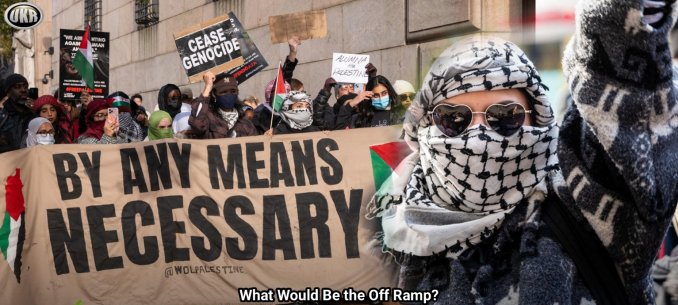
In terms of defusing Civil War
JUPPLANDIA
In both the UK and the US as political violence has increased so too has talk of Civil War. In June this year one of the world’s leading academic authorities on civil war conflicts and how they originate stated that Britain was showing all the classic symptoms of a country descending into Civil War, but it was a description of symptoms that could equally be applied across much of the Western World:
“David Betz, Professor of War in the Modern World at King’s College London, has warned that the UK is at risk of descending into civil war within the next five years due to a breakdown in law and order and the government’s perceived inability to manage multicultural societies peacefully. He identifies factors such as mass immigration, a two-tier justice system, and wasteful spending as contributing to societal instability, with urban areas being particularly vulnerable due to their dependence on external supplies. Betz has specifically stated that Britain and France are among the countries most likely to experience violent civil conflict, with the potential for such conflict to spread to other parts of Europe and the United States. He also notes that if civil war breaks out in one country, there is a 60% to 72% chance it could spread to others, and the median length of such conflicts is six years.”
On the surface such terrifying predictions seem exaggerated. As bad as things are, we look around and see a large amount of normality. In Western European nations, for instance, many people can still go about their daily lives relatively safely. Your chances of being killed by a terrorist are very remote. Tourist areas in big cities are often still places you can visit without being mugged, shot at, or harmed. You can do normal things. You can take your kids out to parks, or you can get some kind of service from the State. Schools and hospitals might not be brilliant, but they are functioning. Talk of Civil War seems crazy when you are actually worrying about the traffic getting to work, or the hole your kid has put in his trousers playing football at break time. It’s mad stuff, because this weekend we went to a playground and got ice cream cones, or last night we tuned into that series we have been waiting for, or today we chatted with Steve from Accounts about the football scores.
The sun is shining. Blockbuster movies are bombing, but you’ve never seen a bombing in real life. Civil War? Really?
There are however a few things that make this sense of normality false. First, the experience of normality itself engrains a false psychological effect, a normalcy bias, which attunes us all to assuming that normality now means normality tomorrow. When civil society collapses into internal war, it doesn’t do it out of nowhere. It builds to that moment slowly, while all of us are still thinking things are normal. And sometimes we might notice increasing crime or increasing authoritarianism, for example (two sides of the same coin of approaching disaster) but still assume these things are going to get sorted out in a peaceful way.
Second, there are the responses that are taken to the building crisis, and whether they are wise or whether they will speed us towards destruction. If the siruation is building towards Civil War, with most people never thinking that’s possible, there are key moments and key choices to make that can defuse the tension and preserve normality, or that increase the tension and trigger the final collapse. It really is a moment where you need good judgement from leadership, but really from an entire ruling class, which includes your opinion formers in media and entertainment as well as your directly political leaders.
Oh shit.
Think of the western world’s leaders, and think of the western world’s journalists, news anchors, and opinion influencing celebrities. Are these people going to be the kind of people likely to spot an approaching Civil War, and then likely to be wise enough to make the choices needed to avoid a Civil War?
The authorities need to balance strength and justice. As hatred and division grows they will have people making it clear that they support violence, are prepared to use violence, and will break the law or celebrate and support those breaking the law. That has to be contained and limited, which requires various forms of force. But apply the force unjustly, unevenly, excessively or clumsily, and you speed the disintegration of the legitimacy of your own authority and build a sense that the existing State and government can’t be trusted and must be removed, increasingly by any means possible.
Be too weak and the conditions of Civil War grow as malign and violent groups expand into the space you’ve offered them. Be too authoritarian and the conditions of Civil War also grow because more people will consider you unjust and be increasingly radicalised against you. Damned if you do, damned if you don’t.
In Third World situations it’s generally been the case that the only ‘solution’ to sectarian, divided societies composed of groups that hate each other is a leadership that combines a lot of authoritarian brutality with a certain degree of competence. Strong man dictatorships have been the answer holding back civil war, anarchy and chaos…until a large scale rebellion both comes and succeeds. Many of these dictatorships were sustained by external support, and then destroyed by external support of their internal enemies. Saddam Hussein could crush opposition and stay in power indefinitely, even following disasters like the Iran-Iraq War, until external enemies defeated and humiliated him (particularly the US going from partial sponsor to outright invader). Assad could balance groups that hated each other in Syria with external Russian support and survive and be winning against a rebellion until that support was withdrawn. Gaddafi’s regime was pretty successful and secure until external forces again heavily backed an internal uprising.
It’s Third World nations, of course, where we expect Civil Wars to happen. Part of our western normalcy bias is the idea that these things and that kind of instability only happen in South America or Africa or the Middle East, and not in the USA or the UK, in France or in Germany. Certain nations have a more developed and engrained normalcy bias due to having had a longer history of political stability. It is 374 years since the last time England had a Civil War, and despite mainland IRA bombings and the Troubles in Northern Ireland that conflict, for most mainland Brits, imported no sense of fundamental crisis and no great impact on their own lives.
I was at the site of a place subjected to an IRA bombing in London a week before it happened and I was already following politics as a geeky 10 year old when the Brighton bombing in 1984 occurred. In 1985 when I was just 11 we had the Brixton riots and a werk later the Broadwater Farm race riot in London, where PC Blakelock was hacked to death by an Afro-Caribbean mob wielding machetes. I was a child of the Thatcher years and a young adult of the Major years. We had the IRA actions and we had a huge amount of leftwing hate and demonisation directed at Thatcher. Major was embroiled in sleaze and scandal. But I can honestly say through my childhood and into my 20s and 30s I had no sense at all at any point that London was dangerous, that Britain was dangerous, or that Civil War was possible in mainland Britain, because even the most extreme things that happened were incredibly rare and not building in intensity or reflective of very widespread attitudes.
Crucially, back then, there was always the expectation that the authorities were not the extremists, that the majority of people were horrified by extreme violence, and that people who supported extreme violence were political outriders and outsiders. People like Jeremy Corbyn existed, but were fringe and would never be considered as potential party leaders. Under Kinnock and in response to Thatcher’s multiple election victories the political Left began policing itself, expelling Militant. In the same Thatcher-Major period (and for some time after) in the US Democrats didn’t sell themselves as extreme radicals, but as moderates with a social conscience. And some of the things that turn Democrats today into angry psychotics, were things Democrats advocated and did (both Bill Clinton and Barack Obama delivered speeches on borders and immigration that, if Trump delivered them word for word today, Bill Clinton and Barack Obama would in 2025 call hate filled, divisive, xenophobic, racist and reminiscent of Adolf Hitler).
Both Blair and Obama, who are in fact very similar figures, had to sell themselves as moderates and outwardly pretend to have been fundamentally opposed to leftwing extremism in order to become the leaders of electable leftwing parties. But the reality, of course, is that they were presentationally opposed to leftwing extremism. They knew they wouldn’t get elected as obvious firebrands and obvious neo-Marxists, and they knew that they had to court Business, Finance and money too. So they spoke about hope, change and positivity. They used soft words and superficial charm. Blair finished Kinnock’s internal war against Labour Militant (what one might call the honest Marxists). He rebranded as New Labour, which was business friendly and didn’t sing Communist slogans anymore. Similarly Obama was supposed to be the first black President in a moderate, unifying way, a healing of old racial divisions, all delivered by a guy who came across like an amiable lounge singer and shared Blair’s hunger for corporate allied self-enrichment, presented as general economic moderation.
Presenting as economic moderates modernised leftism and seemed to self exclude the worst elements, while also serving Party and personal interests by attracting corporations, magnates and sponsors from the billionaire class. But really Blair and Obama delivered the most radical lurches to the Hard Left on social policy and State expansion ever seen. By wearing moderate clothes they achieved more destruction and social engineering and normalisation of extremism than any obvious radical or Marxist ever had. Because these men were Cultural Marxists in business suits and part of the capture of respectability and the mainstream by leftist extremism. Their personal greed and ease with Business was really an accommodation whereby Business was told the State will facilitate your short term profit if you facilitate our long term leftist social programming. You get Big Contracts with a Big State, we get the Big State itself and our ideology pushed by every company.
A genuinely fascist alliance, which would as part of its disguise of itself mirror what a Blair or Obama did personally. Present as moderate, respectable, positive, hopeful and ‘centrist’, while injecting radical left ideas on race, gender, family, sexuality, who the government serves and what people should consider normal, into everything.
This was a deal done BEFORE BlackRock was strong arming thousands of companies to follow extremist DEI race hiring practices and to enforce globalist-leftist ESG policies but explains, just as much as BlackRock’s influence, why every company went mad keen on every progressive ideological position you can think of, and why both the US Constitution and Britain’s traditional unwritten constitution of norms failed so spectacularly to stop the western world becoming the kind of place where a Charlie Kirk is assassinated and hundreds of thousands if not millions of people are happy about it.
Betz in his analysis says he is confused by the way the scholarship on Civil War has identified things that cause it, and that current western governments are well aware of those causal factors and acknowledge them in relation to Third World scenarios but refuse to acknowledge them in First World contexts. Everyone knows that sectarianism and very different and opposed ethnic and religious groups being present in the same place makes civil war more likely. Everyone knows that an increase in demonising rhetoric precedes a Civil War, especially when focused on specific races or groups. Everyone knows that if majorities suddenly shrink or populations suddenly increase, or both, these create internal conflicts for social dominance and priority. Everyone knows that political corruption builds resentment. Everyone knows that tyrannical measures against innocent individuals or groups destroy trust in government, and that high trust means Civil War is unlikely and low trust means it is more likely. Everyone knows that forcing very unpopular policies, and then cracking down hard on dissent rather than changing the policy, builds protest. Everyone knows that legal injustices and double standards that clearly mistreat many while favouring others are going to increase alienation and radicalisation. Everyone knows that the failure of instirutions to be either fair or competent and the failure of government to do basic things well especially in terms of policing and justice but also in terms of economic management, is disastrous.
So Betz is left wondering why, when he has advised them and told them what creates Civil War, western leaders and strategists first agree with his analysis and then do everything he has explained makes Civil War more likely.
Here we have to go back to a few prior points. We have to look at the normalcy bias again. And do it not in terms of Third World nations that have always been hellholes, and not even in terms of ones that had a strong dictator keeping a lid on chaos who is then suddenly weakened or removed. It’s more analogous for the fear we need to have about Civil War in the West to think of nations that were outside the West but seemed very normal, very successful, very safe until a sudden Revolution or a sudden big change or a sudden new leader making very radical changes altered everything. If you were in Venezuela, for instance, in the 1970s things would have seemed both normal and good:
“Venezuela was once one of the wealthiest nations in Latin America and a relatively stable democracy, a status it maintained since 1958 following the end of a military dictatorship. The country’s prosperity was largely fueled by its vast oil reserves, which made it a major global exporter and allowed for significant economic growth, particularly during periods of high oil prices. By the 1970s, Venezuela’s per-capita GDP had soared, and it was considered one of the richest countries in the world. The nation’s stability was underpinned by a political system established through the Punto Fijo Pact, which ensured power-sharing among major parties and upheld democratic elections.
However, this prosperity began to unravel due to a combination of factors. The collapse of oil prices in the 1980s led to a severe economic crisis, forcing the government to accept an International Monetary Fund bailout and implement austerity measures that sparked violent protests in 1989. This event marked a turning point, eroding public trust in the established political system. The subsequent rise of Hugo Chávez in 1998, who capitalized on widespread discontent, shifted the country’s trajectory. While Chávez’s social programs initially reduced poverty by redirecting oil profits, they also increased the nation’s dependence on oil revenues and led to significant mismanagement and corruption. His policies, including the firing of skilled PDVSA employees and the nationalization of industries, damaged the country’s economic infrastructure. The situation worsened after Chávez’s death in 2013, as his successor, Nicolás Maduro, faced a collapsing economy, hyperinflation, and severe shortages of food and medicine, exacerbated by U.S. sanctions and continued economic mismanagement.”
We have also of course all seen images of life under the Shah before the Iranian Revolution of 1979, compared to life in Iran today:

To see Iranian life just prior to the Revolution is to see a westernised, apparently ordered and ordinary world where modernity and normal life is occuring in ways that suggest no hint of approaching disaster:
“Life in Iran before the 1979 revolution was characterized by significant modernization and social change under the rule of Shah Mohammad Reza Pahlavi, but it was also marked by deep social divisions and political repression. The Shah pursued a policy of Western-oriented secular modernization, which led to expanded educational opportunities, economic growth, and greater freedoms for many, particularly in urban centers like Tehran.Women’s rights were notably advanced; they gained the right to vote in the mid-1960s, were encouraged to pursue education and careers, and were allowed to mix freely with men. The hijab was banned, and Western-style clothing became common, especially among the middle and upper classes. Public life included Western-style fashion, social events like picnics, and even mixed-sex gatherings….the middle class grew significantly due to economic expansion and educational reforms…”
But of course the Shah was hated for that modernisation by religious elements, used force to remain in power, and crucially lost key external support when Jimmy Carter decided not to back the Shah when the Revolution came (US Ambassador William H.Sullivan warned that backing the Shah would endanger US interests in Iran, which given Iranian attitudes to the US ever since has to rate as one of the worst pieces of diplomatic advice from an ambassador to his nation in history. France also sheltered the Ayatollah and treated him as some kind of celebrity in exile before his return to Iran).
In the case of the Shah it’s often framed that his autocratic rule caused his fall, but really without the West sheltering his internal greatest opponent and then letting that person return AND failing to show strong support as the crisis developed, the outcome might have been different. But these are examples of the difficulty of balancing strength and justice in a siruation where radical groups determined on revolution already exist.
Now, the West has to think about these things at home. Seriously. Even though the world outside our windows still looks pretty normal, because in many ways it isn’t. All of the things we think are normal could be like those images of Iranians in bikinis. They were going to the beach and eating ice creams too. They were having picnics. And this is always the way with both Civil Wars and Revolutions. Things are normal, until suddenly they aren’t. Inbetween, there’s maybe a small window where people are acting as if everything is normal, pretending everything is normal, and where the chance to keep it normal is dying through that pretence.
The murder of Charlie Kirk and the psychopathic glee in response to it from thousands of Democrat voters is a wake up call. Just like leftist support for the Palestinians (in other words, for the most barbaric Islamic atrocities against peaceful Israeli’s) is a wake up call. Exactly as the assassination attempts on Trump were a wake up call. And it’s a wake up call for the whole western world too because in Britain for example we also have thousands of people who share that gleefully murderous fanaticism. Here, as an example, is the nominally British band Bob Vylan:
“The English group, who rose to attention this summer after they called for ‘Death to the IDF’ during their performance at Glastonbury on live TV, made the incendiary remarks at a gig in the Netherlands.
The frontman Bobby Vylan, real name Pascal Robinson-Foster, told the crowd: ‘I want to dedicate this next one to an absolute piece of s*** of a human being.’
He then gleefully announced: ‘The pronouns was/were. Because if you talk s***, you will get banged. Rest in peace Charlie Kirk, you piece of s***.’
It comes only days after Mr Kirk, the chief executive and co-founder of the conservative youth organisation Turning Point USA, was brutally shot dead at an Utah college event.”
Pascal Robinson-Fraser also instructed people to attack and kill “Nazis” and “Zionists”, in a typically moronic display of modern leftist confusion on what Nazis (who hated Jews) and Zionists (who want Jews to have the safery of a homeland) are.
Many will say this is just a few attention seeking creeps, as they do when the band Kneecap do their cosplaying terrorist supporters act. But many thousands of people agree with them online, and thousands attend their concerts, and mere outrage in response delights them.
Thousands, potentially millions, of Democrat voters have the same hatred, the same fanaticism, the same self blind agreement with political murders of those who think differently to them, that Iranian students backing the Ayatollah’s Revolution had. Thousands, potentially millions, of leftists and Muslims in the UK, France, Germany have the exact same attitudes. But it’s worse even than that.
We aren’t just talking about virtue signalling celebrities wearing bloody hand Palestinian symbols endorsing mobs who ripped Israeli’s apart with their bare hands. We aren’t just talking about controversy chasing shit bands who get off on backing terrorists. We aren’t just talking about a few trans shooters or a few deluded fringe politicians who never get close to leadership.
First, what’s the substantive moral difference between those leftist students and Islamic revolutionaries who sign up to groups like Al Qaeda or ISIS? There isn’t one. There’s no more moral understanding or sane limit in kids cheering on terrorists and cheering on bands who support terrorists than there is in the terrorists themselves. Second, what’s the real substantive moral difference between Democrat or Labour respectable celebrities and respectable leaders now and those savage bloodlust students? There isn’t one.
David Lammy, the current British Secretary of State for Justice, the current British Deputy Prime Minister and the former Foreign Secretary, has in the past called Turning Point UK a “sinister force taking over the country”. He called Kirk and his Turning Point colleagues people who share “hard Right xenophobic bile”. He accused mainstream Conservatives of being Hard Right. He described Donald Trump as a:
“….woman-hating, neo-Nazi-sympathising sociopath” and a “tyrant in a toupee,” adding that Trump was a “profound threat to the international order that has been the foundation of Western progress for so long”. He also referred to Trump as a “racist KKK and Nazi sympathiser” during his first year in office.”:
This is the rhetoric that those celebrating Kirk’s murder believe. This is what Biden did in constantly describing Trump as akin to Hitler, and what Robert Reich did, and what Kamala did, and what Nancy Pelosi did, and what pretty much every single Democrat leader and commenter has done together with British and European leaders of mainstream parties. It’s what thousands of articles have been pushing for 10 years and I defy you to show me a significant difference between this respectable hate and terrorist thinking.
Turning Point UK nailed this when Keir Starmer offered crocodile tear condolences on Charlie Kirk’s death:
“Charlie Kirk is dead because Left-wing politicians like Lammy demonised and misrepresented political opponents and turned them into bogeymen that extremists view as legitimate targets.
‘It’s too late for Charlie, but the rhetoric in our politics must change before more are murdered.’
The language your party and the wider Left uses to describe people like Charlie and us is why we face this violence.”
That is all true, and it’s talking about our British Justice Minister.
Our government is stuffed full of leftist extremists, just like a concert hall where Kneecap or Bob Vylan are playing. They believe the same things. They use the same rhetoric. The only real difference is they imply ‘you should kill this person’ rather than outright stating it.
The mentality of the lunstics amongst us was built by the mainstream, by the mainstream becoming extreme, BEFORE it was spread by Dark Web chat groups. It was mainstream parties of the Left doing it from Obama onwards, which brings us back to that earlier point about how Obama and Blair sold themselves as moderates but actually represented a much more radicalised leftist takeover than the UK or US had ever seen before them.
They normalised treating EVERYONE on the Right or outside their parties as Far Right and worthy of death. Keir Starmer is still doing it about peaceful protest marches or about hanging up an England flag. Tony Blair gave a keynote speech about the “dark forces of Conservatism” in 1999, long before Biden was calling Trump a “threat to Democracy”.
And Blair’s right hand man, who once terrorised ministers into line, who was the hard man ex Mirror journalist responsible for the dodgy dossier that lied Britain into the Iraq War and hundreds of thousands of dead Iraqi’s? He’s still going strong with the same stuff too.
Alastair Campbell, like Stephen King, shared a post claiming that Charlie Kirk believed in stoning gays to death. An obvious lie. An obvious demonisation. An obvious repetition of the rhetoric that inspired Kirk’s murder, as Campbell’s first response to that murder.
Because for nearly 30 years the ‘respectable Left’ has actually been the extremist Left, in nicer suits.
How to avoid a Civil War? Well admitting that would be a start. Stand up, apologise, say that for years and years you have been saying things about the Right that are lies and that lead to murder and violence and that you are ashamed of yourselves. Admit that you have been a sliver away from terrorists, extremists and shooters on campus, and that you normalised treating every rightwing view and every rightwing person as subhuman. Admit that the vast majority of people you have labelled Far Right are nothing of the sort, stop doing it, and join with the Right in limiting free speech restrictions, hate crimes, prosecutions and legal action to the people who are actually killing others and the people actually calling for murder.
Which means, almost entirely, to the Left and to Islam. Very few people on the Right have ever called for murder or backed terrorist groups. Lots of people on the Left have, including at the highest levels of government.
This article (What Would Be the Off Ramp?) was created and published by Jupplandia and is republished here under “Fair Use”

••••
The Liberty Beacon Project is now expanding at a near exponential rate, and for this we are grateful and excited! But we must also be practical. For 7 years we have not asked for any donations, and have built this project with our own funds as we grew. We are now experiencing ever increasing growing pains due to the large number of websites and projects we represent. So we have just installed donation buttons on our websites and ask that you consider this when you visit them. Nothing is too small. We thank you for all your support and your considerations … (TLB)
••••
Comment Policy: As a privately owned web site, we reserve the right to remove comments that contain spam, advertising, vulgarity, threats of violence, racism, or personal/abusive attacks on other users. This also applies to trolling, the use of more than one alias, or just intentional mischief. Enforcement of this policy is at the discretion of this websites administrators. Repeat offenders may be blocked or permanently banned without prior warning.
••••
Disclaimer: TLB websites contain copyrighted material the use of which has not always been specifically authorized by the copyright owner. We are making such material available to our readers under the provisions of “fair use” in an effort to advance a better understanding of political, health, economic and social issues. The material on this site is distributed without profit to those who have expressed a prior interest in receiving it for research and educational purposes. If you wish to use copyrighted material for purposes other than “fair use” you must request permission from the copyright owner.
••••
Disclaimer: The information and opinions shared are for informational purposes only including, but not limited to, text, graphics, images and other material are not intended as medical advice or instruction. Nothing mentioned is intended to be a substitute for professional medical advice, diagnosis or treatment.
Disclaimer: The views and opinions expressed in this article are those of the author and do not necessarily reflect the official policy or position of The Liberty Beacon Project.


Leave a Reply