

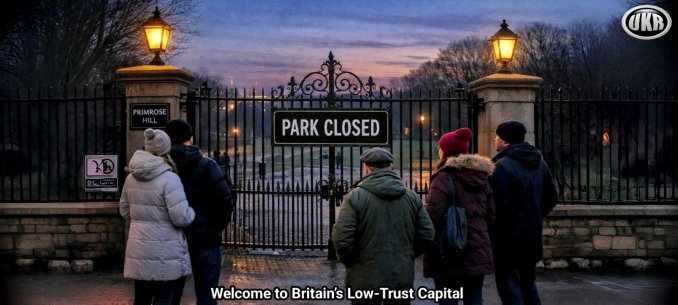
Welcome to Britain’s low-trust capital
TALI FRASER
I took a trip to Primrose Hill yesterday, where one of London’s best parks and view points was still surrounded by two tiers of metal perimeter fencing – all erected with the sole purpose of keeping the public out on New Year’s Eve, at least yesterday there were gaps to let you go for a walk.
The move to block the park off – announced on X the day before – did not turn into a riot or a dramatic confrontation, but remained something more revealing: the quiet withdrawal of public life. Families with their sparklers, students with their flasks, couples hoping to share the panoramic view – all had to change their plans. One of the top free spots to watch the capital’s fireworks displays, where 30,000 people celebrated in 2024, was locked off.
The reaction was confused rather than furious. Crowds ended up gathering in Primrose Hill, just on the road next to the park.
It has been a bit of a blame game when it comes to reasoning. The Royal Parks charity, which manages Primrose Hill, previously said that the capacity to manage crowds of the size usually watching the fireworks event would be “severely diminished” in part due to the closure of The Metropolitan Police’s Royal Parks Operational Command Unit. But a spokesperson for the Met says: “It is not accurate to suggest the decision was necessary as a result of the disbanding of the Royal Parks policing team.”
The best and safest city in the world, hey? Where crowds can’t gather at a popular spot to ring in the New Year. The tax payer is prohibited from using a public space they pay for, to view a display they pay for.
Whatever it may be, the results are the same; closures are not neutral acts, especially when it comes to constraining the public’s choices. It is a sign of the levels of trust in society, and we seem, in London especially, to be running short of it.
For years, Primrose Hill on New Year’s Eve had been what should be a normal expression of spontaneous civic life. No tickets. No wristbands. Londoners gathering, standing together, counting down to midnight. That such a gathering now is readily blocked reflects a capital that no longer trusts its citizens to take part in that spontaneous civic life.
This matters because Britain is sliding into a low-trust society. The Edelman Trust Barometer shows the UK has one of the largest trust gaps in the world between high and low-income respondents. That erosion has consequences. In low-trust societies, people stop assuming good behaviour will be reciprocated. Antisocial behaviour becomes commonplace. Citizens retreat rather than intervene and norms of politeness weaken.
London increasingly fits that pattern. Violent crime may be down, but antisocial behaviour is rising. Shoplifting in the capital jumped by 54 per cent last year. Snatching from pedestrians is at its highest level since 2003, mainly phones now. Trains are vandalised faster than Transport for London can clean them. Most people no longer feel comfortable asking a fellow passenger to turn down loud music. The shared assumptions that once made public life tolerable are fraying.
In such an environment, functions of the state step in as its shepherd. More barriers. More wardens. More closures. As Alexis de Tocqueville warned of the overbearing state: “It does not tyrannise, it hinders, it represses, it enervates, it extinguishes, it stupefies, and finally it reduces each nation to being nothing more than a flock of timid and industrious animals, of which the government is the shepherd.” The public square quietly managed out of existence.
This is the real danger of a low-trust society. Like the sociologist Robert Nisbet argued, when people believe community has been lost “there will be a conscious quest for community in the form of association that seems to promise the greatest moral refuge”. It is not the greatest leap to draw a line from declining trust to rising polarisation. When common spaces disappear, so does common identity.
But this is not inevitable, nor does it have to continue. We can accept a future in which New Year’s Eve is something watched on a screen while parks sit empty behind fences. Or we can take the erosion of trust and community seriously.
The state must be firmer in enforcing basic standards of behaviour, so that decent people are not the ones forced to withdraw. Communities must be supported in reasserting these norms. We must be less embarrassed about making an effort to promote a shared civic culture in public life.
Otherwise, we will continue down the path Tocqueville warned.
At midnight, fireworks still burst above London, but Primrose Hill stood dark and empty. A functioning city can’t celebrate like that.

••••
The Liberty Beacon Project is now expanding at a near exponential rate, and for this we are grateful and excited! But we must also be practical. For 7 years we have not asked for any donations, and have built this project with our own funds as we grew. We are now experiencing ever increasing growing pains due to the large number of websites and projects we represent. So we have just installed donation buttons on our websites and ask that you consider this when you visit them. Nothing is too small. We thank you for all your support and your considerations … (TLB)
••••
Comment Policy: As a privately owned web site, we reserve the right to remove comments that contain spam, advertising, vulgarity, threats of violence, racism, or personal/abusive attacks on other users. This also applies to trolling, the use of more than one alias, or just intentional mischief. Enforcement of this policy is at the discretion of this websites administrators. Repeat offenders may be blocked or permanently banned without prior warning.
••••
Disclaimer: TLB websites contain copyrighted material the use of which has not always been specifically authorized by the copyright owner. We are making such material available to our readers under the provisions of “fair use” in an effort to advance a better understanding of political, health, economic and social issues. The material on this site is distributed without profit to those who have expressed a prior interest in receiving it for research and educational purposes. If you wish to use copyrighted material for purposes other than “fair use” you must request permission from the copyright owner.
••••
Disclaimer: The information and opinions shared are for informational purposes only including, but not limited to, text, graphics, images and other material are not intended as medical advice or instruction. Nothing mentioned is intended to be a substitute for professional medical advice, diagnosis or treatment.
Disclaimer: The views and opinions expressed in this article are those of the author and do not necessarily reflect the official policy or position of The Liberty Beacon Project.


Leave a Reply