

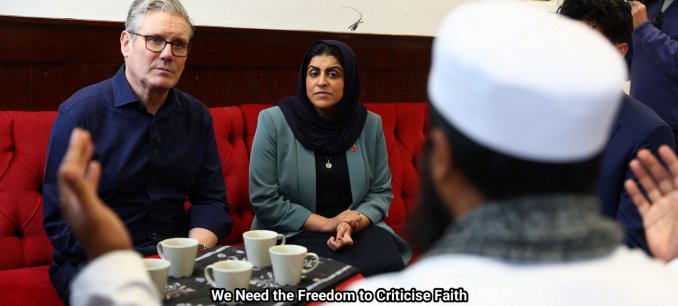
We need the freedom to criticise faith
The government’s “anti-Muslim hostility” definition is still a problem for free speech
HARDEEP SINGH
Last week, the BBC revealed a draft version of new definition of “anti-Muslim hostility” devised by the Islamophobia/anti-Muslim hatred Working Group. In its final form, it will replace the now shelved all-party-parliamentary (APPG) definition of “Islamophobia” (2018) adopted by Labour, many Labour led councils and unsurprisingly, The Mayor of London.
I don’t much like the word “phobia” attached to any given word, because I don’t think it is appropriate to attach a mental health diagnosis to opinions. The problem is the new draft “anti-Musim hostility” definition, although an improvement on the flawed APPG one (significantly it sheds the nonsensical subjective term “Islamophobia) still risks censoring free speech, or at least make people think twice before discussing issues of significant public concern, like terrorism, misogyny and “grooming gangs”. The existing legal framework in England and Wales provides equal protection for all faiths; therefore, establishing a special Working Group dedicated solely to one group perpetuates a two-tier policy approach (a concern I’ve previously highlighted in The Critic).
One of the problems is the introduction of the word “hostility”. Like, “Islamophobia” or “Muslimness” (from the APPG definition), it is extremely vague. When it comes to “hate crime”, the Crown Prosecution Service (CPS) concedes that “hostility” is not defined in law, so is interpreted via its ordinary meaning, which includes: “ill-will, spite, contempt, prejudice, unfriendliness, antagonism, resentment, and dislike”. In effect this is simply replacing words open to subjective interpretation, with other words also open to subjective interpretation. Defining “anti-Muslim discrimination” would have made much more sense. Perhaps, even the way someone says “hello” could be interpreted as “unfriendly”? Or uncompromising objection to halal slaughter considered “antagonism”? As the National Secular Society (NSS) have warned, “the adoption of any new definition – however benign it appears on its face – risks enforcing a ‘two-tier’ narrative, damaging community cohesion and entrenching grievance-based politics…”
Another problem is the sneaky introduction of the term “racialisation” into the mix. A particularly problematic sentence in the draft definition reads: “the prejudicial stereotyping and racialisation of Muslims … to stir up hatred against them”. Last time I checked, Islam is not made up of a single race, but adherents from every race possibly imaginable. So, this is yet another attempt to ascribe a race onto belief. Interchanging an immutable characteristic with a mutable one does not work.
Last year, the government wrote to the Network of Sikh Organisations, confirming that the APPG definition does “not fit” with the existing legal framework, primarily because of its conflation of race with religion. “Islamophobia”, it asserted, was a “type of racism”. The new term “racialisation” falls foul here too, because The Equality Act 2010 defines race in terms of colour, nationality and national or ethnic origins — not religiosity. Moreover, as the Free Speech Union’s (FSU) Lord Toby Young points out, “prejudicial stereotyping”, as a form of anti-Muslim hatred, “could inhibit a social worker or school teacher in a Muslim area from drawing attention to child sexual exploitation, not to mention female genital mutilation or forced marriages.” The statement “Muslim men are permitted to have polygamous marriages”, although true, could get you in trouble with your employer — or, worse still, the police — as “prejudicial stereotyping”.
Like it or not, a de-facto blasphemy law is already in existence
The government is due to publish their final definition imminently — they have held off because of the antisemitic jihadist attack in Sydney. Although any new definition will be non-statutory, it will still be used as a yardstick by councils, universities, employers and more significantly the police, in deciding whether you are guilty of committing a hate crime, or a non-crime hate incident. A Boston councillor was denied the Mayoralty for Facebook posts during the Qatar football World Cup, in which he criticised Islamic doctrine with reference to criminalising homosexuality and restricting women’s rights. He was accused of “hateful speech” towards Muslims, so you can see where all of this could be heading, and why we should be fearful of a blasphemy code of sorts. We already have protestors burning the Koran being arrested under the Public Order Act 1986, and a teacher remains in hiding for showing a cartoon — so, like it or not, a de-facto blasphemy law is already in existence.
Unsurprisingly, Muslim activist groups, like Muslim Engagement and Development have expressed their “red line” insofar as they want a definition to recognise, “a distinct form of racialised discrimination”. The Muslim Council of Britain are unhappy too — but it’s actually hard to disagree with them when they request transparency and the Working Group’s recommendations to be published. Indeed, the group has been secretive. Remarkably, their remit was to “provide private advice by internal consideration by ministers only”. The government said that “the work of the Group will not be made public”.
Some politicians have pushed back. Over the summer, Claire Coutinho MP, Shadow Energy Secretary, ensured the public had their say in the Working Group consultation, which was initially only shared with select stakeholders. Nick Timothy MP, who has bravely put his head above the parapet on several thorny issues, including this, has pointed to a particular Hadith which some extremists like IS, would use to justify violence. Of course, not all scholars, or practitioners would unanimously agree on meaning and (or) authenticity of such verses. However, the point is we must be free to discuss them — without being accused of “stereotyping” or “racialising” Muslims.

••••
The Liberty Beacon Project is now expanding at a near exponential rate, and for this we are grateful and excited! But we must also be practical. For 7 years we have not asked for any donations, and have built this project with our own funds as we grew. We are now experiencing ever increasing growing pains due to the large number of websites and projects we represent. So we have just installed donation buttons on our websites and ask that you consider this when you visit them. Nothing is too small. We thank you for all your support and your considerations … (TLB)
••••
Comment Policy: As a privately owned web site, we reserve the right to remove comments that contain spam, advertising, vulgarity, threats of violence, racism, or personal/abusive attacks on other users. This also applies to trolling, the use of more than one alias, or just intentional mischief. Enforcement of this policy is at the discretion of this websites administrators. Repeat offenders may be blocked or permanently banned without prior warning.
••••
Disclaimer: TLB websites contain copyrighted material the use of which has not always been specifically authorized by the copyright owner. We are making such material available to our readers under the provisions of “fair use” in an effort to advance a better understanding of political, health, economic and social issues. The material on this site is distributed without profit to those who have expressed a prior interest in receiving it for research and educational purposes. If you wish to use copyrighted material for purposes other than “fair use” you must request permission from the copyright owner.
••••
Disclaimer: The information and opinions shared are for informational purposes only including, but not limited to, text, graphics, images and other material are not intended as medical advice or instruction. Nothing mentioned is intended to be a substitute for professional medical advice, diagnosis or treatment.
Disclaimer: The views and opinions expressed in this article are those of the author and do not necessarily reflect the official policy or position of The Liberty Beacon Project.


Leave a Reply