

Politics: limit of tolerance
RICHARD NORTH
While the perturbations from the shooting in Minneapolis continue, the repercussions of just one aspect of the UK’s derelict immigration policy are given far less exposure in the British media.
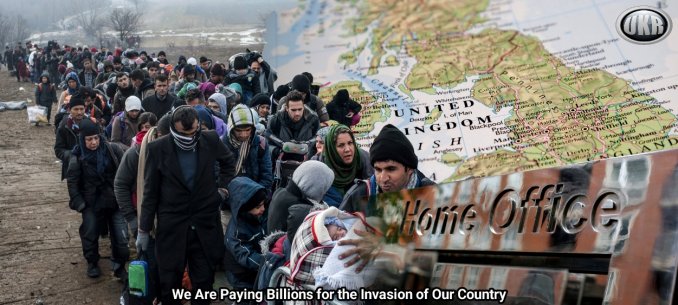
This is the demonstration outside the Crowborough military training area in East Sussex, which has been turned over to housing illegal migrants at the behest of The Muslim Lady, as an alternative to keeping them in hotels.
Without consultation, much less the approval of local residents, as many as 500 military-aged foreign males are to be accommodated on this site, while given free rein to come and go, whence their potential impact on the local area is the driver of what are set to be continued protests.
Thus, while the global Left might pile in on Trump’s robust deportation policy, over in the UK we are looking at the consequences of a weak-willed timorous government that has allowed the flow of illegal migrants to build to a crisis point, the response being to disadvantage entirely blameless communities such as the town of Crowborough.
Dealing with unwanted immigrants is, of course, a complex problem and, as long as there are hard cases, there will always be the bleeding heart “liberals” who oppose any and all measures taken to resolve the issues arising.
In demonising the remedies though, some people (too many) forget that the ultimate solution of mass deportation is simply the necessary consequence of the failures in policy which allowed mass immigration in the first place.
Thus, what has come to be known as remigration is not a policy in its own right, but a remedial measure required to remedy serious policy failures, stretching back more than half a century. And while any such response is bound to be messy and involve much hardship and disturbance, the fault lies not with the remedy but with those responsible for the policy failures in the first place.
While there are those who will even go so far as to deny that there have been policy failures – and even argue the mass immigration is a “good thing” – the adverse consequences are now so clear that there is a growing, implacable constituency which is no longer prepared to be gaslighted into accepting the consequences of these failures.
A small straw in the wind is the report in today’s Telegraph which tells us that the cost of policing the anticipated protests at Crowborough over the next year is expected to run to £5 million.
That, effectively, runs to £50,000 per migrant, which is actually higher than the £41,000 average annual cost of housing each of these parasites in a hotel. This compares, incidentally, with the £1.6 million cost of policing demonstrations from July to September last year at the Bell Hotel in Epping.
These are direct policing costs, but if one looks at the so-called Southport riots – which were indirectly a consequence of immigration – the cost of policing these was estimated at £31.7 million.
Then there are the costs of policing pro-Palestinian protests in London which, to the end of 2024 had cost the Met Police over £53 million – some of which must be attributable to the high proportion of immigrants on the marches.
These, of course, are only a fraction of the costs borne by society, with the recent “Boriswave” potentially imposing a lifetime net fiscal cost of £234 billion, equivalent to a bill of £8,200 for every UK household, spread across several decades.
Other estimates of migration costs suggest that low-earning or low-skilled immigrants to the UK have a negative lifetime fiscal impact of £150,000 – the difference between the public services and benefits consumed and their contributions in taxes.
Some estimates suggest that if a low-earning immigrant has a family (non-working partner, children), the lifetime cost to the state can reach up to £1 million (based on a 2010 calculation).
No cost is attributed to the social dislocation occasioned by the lack of integration, or the social stresses that are evident in the recent Maccabi TA away fan “ban” and the more recent prohibition of Ukip’s “March with Jesus” ban in Whitechapel.
Nor can any easy estimate be made of the total cost of immigrant-related criminality in the UK. Fragments of the costs are identifiable such as the annual cost of keeping the 10,000-plus foreign offenders in English jails, running at over £600 million a year.
Another identifiable cost is the ongoing problem of illicit tobacco sales – largely attributed to foreign criminals – estimated to cost the exchequer £2.3 billion annually in lost revenue.
Gang-related shoplifting – most often attributed to immigrants – costs the retail industry close to £1 billion a year and as much again in additional prevention measures (CCTV, guards and security technology). Then there is mobile-phone theft, which accounts for at least £70 million a year in London alone – most thefts being attributed to immigrant gangs.
Of course, it is not possible to attribute a direct cost to some criminal activity, such as the Pakistani-related grooming gangs, or the epidemic of rapes and stabbings on the streets of the nation. But there is a very real social cost in terms of broken lives and the loss of social cohesion.
For some enterprising think tank, it might be a useful exercise to produce a global cost to our nation of the immigrant communities. If one factored in such costs as the 60 percent loss in property values experienced in some areas where immigrant ghettoes have formed, the total might be astronomical.
One might also take into account opportunity costs. Immigrant communities are reckoned to send out of the country approximately £9 billion a year (that we know of) in personal remittances. Amongst other things, this goes to building lavish mansions in Kashmir, money that is not invested in the UK to the benefit of the community at large.
When we bemoan the loss of our high-trust society and witness the gradual transformation of our towns and cities into litter-strewn third-world slums, it is very hard to accept that any benefits that might accrue from immigration are worth the very palpable losses.
As such, despite the squealing of the “progressives” on both sides of the Atlantic, one can only look at the situation in Trump’s America with envy. Here, at least, is a politician who recognises that there is a problem and does not insult his voter base by gaslighting them about the benefits of diversity.
With the recent shooting to two protesters by ICE agents, the Left believe they have their martyrs, exploited as political leverage in the ongoing attempt to stop the deportation. But a couple of well-publicised deaths is nothing compared to the thousands or hundreds of thousands who will die if public dissatisfaction over immigration drives the onset of civil war.
Too many people are now convinced that this is our direction of travel for the possibility to be ignored, and some, like David Betz, suggest that we only have five years or so before we are shooting our politicians in the streets and driving out the immigrant communities by force.
Those who are hyperventilating about the impact of ICE activities, and Trump’s policies, therefore, need to be conscious of the very real possibility that the alternative could be far worse. The writing was on the wall at Crowborough. The English will not tolerate being ignored for much longer.


Leave a Reply