

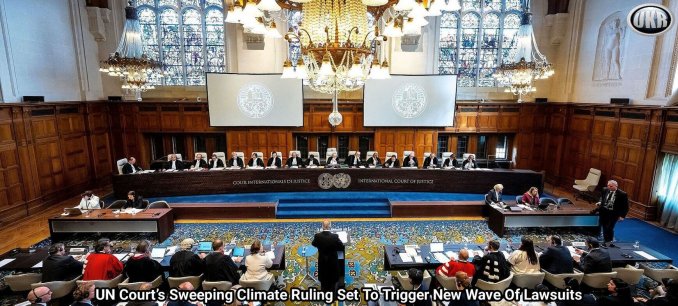
The International Court of Justice decision hands a win to activists, poorer nations, and trial lawyers.

Last month, the International Court of Justice (ICJ) issued a sweeping ruling on the legal duties of states to respond to climate change, demanding “deep, rapid and sustained reductions” in emissions and opening the door to lawsuits for climate reparations. [emphasis, links added]
The ruling is a landmark moment in international law that deserves more attention than it has gotten: In essence, the United Nations’ highest court has deemed climate inaction a human rights violation and an infringement of international law.
The judgment is sure to cause significant economic harm, with far-reaching consequences for human well-being.
Though technically advisory and nonbinding, such statements by the ICJ are considered authoritative interpretations of relevant international agreements and law, and can sway both international and national courts. Thus, the ruling gives nations and activists a powerful tool to advance even more climate lawsuits.
Any country could be sued for falling short of the legal standards it lays out — including the United States, despite its having withdrawn from the Paris agreement’s climate pledges.
The ICJ decision warns, for instance, that the “failure of a State to take appropriate action to protect the climate system from [greenhouse gas] emissions” — including through fossil fuel production and consumption, or even granting exploration licenses — “may constitute an internationally wrongful act.”
That is an extraordinarily wide legal net.
Simmons & Simmons, a leading international law firm, concluded that the judgment will “redefine the legal landscape of global climate governance” and even shape national court decisions over domestic policies.
Last month, climate lawsuits worldwide reached 3,099, up from 2,550 two years earlier. Among recent findings, the European Court of Human Rights used a human rights argument to force harsher climate policies on Switzerland — creating a legal precedent expected to unlock even more lawsuits.
A German court ruled that firms can face civil action for climate damages, which should frighten any U.S. company operating in Europe. Within the United States, fossil fuel firms are being sued over rising sea levels. Climate activists expect many more lawsuits to follow.
Everyone should be concerned when judges replace democratically elected representatives but decree higher energy bills. Worse, however, the ICJ’s ruling doesn’t even get the science right.
The judges repeat activists’ claims when they conclude that climate change is “an existential problem of planetary proportions that imperils all forms of life,” a description that is far from the serious science of the U.N.’s own climate panel, which made no such conclusion.
Most forms of life are actually thriving, as more than 80 percent of global biomass represented by plant life experiences a carbon dioxide-fueled global greening.
The judges also claim that hurricanes are becoming more frequent despite global evidence showing otherwise. More seriously, the judges misread the 2015 Paris agreement, replacing its 1.5 degrees Celsius soft ambition with a mandatory “primary temperature goal.”
Keeping temperature increases to 1.5 degrees is not, in fact, what nations promised and is widely considered unachievable at this stage.
…strong climate policies are among the least efficient ways to improve human welfare, as shown by hundreds of cost-benefit assessments…
The largest problem with the ruling is one of myopia. By narrowly focusing on climate concerns when discussing human rights, the ICJ ends up downgrading humanity’s many other needs: food, health care, education, and jobs.
Yet, strong climate policies are among the least efficient ways to improve human welfare, as shown by hundreds of cost-benefit assessments done for my organization, the Copenhagen Consensus Center.
Further, the call by the court for rich nations to pay restitution to poorer ones assumes fossil fuels are a net evil. Yes, fossil fuels cause global warming, which produces harm.
But fossil fuels have overall been a tremendous engine of progress since the Industrial Revolution, powering advances in agriculture, medicine, and technology.
Synthetic fertilizers, made possible by fossil fuels, feed half the world’s population. Over the past 60 years, China has increased its annual coal consumption 19-fold, which has helped it virtually eliminate extreme poverty.
And, despite climate change, fossil fuels are likely to continue to improve life, as even the U.N. climate panel scenarios show. Researchers identified various scenarios for the 21st century, with one future dependent on fossil fuels and another with a strong focus on emission reduction.
The fossil fuel-driven scenario actually delivers greater human opportunity than its green scenario. For the rest of the century, much higher incomes, driven by reliable energy, will deliver better education, less poverty, lower inequality, more food, and longer life expectancy.
Even taking into account higher climate damage, fossil fuels will leave people much better off, even in vulnerable Africa.
Read rest at Washington Post (archive here)
Top photo by Ehimetalor Akhere Unuabona on Unsplash
Bjorn Lomborg is President of the Copenhagen Consensus, a Visiting Fellow at Stanford University’s Hoover Institution, and author of “False Alarm” and “Best Things First.”
Featured image: thehindu.com

••••
The Liberty Beacon Project is now expanding at a near exponential rate, and for this we are grateful and excited! But we must also be practical. For 7 years we have not asked for any donations, and have built this project with our own funds as we grew. We are now experiencing ever increasing growing pains due to the large number of websites and projects we represent. So we have just installed donation buttons on our websites and ask that you consider this when you visit them. Nothing is too small. We thank you for all your support and your considerations … (TLB)
••••
Comment Policy: As a privately owned web site, we reserve the right to remove comments that contain spam, advertising, vulgarity, threats of violence, racism, or personal/abusive attacks on other users. This also applies to trolling, the use of more than one alias, or just intentional mischief. Enforcement of this policy is at the discretion of this websites administrators. Repeat offenders may be blocked or permanently banned without prior warning.
••••
Disclaimer: TLB websites contain copyrighted material the use of which has not always been specifically authorized by the copyright owner. We are making such material available to our readers under the provisions of “fair use” in an effort to advance a better understanding of political, health, economic and social issues. The material on this site is distributed without profit to those who have expressed a prior interest in receiving it for research and educational purposes. If you wish to use copyrighted material for purposes other than “fair use” you must request permission from the copyright owner.
••••
Disclaimer: The information and opinions shared are for informational purposes only including, but not limited to, text, graphics, images and other material are not intended as medical advice or instruction. Nothing mentioned is intended to be a substitute for professional medical advice, diagnosis or treatment.
Disclaimer: The views and opinions expressed in this article are those of the author and do not necessarily reflect the official policy or position of The Liberty Beacon Project.


Leave a Reply