

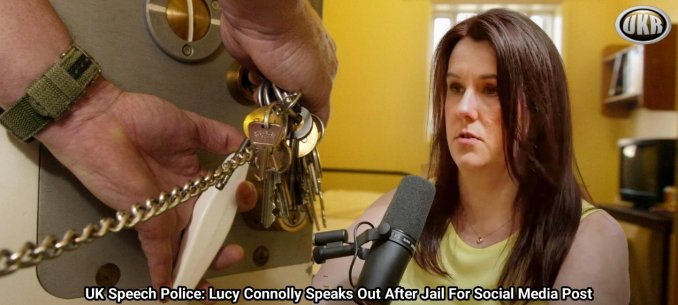
Britain’s dangerous speech laws turned a mother into an international flashpoint for civil liberties.
CAM WAKEFIELD
Lucy Connolly is not, by her own admission, a politician, a pundit, or a revolutionary.
She is, as she puts it, a “nobody.” A mother of two from Northampton, England, married to an engineer and local politician; and, until last year, was more concerned with school runs and snack schedules than the state of Britain’s freedom of expression.
Then came a social media post, written in a moment of raw emotion after a horrific mass killing, and the next thing she knew, Connolly was in prison serving a sentence for inciting racial hatred.
The facts of the case are already well documented. In the immediate aftermath of the Southport murders, where three girls were killed at a Taylor Swift-themed dance event, Connolly posted on X, calling for mass deportations. Her comments were inflammatory, emotional, and, within hours, deleted.
Days later, the police came knocking. Connolly was arrested, charged, and eventually sentenced to 31 months behind bars. She served just over a year.
Lucy Connolly’s imprisonment has sparked a renewed conversation about the fragile state of free speech in the United Kingdom. Her case became a stark reminder of how little legal protection exists for freedom of expression in Britain, particularly when compared to countries like the United States.
In the UK, there is no equivalent to the First Amendment. Speech can and regularly does result in criminal charges if it is deemed “grossly offensive” or judged to incite hatred, a standard so vague and subjective that it often hinges on political context, public backlash, or media scrutiny.
Connolly’s conviction under hate speech laws for a deleted tweet that expressed rage following a horrific child murder is a chilling example of where those limits now fall.
Connolly’s persecution received international attention. Across the Atlantic, the legal outcome would almost certainly have been different. In the United States, even the most inflammatory speech is generally protected unless it directly incites imminent lawless action.
That line, clearly defined by decades of Supreme Court rulings, allows for harsh, even outrageous expression without fear of state punishment. The American model treats speech as a shield against government overreach; the UK, increasingly, uses speech as a gateway to prosecution.
As Connolly herself pointed out in an interview with the Telegraph after finally being released from prison, “I will never understand how it got to this.” The truth is, it got to this because the UK’s legal framework allows it, and increasingly, encourages it.
Connolly is calling it what she believes it was: a political prosecution.
“Absolutely. Me and several other people,” she said to Allison Pearson, when asked if she saw herself as a political prisoner. And she does not mince words about who she believes orchestrated the example-making. The Prime Minister himself.
Connolly says her tweet was not premeditated. It was not part of any campaign. It was a burst of rage, written in grief. She had lost her first child in 2012 due to failures of the UK’s National Health Service, a wound that, she says, was ripped wide open by the killings in Southport.
“It came from a place of pain,” she told Pearson. “It was not my finest moment.” But she insists it was not an incitement to violence, nor was it rooted in hatred. “I definitely don’t advocate violence,” she said.
The state argued otherwise. The CPS believed the post could incite racial hatred and saw fit to prosecute under one of the UK’s most serious public order laws. Connolly’s supporters, on the other hand, argue that while the post was unquestionably offensive and wrong, the response from the state was wildly disproportionate.
The political undercurrent in Connolly’s prosecution is impossible to ignore, especially given the timing. Just days before her arrest, Prime Minister Keir Starmer gave a televised speech in the wake of riots across the country following the Southport killings. He condemned what he described as “far-right thuggery” and warned that those stoking unrest online would be dealt with.
Connolly believes those comments were not rhetorical. They were operational. “A hundred per cent,” she said, when asked if she believed Starmer’s remarks influenced her prosecution. “He needs to practice what he preaches. He’s a human rights lawyer, so maybe he needs to look at what people’s human rights are; what freedom of speech means.”
Speaking to Dan Wootton of the Outspoken podcast, Connolly went further.
Connolly accused Starmer of turning her into a political example.
Connolly said Starmer deliberately pushed for her to be remanded in custody as part of a wider crackdown.
“Remand” means being held in prison before trial or sentencing rather than being released on bail. Bail is normally granted to defendants who are not considered a flight risk, particularly first-time offenders, but Connolly says she was denied that standard practice.
“Instead of saying, you know, we know you’re upset, we know you’re angry, but this is not the way, and it won’t be tolerated,” Starmer instead said: “You’re all far right activists and racists and thugs. And you know, I don’t care if you’re upset that those three children have died, I don’t care if you’re scared for your own children, this is what we’re going to do. And you know, he said it himself, we will remand you, because that isn’t standard practice. To remand people like me, that isn’t a flight risk, that’s never offended before, and was very unlikely to offend again. It wouldn’t be standard practice,” she said.
Starmer’s message was clear. Social media rage was going to be met with legal action. Connolly, many believe, simply became the most convenient test case.
On the wider question of civil liberties under the Starmer government, Connolly was blunt: “I don’t think so, no [the UK does not have free speech]. And that’s become increasingly apparent, isn’t it?…We need to remember that there are still other people in prison.”
She described those detainees as “other political prisoners,” adding: “So I would like Keir Starmer and the CPS and any of these people that had a hand in this to tell me exactly what they are achieving by putting the likes of me in prison…What are they gaining apart from an absolute minimum of £55,000 a year bill to the taxpayer? What’s being gained?”
Connolly maintains she was pressured into pleading guilty. The courts were backlogged. Her daughter was waiting at home. Her legal team advised her that a trial would drag out for months. “What is my quickest route home?” she asked. And with that, she signed the papers.
She also claims the police misrepresented her during the investigation. A CPS statement initially alleged that she told officers she “disliked immigrants.” That was later walked back.
Lucy Connolly did not wait long to make her intentions clear. Just one day after stepping out of HMP Peterborough, she announced she was weighing legal action against the very authorities who put her there.
“That’s something that I will be looking into,” she told The Telegraph. “I don’t want to say too much because I need to seek legal advice on that, but I do think the police were dishonest in what they released and what they said about me, and I will be holding them to account for that.”
Since her release, she has returned to being a mother, albeit one who now sees the state from a far less innocent perspective. She marked her return with a bracelet and necklace gifted by her daughter, a private moment after more than a year of very public punishment.
“They hope they broke me while I was in there,” she said. “But I’m here to tell you that they didn’t.”
This article (UK Speech Police: Lucy Connolly Speaks Out After Jail For Social Media Post) was created and published by Reclaim the Net and is republished here under “Fair Use” with attribution to the author Cam Wakefield
See Related Video Below
LUCY CONNOLLY SPEAKS OUT IN FIRST INTERVIEW AFTER BEING LOCKED UP IN JAIL FOR 380 DAYS FOR A TWEET
Britain’s political prisoner Lucy Connolly – locked up for 380 days for a tweet she deleted within hours – sits down with Dan for her first interview, just one day after being released from prison.
WATCH:

••••
The Liberty Beacon Project is now expanding at a near exponential rate, and for this we are grateful and excited! But we must also be practical. For 7 years we have not asked for any donations, and have built this project with our own funds as we grew. We are now experiencing ever increasing growing pains due to the large number of websites and projects we represent. So we have just installed donation buttons on our websites and ask that you consider this when you visit them. Nothing is too small. We thank you for all your support and your considerations … (TLB)
••••
Comment Policy: As a privately owned web site, we reserve the right to remove comments that contain spam, advertising, vulgarity, threats of violence, racism, or personal/abusive attacks on other users. This also applies to trolling, the use of more than one alias, or just intentional mischief. Enforcement of this policy is at the discretion of this websites administrators. Repeat offenders may be blocked or permanently banned without prior warning.
••••
Disclaimer: TLB websites contain copyrighted material the use of which has not always been specifically authorized by the copyright owner. We are making such material available to our readers under the provisions of “fair use” in an effort to advance a better understanding of political, health, economic and social issues. The material on this site is distributed without profit to those who have expressed a prior interest in receiving it for research and educational purposes. If you wish to use copyrighted material for purposes other than “fair use” you must request permission from the copyright owner.
••••
Disclaimer: The information and opinions shared are for informational purposes only including, but not limited to, text, graphics, images and other material are not intended as medical advice or instruction. Nothing mentioned is intended to be a substitute for professional medical advice, diagnosis or treatment.
Disclaimer: The views and opinions expressed in this article are those of the author and do not necessarily reflect the official policy or position of The Liberty Beacon Project.


Leave a Reply