

Lawmakers promised to protect free speech by regulating nearly every way it can occur
CAM WAKEFIELD
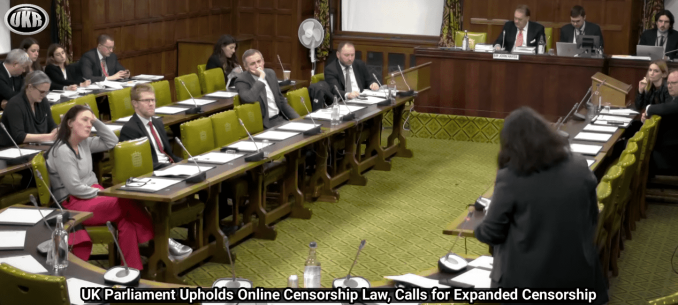
This week in the UK, Parliament held a debate in response to a public petition that gathered hundreds of thousands of signatures calling for the repeal of the Online Safety Act (OSA).
It was a rare opportunity for elected officials to prove they still listen to their constituents.
Instead, the overwhelming message from MPs was clear: thanks for your concern, but we’d actually like even more control over what you can do online.
One by one, MPs stood up not to defend free expression, or question whether one of the most radical internet control laws in modern British history might have gone too far, but to argue that it hadn’t gone far enough.
“It’s Not Censorship, It’s Responsibility” (Apparently)
Lizzi Collinge, Labour MP for Morecambe and Lunesdale, insisted the OSA “is not about controlling speech.” She claimed it was about giving the online world the same “safety features” as the offline one.
This was a recurring theme throughout the debate: reassure the public that speech isn’t being restricted while calling for more mechanisms to restrict it.
Ian Murray, Minister for Digital Government and Data, also insisted the OSA protects freedom of expression. According to him, there’s no contradiction in saying people can speak freely, as long as they’re age-verified, avoid VPNs, and don’t say anything that might be flagged by a government regulator.
It’s a neat trick. Say you support free speech, then build an entire law designed to monitor, filter, and police it.
VPNs in the Firing Line
There is a growing fixation inside government with VPNs. These are basic privacy tools used by millions of people every day, often to protect their data. But several MPs, including Jim McMahon, Julia Lopez, and Ian Murray, suggested VPNs should be subject to age verification or regulatory restrictions.
It’s unclear whether these MPs understand how VPNs work or if they simply dislike the idea of anyone browsing the internet without supervision.
Either way, the intent is clear. The government wants fewer ways for people to browse anonymously.
More: From Madison to Moscow: How VPNs Work and Why Governments (Despite Trying) Can’t Stop Them
The AI Panic Button
Several MPs were clearly rattled by the existence of AI chatbots and called for new censorship powers to rein them in.
Manuela Perteghella warned that the OSA “leaves a significant gap” around generative AI, claiming children are at risk from private conversations with bots.
Ann Davies said the government wasn’t moving quickly enough to regulate this emerging technology.
Lola McEvoy, meanwhile, called for bots to be labelled clearly so users would know when they’re talking to a machine. She also demanded stronger age verification.
The idea that every website should identify bots like they’re wearing a hi-vis jacket is a perfect metaphor for how Parliament thinks the internet should work.
Censorship as Cure-All
Jim McMahon gave the clearest call for wider censorship. He argued the current OSA doesn’t do enough to tackle foreign influence, misinformation, racism, misogyny, and hate. He also claimed major platforms are suppressing “mainstream opinion” in favor of falsehoods.
Emily Darlington, MP for Milton Keynes Central, joined the call for greater platform moderation.
She said platforms should be able to remove false claims, even offering a bizarre example of someone saying she has pink eyes.
“Somebody could post that I am actually purple and have pink eyes,” she said. “I would say, ‘I don’t want you to say that,’ and the platform would say, ‘But there’s nothing offensive about it.’ I would say, ‘But it’s not me.’ The thing is that this is happening in much more offensive ways.”
Her larger point was that online slander should be taken down by force if necessary. She also supported end-to-end encryption backdoors, which would allow private messages to be scanned before being sent.
A Lone Voice in the Wilderness
Lewis Atkinson, Labour MP for Sunderland Central, did raise some concerns. He said he spoke with petition creator Alex Baynham and acknowledged the chilling effect of the OSA on small forums and community websites.

He noted that 300 forums had already shut down or migrated to larger platforms like Facebook because of legal risk. He mentioned a Sunderland AFC message board admin who almost closed the site due to the overwhelming volume of guidance from Ofcom.
But even with all this evidence in front of him, Atkinson couldn’t bring himself to support repeal. Instead, he hedged, suggesting reform would be more realistic than repeal. He backed several of the OSA’s key features, including stronger age verification.
What This Debate Actually Revealed
This was not a debate in any meaningful sense. It was a full-throated defense of a law that is already doing damage to online spaces and a promise that more is coming.
MPs didn’t engage seriously with the petition. They didn’t question whether the OSA is overreaching or whether it might be driving smaller forums offline. They mostly ignored the fact that the law makes the internet harder to navigate unless you’re a large company with a legal department.
Instead, they said the OSA is working well and that it needs more teeth. They want to control AI, crack down on VPNs, regulate encryption, and force companies to implement more age verification.
The public might be concerned about censorship, surveillance, and freedom of expression. But the mood in Westminster is very different.
They don’t want to repeal the OSA. In fact, their attack on civil liberties is only just getting started.
This article (UK Parliament Rejects Petition to Repeal Online Censorship Law, Calls for Expanded Censorship) was created and published by Reclaim the Net and is republished here under “Fair Use” with attribution to the author Cam Wakefield

••••
The Liberty Beacon Project is now expanding at a near exponential rate, and for this we are grateful and excited! But we must also be practical. For 7 years we have not asked for any donations, and have built this project with our own funds as we grew. We are now experiencing ever increasing growing pains due to the large number of websites and projects we represent. So we have just installed donation buttons on our websites and ask that you consider this when you visit them. Nothing is too small. We thank you for all your support and your considerations … (TLB)
••••
Comment Policy: As a privately owned web site, we reserve the right to remove comments that contain spam, advertising, vulgarity, threats of violence, racism, or personal/abusive attacks on other users. This also applies to trolling, the use of more than one alias, or just intentional mischief. Enforcement of this policy is at the discretion of this websites administrators. Repeat offenders may be blocked or permanently banned without prior warning.
••••
Disclaimer: TLB websites contain copyrighted material the use of which has not always been specifically authorized by the copyright owner. We are making such material available to our readers under the provisions of “fair use” in an effort to advance a better understanding of political, health, economic and social issues. The material on this site is distributed without profit to those who have expressed a prior interest in receiving it for research and educational purposes. If you wish to use copyrighted material for purposes other than “fair use” you must request permission from the copyright owner.
••••
Disclaimer: The information and opinions shared are for informational purposes only including, but not limited to, text, graphics, images and other material are not intended as medical advice or instruction. Nothing mentioned is intended to be a substitute for professional medical advice, diagnosis or treatment.
Disclaimer: The views and opinions expressed in this article are those of the author and do not necessarily reflect the official policy or position of The Liberty Beacon Project.


Leave a Reply