

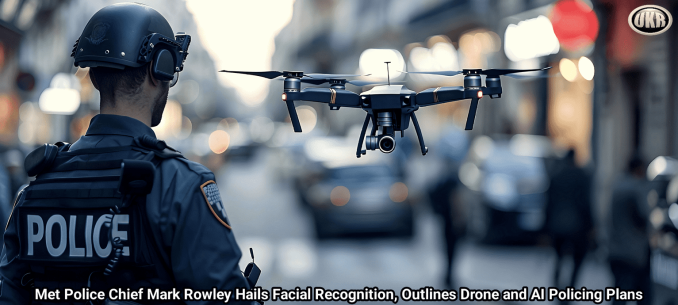
A face in the crowd is all it takes to be caught in the dragnet of a digital police state.
.
KEN MACON
The steady spread of facial recognition technology onto Britain’s streets is drawing alarm from those who see it as a step toward mass surveillance, even as police leaders celebrate it as a powerful new weapon against crime.
Live Facial Recognition (LFR) is a system that scans people’s faces in public spaces and compares them against watchlists.
Civil liberties groups warn it normalizes biometric monitoring of ordinary citizens, while the Metropolitan Police insist it is already producing results.
Britain’s senior police leadership is promoting these biometric and artificial intelligence systems as central to the future of policing, with commissioner Sir Mark Rowley arguing that such tools are already transforming the way the Met operates.
Speaking to the TechUK trade association, Rowley described Live Facial Recognition (LFR) as a “game-changing tool” and pointed to more than 700 arrests linked to its use so far this year.
Camera vans stationed on streets have been deployed to flag people wanted for serious crimes or those breaking license conditions.
Rowley highlighted a recent deployment at the Notting Hill Carnival, where he joined officers using LFR.
“Every officer I spoke to was energized by the potential,” he said to The Sun. According to the commissioner, the weekend brought 61 arrests, including individuals sought in cases of serious violence and offenses against women and girls.
Rowley claimed that the technology played “a critical role” in making the carnival safer.
Beyond facial recognition, Rowley spoke of expanding the Met’s reliance on drones. “From searching for missing people, to arriving quickly at serious traffic incidents, or replacing the expensive and noisy helicopter at large public events,” he said, “done well, drones will be another tool to help officers make faster, more informed decisions on the ground.”
The commissioner also promoted the V100 program, which draws on data analysis to focus resources on those considered the highest risk to women. He said this initiative has already led to the conviction of more than 160 offenders he described as “the most prolific and predatory” in London.
Artificial Intelligence is being tested in other areas too, particularly to review CCTV footage.
Rowley noted the labour involved in manually tracing suspects through crowded areas. “Take Oxford Street, with 27 junctions—a trawl to identify a suspect’s route can take two days,” he explained.
“Now imagine telling AI to find clips of a male wearing a red baseball cap between X and Y hours, and getting results in hours. That’s game-changing.”
While the Met portrays these systems as advances in crime prevention, their deployment raises questions about surveillance creeping deeper into everyday life.
Expansions in facial recognition, drone monitoring, and algorithmic analysis are often introduced as matters of efficiency and safety, but they risk building an infrastructure of constant observation where privacy rights are gradually eroded.
Shaun Thompson’s case has already been cited by campaigners as evidence of the risks that come with rolling out facial recognition on public streets.
He was mistakenly identified by the technology, stopped, and treated as though he were a wanted suspect before the error was realized.
Incidents like this highlight the danger of false matches and the lack of safeguards around biometric surveillance.
For ordinary people, the impact is clear: even if you have done nothing wrong, you can still find yourself pulled into a system that treats you as guilty first and asks questions later.
This article (UK Met Police Chief Mark Rowley Hails Facial Recognition, Outlines Drone and AI Policing Plans) was created and published by Reclaim the Net and is republished here under “Fair Use” with attribution to the author Ken Macon

••••
The Liberty Beacon Project is now expanding at a near exponential rate, and for this we are grateful and excited! But we must also be practical. For 7 years we have not asked for any donations, and have built this project with our own funds as we grew. We are now experiencing ever increasing growing pains due to the large number of websites and projects we represent. So we have just installed donation buttons on our websites and ask that you consider this when you visit them. Nothing is too small. We thank you for all your support and your considerations … (TLB)
••••
Comment Policy: As a privately owned web site, we reserve the right to remove comments that contain spam, advertising, vulgarity, threats of violence, racism, or personal/abusive attacks on other users. This also applies to trolling, the use of more than one alias, or just intentional mischief. Enforcement of this policy is at the discretion of this websites administrators. Repeat offenders may be blocked or permanently banned without prior warning.
••••
Disclaimer: TLB websites contain copyrighted material the use of which has not always been specifically authorized by the copyright owner. We are making such material available to our readers under the provisions of “fair use” in an effort to advance a better understanding of political, health, economic and social issues. The material on this site is distributed without profit to those who have expressed a prior interest in receiving it for research and educational purposes. If you wish to use copyrighted material for purposes other than “fair use” you must request permission from the copyright owner.
••••
Disclaimer: The information and opinions shared are for informational purposes only including, but not limited to, text, graphics, images and other material are not intended as medical advice or instruction. Nothing mentioned is intended to be a substitute for professional medical advice, diagnosis or treatment.
Disclaimer: The views and opinions expressed in this article are those of the author and do not necessarily reflect the official policy or position of The Liberty Beacon Project.


Leave a Reply