

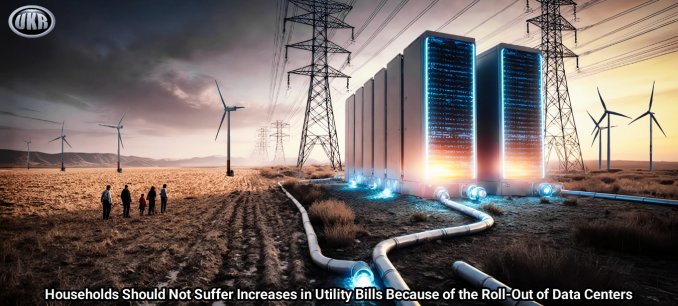
Uk households should NOT suffer increases in utility bills because of the roll-out of data centers – maybe data centres should supply to the UK grid during ‘no-wind’ and dark periods?
66 data cetres ad 6TW OF ELECTRICITY could supply 1.5 million UK homes
PETER HALLIGAN
From Brave AI:
“The UK is planning nearly **100 new data centres**, representing an almost 20% increase in the current data centre count, according to analysis by construction researchers Barbour ABI. This expansion is driven by the rising demand for AI processing power, with most projects expected to be completed within the next five years.
- “66 upcoming data centres are projected to add over 6,035 MW of power capacity by 2030, according to Arizton Advisory & Intelligence.
- Over half of the planned facilities are located in London and surrounding counties, with significant developments also expected in Wales, Greater Manchester, and the north-east.
- Major projects include a £10bn AI data centre in Blyth, Newcastle (Blackstone Group), four Microsoft sites (£330m), and two Google facilities (£450m) in north-east London.
These developments are part of the UK’s effort to solidify its position as the third-largest data centre market globally, behind the US and Germany, and are classified as critical national infrastructure by the government.
The expression ‘add over 6,035 MW of power capacity by 2030,’ Is somewhat misleading – these data centres will drain 6 TWh from the grid from 2030 – meaning 6Twh of alternative supply will have to be secured.
“A 6,035 MW power station could supply approximately 1.4 million to 1.6 million UK households, depending on the assumed average electricity consumption and whether the power is used for electricity only or includes heating.
“The UK’s total electricity generation in 2024 was 284.9 terawatt-hours (TWh), according to official statistics. This marks a decline from 2023’s 292.7 TWh, primarily due to record-high electricity imports reducing the need for domestic generation. In 2024, renewables generated over half (50.4%) of the UK’s electricity, with wind power contributing 29.2% of the total.
Wind power Is horribly expensive, has been ‘monopoly priced by morons for the next 20 years’ and does not provide the ‘always on’ supply demanded by data centres and households (and everyone else).
The US has recognised the risks to consumer prices for electricity – there is not much chatter about the UK even considering this.
From here:
Senate Bill Would Ensure Data Centers Do Not Pass Energy Costs Onto Consumers | ZeroHedge
“It’s a simple supply and demand issue. A new power consumer shows up and immediately starts draining hundreds of megawatt of power while the new power generation being developed by the utility servicing the connected grid takes several years to add new generation capacity. The pitch circulated by lawmakers is to require new data centers to show up with their own power and hand, therefore preventing the pass on of costs to household rate payers.
Imagine that! Data centers supplying their own power and not impacting the supply used by the national grid!
Which rather begs he question. “if data centres can supply their own electricity at below the price charged to households, why can’t other electricity companies supply at the same (lower) price?
The simple reason is that data centres don’t want anything to do with the intermittent, expensive and unreliable wind and solar generated electricity that is being forced on UK households!
Back to the ZH article:
“There’s a slew of ways to go about powering a multi-megawatt or gigawatt scale data center. The method most frequently referenced for reducing rate payer burden is
behind-the-meter arrangements.
This means the power generator is directly connected to the facility through on-site transmission structures without interacting with the grid in any way.
“Alternatively, facilities could opt for the
front-of-the-meter arrangement
where they still bring their own power, but transmit the power through the local grid, even if they are located physically near each other. This arrangement supports the grid while still minimizing cost to the rate payer because of the addition of overall capacity. Connecting to the grid and utilizing existing transmission lines and transformers could minimize time to initial operation, as well as require grid infrastructure upgrades. Requiring the new data center to finance the grid upgrades would reduce consumer costs as well.
“The bill being pushed by Sen Hawley is calling for behind-the-meter arrangements, but the legislation could change as it passes through everyone’s hands. Most grid advocates have called for front-of-the-meter arrangements to maximize household consumer benefit.
I wonder why the data centres don’t build excess capacity that thy can sell to consumers for cheaper prices! Make data centres compete head on with wind and solar electricity generation?
The answer to fairer and cheaper electricity lies anywhere but with wind and solar!
Onwards!
PLEASE take a paid subscription or follow/recommend my site to others you think might be interested. You may also donate via Ko-fi – (any amount three dollars and above here): https://ko-fi.com/peterhalligan
This article (Uk households should NOT suffer increases in utility bills because of the roll-out of data centers – maybe data centres should supply to the UK grid during ‘no-wind’ and dark periods?) was created and published by Peter Halligan and is republished here under “Fair Use”


Leave a Reply