

To enable the “adoption” of the Pandemic Treaty next week, WHO is making up the rules as it goes along
RHODA WILSON
The World Health Organisation’s draft Pandemic Agreement is being presented to the 78th World Health Assembly (“WHA”) for adoption next week. However, this “adoption” is not what it seems.
A critical part of the agreement, the Pathogen Access and Benefit-Sharing (“PABS”) System is proving controversial and is still to be negotiated. So, to enable the Pandemic Agreement to be “adopted” next week, WHO has devised a workaround – WHO is making up the rules as it goes along.
WHO is now saying that if countries agree to “adopt” the Pandemic Agreement at the WHA, the Agreement will be deposited with Tedros Adhanom Ghebreyesus for countries to sign. But, the signing of the Agreement will not be possible any time soon.
If it is “adopted,” countries need to notify Tedros on whether they intend to accept the Pandemic Agreement within 18 months of the WHA. However, member states can only sign the Pandemic Agreement after an annexe for the much-contested PABS System has been adopted by a future WHA.
From the moment a member state signs the Pandemic Agreement, it will be expected not to undermine it. Does this mean that they cannot speak against it or criticise it? Is WHO using a top-down approach to censor governments, officials and advisors? Is WHO also expecting governments that sign its agreement to ensure that their citizens do not undermine the Pandemic Agreement as well? Censorship is the first sign that something bad is afoot.
After signing the Pandemic Agreement, the member states then need to take the appropriate action within their countries to ratify or adopt the agreement so it takes effect. In the UK, for example, the Public Health (Control of Disease) Act [1984] grants the Secretary of State for Health and Social Care, currently Wes Streeting, the power to adopt or give effect to such an agreement without reference to anyone else. To stop WHO’s nefarious pandemic agenda from being implemented in the UK, the section of the Act granting Streeting this power, section 45, needs to be repealed.
In the following, Meryl Nass shares an article published by Health Policy Watch and provides some comments on the “jumbled-up mess” WHO is creating and the sneaky changes to the voting process to enable the “adoption” of the Pandemic Treaty at next week’s WHA.
Note: The Pandemic Agreement has been called various names over the years. It has also been referred to as the Pandemic Treaty, Pandemic Accord and WHO Convention Agreement + (“WHO CA+”).
WHO Outlines Long Road Ahead Before Pandemic Agreement Comes into Force
By Meryl Nass
Apparently what the WHO bureaucracy decided they would be able to take a vote on the Pandemic Treaty at this WHA meeting, even before there is a (required by the treaty) PABS agreement on the pathogen lending library – but then they would not accept ratifications until after a PABS Annexe had been approved in the future. That way, they don’t lose momentum. Remember how the negotiators used to say about the Pandemic Treaty, “Nothing is decided until everything is decided”? Well, that got dropped like a hot potato.
But as I’ve told you, the WHO puppeteers HATE votes. And so, as I surmised, the bureaucrats have said that although a 2/3 vote is required to pass the treaty, they believe a “consensus” process will suffice instead. Those are much easier for them to arrange.
I imagine the bureaucrats were a bit frazzled since many are losing their jobs or being switched to new jobs, and they don’t know if they will be paid.
They are a sneaky lot. They were required to complete the treaty negotiations by this month, but that was impossible due to PABS (dis)agreements, so they created this jumbled-up mess in which you can vote on the treaty but you can’t ratify it, and it really won’t exist until the PABS section has been agreed.
I’m not sure all these machinations are kosher but no nations ever openly complain, so this is what we will see in Geneva over the next 2 weeks.
None of this requires that a Conference of the Parties be stood up to make the rules for how the treaty will operate. So, members will be signing a document whose actualities remain unknown. Never mind; by the time it comes into force all these diplomats will be in other positions.
Now, the article below reports the chronology of how the treaty will come into force with even more twists and turns. I don’t quite understand it. But in any event, this treaty is a long way off, if it ever will be settled.
Hopefully, under President Trump a real Treaty to ban gain-of-function and truly stop pandemics will be negotiated instead. I know people are working on it.
WHO Outlines Long Road Ahead Before Pandemic Agreement Comes into Force
By Kerry Cullinan as published by Health Policy Watch on 12 May 2025

The final draft of the pandemic agreement for the World Health Assembly (“WHA”) next week was published by the World Health Organisation (“WHO”) on Wednesday – along with a document outlining the long road member states still have to travel before it is enforced.
This follows the historic agreement reached on the text in the early hours of 16 April after three years of talks on how to prevent, prepare for, and deal with, future pandemics in an equitable manner – unlike what happened during covid when wealthy nations hoarded vaccines at the expense of low- and middle-income countries.
The procedural document outlining the steps to adoption, which will be done in terms of Article 19 of the WHO Constitution, makes sobering reading.
While the agreement needs a two-thirds vote to pass, “adoption of the text by consensus automatically fulfils this requirement,” it notes.
Once the WHA has adopted the agreement via a resolution, it will be deposited with the Secretary-General of the United Nations, who will ensure it is prepared in various languages for signature.
Member states are expected to notify the WHO Director General on whether they intend to accept the agreement within 18 months of its adoption by the WHA.
Still More PABS Negotiations
But member states’ signature of the pandemic agreement will only happen after the adoption of an annex on the much-contested Pathogen Access and Benefit-Sharing (PABS) System – a mechanism on how to share information about pathogens with pandemic potential and any possible benefits (such as vaccines and therapeutics) that might arise from sharing this information.
This annexe – called the PABS instrument – still has to be negotiated, and it deals with a range of issues including “the provisions governing the PABS System, definitions of pathogens with pandemic potential and PABS Materials and Sequence Information, modalities, legal nature, terms and conditions, and operational dimensions.”
This means the PABS can of worms will be reopened in the coming months and member states will once again have to find agreement on this highly contested subject.
Only once the annexe has been agreed, will the WHO Pandemic Agreement be open for signature by heads of state.
But even once the heads of state have signed the agreement, countries are not bound by its provisions.
Instead, by signing, a head of state would be “expressing political approval of the treaty concerned, and raises an expectation that the signatory will in due course take the appropriate domestic actions to become a contracting party.”
However, before domestic ratification, member states that have signed the treaty will be expected not to undermine the agreement.
Countries that have ratified the pandemic agreement will then be expected to deposit instruments of ratification with the UN Secretary-General and once 60 countries have done so, it will come into force and the first Conference of [the] Parties will be held.
The entire process is likely to take several years, during which time another pandemic can engulf the world.

About the Author
Dr. Meryl Nass is a physician and researcher who proved that the world’s largest anthrax epidemic, in Rhodesia (now Zimbabwe), was due to biological warfare. She had her license suspended for prescribing covid medications that worked. She posts invaluable information on her Substack page ‘Meryl’s Covid Newsletter’ and the website ‘Door to Freedom’. She also occasionally posts articles on a blog titled ‘Anthrax Vaccine’.
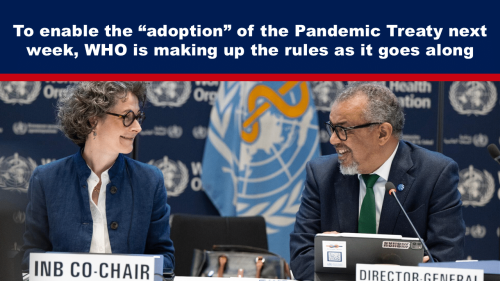
Featured image: French ambassador for global health Anne-Claire Amprou and WHO Director-General Tedros the Terrorist smiling at each other after the draft Pandemic Agreement was agreed. Source: World Health Organisation
To enable the “adoption” of the Pandemic Treaty next week, WHO is making up the rules as it goes along was created and published by The Expose and is republished here under “Fair Use” with attribution to the authors Meryl Nass and Rhoda Wilson
See Related Article Below
WHO’s PANDEMIC AGREEMENT Just a Ploy to CONTROL Every Aspect of Any SCAMDEMIC They Declare at Any Time and Indefinitely
The WHO was the fulcrum for the New World Order and the Great Reset using the Plandemic as the catapult for depopulation and complete control of populace
LIONESS OF JUDAH MINISTRY
By S.D. Wells May 16, 2025
They had it for a little while. Complete control. The New World Order, run by the globalists and their right arm, Big Pharma, had complete control of nearly every human on planet earth during the beginning of the Covid plandemic. It worked. The mass-propaganda campaign of fear caused mass panic and everyone lost their minds, bowing down to the nonsensical “protocol” of lockdowns, masks, social distancing, antibacterial lathering for a virus, and mass-death-jab indoctrination.
All the big-wig organizations were in on it: WHO, CDC, FDA, WEF, all of them. The end game was to get every human being injected with “technology” where their cells create billions of prions that drive all-cause mortality, so nobody can boil it back to the death jabs, but the world would only consist of a couple billion people within a few years. Hindsight is 20/20, so anyone can see from the carnage of the clot shots that this is no conspiracy theory.
The WHO was the fulcrum for the New World Order and the Great Reset using the Plandemic as the catapult for depopulation and complete control of populace
The WHO was the fulcrum for the New World Order, the Great Reset, and they wanted complete control of everyone’s lives, including taking away all medical freedoms and right to free speech and press.
In fact, the Brownstone Institute recently published a commentary analyzing the draft Pandemic Agreement set to be considered at the upcoming 78th World Health Assembly.
The agreement, which complements the 2005 International Health Regulations (IHR) amended in 2024, aims to centralize pandemic management under the World Health Organization (WHO).
While much of the document uses non-binding language like “may” and “where appropriate,” it reflects WHO’s push for control over all aspects of pandemics, from declaration to response, including vaccine distribution and supply chains.
Critics argue that the agreement lacks proportionality and narrowly focuses on certain populations while ignoring broader health needs. For instance, it overlooks the importance of individual resilience and the unique health priorities of regions like Africa, which has a predominantly young population.
Instead of decentralizing health care, the WHO is promoting a “whole-of-government” approach, which some say has caused harm, particularly in lower-income countries during the COVID-19 response. The agreement also emphasizes WHO-approved vaccines and allopathic medicines while downplaying traditional healing practices.
The draft agreement links health with climate change, framing it as a major threat to global health. This reflects a growing trend within the WHO to expand its mandate beyond traditional health issues.
However, the agreement’s focus on large-scale, centralized solutions raises concerns about practicality and cost, especially for developing countries. For example, Article 9 of the agreement calls for low-cost vaccines and technology transfers to less-developed nations but implementing this could be challenging and expensive.
Additionally, the agreement includes provisions for a Pathogen Access and Benefit-Sharing System (PABS), aimed at sharing pathogen materials and ensuring equitable benefits.
However, the details of this system remain unclear, and critics warn it could create conflicts of interest and Intellectual Property (IP) disputes. The WHO’s role in training and capacity-building for pandemic product production is also seen as overreaching, given its limitations.
Overall, the Brownstone Institute and others argue that the Pandemic Agreement and related IHR amendments give the WHO too much power, potentially at the expense of local health systems and broader health equity.
The centralized approach, coupled with WHO’s questionable track record during the COVID-19 pandemic, raises concerns about transparency, fairness, and effectiveness.
The agreement’s focus on global health industry profits and its lack of practical solutions for developing countries further highlight the need for a more balanced, decentralized approach to pandemic preparedness and response.
Sources for this article include:

••••
The Liberty Beacon Project is now expanding at a near exponential rate, and for this we are grateful and excited! But we must also be practical. For 7 years we have not asked for any donations, and have built this project with our own funds as we grew. We are now experiencing ever increasing growing pains due to the large number of websites and projects we represent. So we have just installed donation buttons on our websites and ask that you consider this when you visit them. Nothing is too small. We thank you for all your support and your considerations … (TLB)
••••
Comment Policy: As a privately owned web site, we reserve the right to remove comments that contain spam, advertising, vulgarity, threats of violence, racism, or personal/abusive attacks on other users. This also applies to trolling, the use of more than one alias, or just intentional mischief. Enforcement of this policy is at the discretion of this websites administrators. Repeat offenders may be blocked or permanently banned without prior warning.
••••
Disclaimer: TLB websites contain copyrighted material the use of which has not always been specifically authorized by the copyright owner. We are making such material available to our readers under the provisions of “fair use” in an effort to advance a better understanding of political, health, economic and social issues. The material on this site is distributed without profit to those who have expressed a prior interest in receiving it for research and educational purposes. If you wish to use copyrighted material for purposes other than “fair use” you must request permission from the copyright owner.
••••
Disclaimer: The information and opinions shared are for informational purposes only including, but not limited to, text, graphics, images and other material are not intended as medical advice or instruction. Nothing mentioned is intended to be a substitute for professional medical advice, diagnosis or treatment.
Disclaimer: The views and opinions expressed in this article are those of the author and do not necessarily reflect the official policy or position of The Liberty Beacon Project.


Leave a Reply