

GAVIN ASHENDEN
WHEN the Pope addressed the Vatican ambassadors accredited to the Holy See his speech ought to have made the headlines of every free newspaper across the Western world.
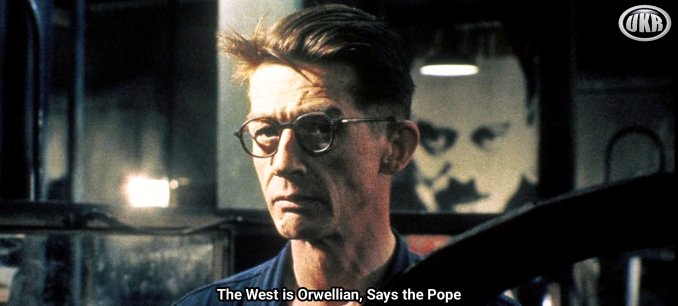
Perhaps we should be grateful that Leo XIV used the word ‘Orwellian’ because that caught the attention of a few commentators. Otherwise, one of the most important papal contributions to public cultural and political dialogue I have ever read disappeared into the fog of international news.
He attacked multiculturalism. He attacked surrogacy. He praised without reserve the vocation to love and life expressed exclusively and in indissoluble union between a man and a woman. He praised the institution of the family as the glue that holds civilisation together. He decried discrimination against Christians in Europe and America simply for being Christians.
He drew the attention of the world to the genocide of Christians in Nigeria and other parts of Africa. He complained bitterly about Islamic violence against Christians in Bangladesh and in Damascus. He singled out Islamists around the world for their relentless destruction of Christianity.
He claimed that 64 per cent of the world’s population are having their religious freedom circumscribed by oppressors.
He pointed an accusing finger at Western consumerist society as it destroys babies in the womb through abortion and vulnerable adults at the end of their lives through euthanasia. And he claimed that violent language is being used as a weapon to destroy free speech.
It was that moment — that criticism — that blipped briefly on the radar of international interest, largely because he used the word ‘Orwellian’. Yet, on the Richter scale of world journalism, it scarcely made the needle quiver at all.
It is worth quoting his words. They were carefully chosen and offer a powerful critique.
Leo said: ‘We should also note the paradox that this weakening of language is often invoked in the name the freedom of expression itself. However, on closer inspection, the opposite is true, for freedom of speech and expression is guaranteed precisely by the certainty of language and the fact that every term is anchored in the truth. It is painful to see how, especially in the West, the space for genuine freedom of expression is rapidly shrinking. At the same time, a new Orwellian-style language is developing which, in an attempt to be increasingly inclusive, ends up excluding those who do not conform to the ideologies that are fuelling it.
‘Unfortunately, this leads to other consequences that end up restricting fundamental human rights, starting with the freedom of conscience.’
Why were there no editors who wrote headlines saying: Pope condemns DEI. Pope attacks censorship. Pope decries post-modernity. Pope resists post-truth. There was virtual silence in the world’s press, and yet this was one of the most powerful speeches that ought to have caught the attention of thinking people in the West.
Why? Was it down to a general cynicism about Catholicism? One friend I discussed it with asked me where exactly freedom of speech was in the early centuries when Catholics had the upper hand in society. It is a good and important question, a shame that the Pope himself did not address it, but one can only say so many things in a single speech.
It is perfectly true that the Catholic Church has not been committed to an absolute right to freedom of speech for the last 2,000 years — but it has been deeply committed to true speech.
The idea of free speech as an absolute individual right is a distinctly Enlightenment development. It presupposes a society metaphysically agnostic about truth, treating speech chiefly as an expression of personal autonomy.
The Church has always had a much less narcissistic and more metaphysically responsible regard for truth than simply seeing speech in that way. From the very beginning, the Church understood speech as morally charged, teleological, instrumental, and ordered towards exposing, describing, and protecting reality.
The Church’s textbook was the Bible: In the beginning was the Word, and the Word was God, and the Word was with God. The Word was the principle of the Incarnation, by which ultimate reality takes on human form. Words are not neutral tools, but a further means of revelation.
The difference between the Church’s moral commitment to truth and the Enlightenment ideal of freedom of expression is that the Church has a prior commitment to truth, not merely to opinion.
She heeds the words of Jesus Christ who promised that ‘the truth shall set you free’ (John 8:32).
History reveals that ideas have consequences, and that some falsehoods can be socially destructive —perhaps as destructive as physical acts.
Why does this matter now more than ever? Because, as Pope Leo implies, liberal societies now police language aggressively, censoring speech deemed harmful, offensive, or destabilising even if it is true. Modern censorship is about power, not truth. Secular culture has become deeply ambivalent in its adjudication between power and truth in the exercise of speech.
The Church has always refused to reduce communication to the exercise of power. It has recognised that if it betrays its commitment to truth, corruption follows and collapse is inevitable. Deprived of truth, it would become no different from any other power broker. Consequently, voices have always arisen within the Church to call it back to truth, even at great cost.
In this meltdown of post-modernity and post-truth, secular society finds itself deeply confused about the use and abuse of speech. It no longer knows whether language exists to tell the truth or to enforce power. The Church, for all its failures and scandals, has never abandoned the conviction that words matter because reality matters — and that truth is not constructed by consent, but discovered by fidelity.
In an age in which speech is once again being regulated — not carefully, but brutally and arbitrarily — the Church’s older distinction between free speech and true speech deserves not reflex condemnation, but serious reconsideration. A culture which makes truth subservient to the whims of the powerful does not become liberated, it becomes manipulable.
Orwell wrote his finest works in the mid-20th century, an era defined by resistance to two totalitarian systems that sought to remake humanity by coercing language and thought.
Pope Leo appears to be warning the West in particular that the 21st century is preparing for the next iteration of that struggle. Once again, the contest is not between left and right, but between truth and tyranny.
And once again, the Catholic Church — stubborn, unfashionable, and deeply misunderstood — finds itself on the wrong side of the cultural consensus and the right side of the argument.
This article (The West is Orwellian, says the Pope) was created and published by Conservative Woman and is republished here under “Fair Use” with attribution to the author Gavin Ashenden


Leave a Reply