

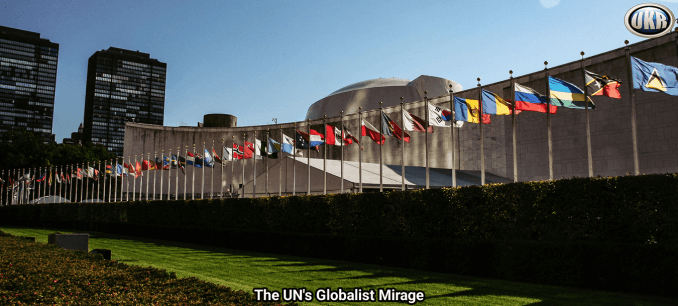
Why Empowering the United Nations Risks Unleashing Global Violence, Turmoil, and Catastrophe

.
TOM ARMSTRONG
In a world still haunted by the shadows of the Second World War, the United Nations stands as a monument to the victors’ uneasy peace. Yet, as Timofey Bordachev, Programme Director of the Valdai Club, astutely observes in his recent article for Vzglyad, the UN’s foundations are not in its lofty charters or idealistic resolutions, but in the raw, unyielding reality of power. China’s recent invocation of Articles 53, 77, and 107 of the UN Charter, reminding Japan of the victors’ right to unilateral military action against former enemies, serves as a stark warning. It underscores that the global order remains tethered to the outcomes of 1945, where military might and nuclear arsenals dictate.
However, this truth is increasingly ignored by the Globalist ‘elite’ seeking to transform the UN into a supranational powerhouse capable of overriding, ultimately eliminating, nation states in the name of “global governance.” Initiatives like Agenda 2030, the proposed Pandemic Treaty through the World Health Organisation (WHO), and expansive climate accords aim to centralise authority in New York and Geneva. Far from fostering harmony, this push risks shattering the fragile balance that has prevented another world war for eight decades. By diluting the influence of the permanent Security Council, imperfect though it is, and imposing uniform rules on a multipolar world, Globalists are courting catastrophe. Violence, economic turmoil, and societal upheaval could erupt as major powers resist, minor states rebel, and non-state actors exploit the chaos. The Russian Bordachev argues that the Globalist agenda through the UN is not a path to progress but a recipe for disaster, with profound implications for Britain and the world. Bordachev rightly dismisses the ongoing clamour for UN Security Council reform as “hollow.” Calls from nations like India, Brazil, and Germany to expand permanent membership reflect economic shifts but ignore the UN’s core logic: it endures because it mirrors the post-WWII power distribution. Britain and France retain vetoes not due to current GDP rankings but because their forces marched into Berlin in 1945, and they swiftly developed nuclear deterrents. Similarly, Russia, China, and the United States wield influence as the era’s victors, their arsenals ensuring compliance.
Globalists, however, envision a “reformed” UN as a vehicle for their ambitions and seek to use Security Council reform to further that aim. The Pact for the Future, adopted at the UN Summit in September 2024, promises “inclusive” governance, digital cooperation, and sustainable development goals that transcend borders. Proponents, including UN Secretary-General António Guterres, argue this will address “global challenges” like climate change and pandemics. Yet, as Bordachev notes, institutions only survive when they align with real power. Forcing reforms that ostensibly elevate emerging powers without corresponding military clout risks alienating the P5 (permanent five), most especially those not controlled by Globalists, like Russia and China. Imagine a scenario where a India or Brazil pushes for sanctions against China over Taiwan, or the USA over Venezuela. Beijing’s response would not be diplomatic negotiation but a forceful reassertion of its “victor’s rights,” as hinted in its recent jab at Japan.
This misalignment could ignite dangerous regional conflicts in the manner of the war in Ukraine, where Globalist are heavily implicated. In Asia, where tensions simmer in the South China Sea, an empowered UN attempting to mediate with “Globalist” impartiality might provoke China to invoke those archaic Charter articles more aggressively. Bordachev warns that such revolutions in international architecture are “neither peaceful nor orderly.” History concurs: the League of Nations’ failure in the 1930s stemmed from its inability to enforce rules amid shifting powers, paving the way for Hitler’s aggression and the horrors of WWII. A similar fate awaits a Globalist UN, where ostensibly well-intentioned but essentially sinister reforms become flashpoints for violence.
The Globalist push manifests most perilously in initiatives granting the UN legal power. Agenda 2030’s Sustainable Development Goals (SDG), launched in 2015, exemplify this. Framed as a blueprint for eradicating poverty and inequality, it increasingly demands national compliance. By 2025, over 100 countries have integrated SDG into domestic policy, but critics like Bordachev see this as a facade. The real issue is enforcement: the UN lacks teeth, so Globalists advocate for binding mechanisms, such as the proposed Global Digital Compact, which could regulate online speech and data flows worldwide.
For Britain, this erosion of sovereignty is acute. Brexit offered the opportunity to reclaim control from supranational bodies like the EU. Yet, Globalist pressures from Brussels and the UN met with meek obedience from the British Establishment. The Net Zero agenda, tied to SDG 13 (climate action), pushes for UN-monitored carbon taxes and energy transitions. If enforced through trade sanctions or “climate courts,” resistant nations like the US, under a potentially nationalist administration, could withdraw funding or cooperation, crippling the organisation and causing instability around the world. Bordachev’s point is prescient: when rhetoric detaches from ground realities, such as Europe’s absurdities in Ukraine and the Middle East, the system drifts toward collapse and mayhem.
Worse, this could unleash economic turmoil. The UN’s push for “equitable” resource distribution ignores power imbalances. Imagine a reformed UN Security Council mandating wealth transfers from victors like the US to “victim” states. Resentment would boil over, leading to trade wars or blockades. In 2023, the World Bank estimated that SDG implementation requires $2.5–3 trillion annually which, if attempted, could easily spark hyperinflation and famines. Britain’s economy, already strained by Net Zero lunacy and socialist spite, would suffer as global supply chains fracture amid retaliatory tariffs.
Social catastrophe looms too. Globalist UN policies often prioritise “inclusivity” over cultural realities, stoking divisions. The push for gender equality (SDG 5) and migration compacts has fuelled ‘populist’ backlashes in Europe, including Britain’s 2024 anti-immigration riots. If the UN gains more power through a binding Migration Governance Framework (eagerly though silently sought by the UK Establishment), nations could face mandated refugee quotas, igniting ‘xenophobic’ violence, even civil war. Bordachev’s observation that stability requires acceptance by major players rings true: imposing such agendas on unwilling peoples could further radicalise populations and provoke internal strife or proxy wars.
To grasp the risks, consider the historical parallels Bordachev invokes. The Holy Alliance of 1815, formed after Napoleon’s defeat, aimed to preserve monarchic order through collective intervention. It collapsed amid revolutions in 1848 because it failed to adapt to rising nationalism, unleashing decades of European turmoil. Similarly, the League of Nations, born from WWI’s ashes, promised collective security but crumbled when Britain and France, dominated by appeasers, couldn’t counter Germany and Italy’s resurgence. The result? Another world war, 50–85 million dead.
Today’s Globalist UN echoes these failures. Bordachev notes that the League wasn’t doomed by design but by power imbalances and Establishment weakness as exemplified by the infamous Oxford Union declaration they would not fight for King and Country. The same applies now: empowering the UN to police climate or health without P5 buy-in promotes internal strife and invites defiance. China’s reminder to Japan signals discomfort with any dilution of its status. If Globalists persist, perhaps through the WHO’s Pandemic Treaty, which could mandate lockdowns or vaccine distributions, resistant states might form rival blocs. An anti-Globalist “Global South” alliance, led by BRICS nations, could fracture global trade and sparking resource wars over rare earths or water.
In the Middle East, as Bordachev highlights, an empowered UN might attempt “humanitarian interventions” in Gaza or Yemen. But without Russian and/or Chinese consent, this becomes neo-colonialism, possibly provoking jihadist insurgencies. The 2003 Iraq invasion, justified under vague UN resolutions, led to ISIS’s rise and millions displaced. Scaling this globally could result in multiple similar catastrophes, with refugee crises overwhelming Europe and breeding terrorism.
At the heart of Bordachev’s argument is the UN’s reflection of nuclear realities. The P5’s vetoes and arsenals, if united, prevent rash actions, maintaining deterrence. Globalist reforms threaten it. Proposals to abolish vetoes for “humanitarian” votes could unravel it. Imagine a UN resolution condemning Russia’s actions in Ukraine, enforced by a coalition excluding Moscow and Beijing. Retaliation might escalate to tactical nuclear use, as doctrines allow. Bordachev emphasises that nuclear powers embody the “legitimacy of the victor.” Diluting their influence invites proliferation: if the UN sidelines them, nations like Iran or Saudi Arabia might accelerate bomb programmes, heightening risks of accidental war. The Doomsday Clock, at 90 seconds to midnight in 2025, underscores this peril. Globalist overreach could push it to zero. For Britain, a P5 member with Trident submarines, this means vulnerability. If UN globalism erodes veto power, London could face isolation on issues like the Falklands, provoking Argentine revanchism or Chinese pressure in the Indo-Pacific.
Beyond violence, Globalist UN policies threaten economic collapse. The push for “just transitions” in energy could force deindustrialisation in hydro-carbon dependent economies, leading to job losses and recessions. Britain’s North Sea oil phase-out, aligned with UN climate goals, has already sparked protests; amplifying this globally risks supply shocks akin to the 1973 oil crisis, but far worse. Imposing accepted norms erodes cultural identities, breeding resentment. In diverse Britain, UN-driven “diversity” mandates could exacerbate divisions, as seen in the 2025 culture wars over gender education. Turmoil follows: riots, polarisation, democratic backsliding.
Bordachev concludes that the UN remains relevant by expressing WWII’s hierarchy. Britain must heed this: resist Globalist expansions, safeguard sovereignty, and advocate restrained reforms. The alternative, violence, turmoil, catastrophe. In embracing globalism, the Globalist ‘elite’ risks the destruction of civilisation. As Bordachev warns, revolutions redraw borders in blood. And most of it is the blood of the ordinary citizen.

••••
The Liberty Beacon Project is now expanding at a near exponential rate, and for this we are grateful and excited! But we must also be practical. For 7 years we have not asked for any donations, and have built this project with our own funds as we grew. We are now experiencing ever increasing growing pains due to the large number of websites and projects we represent. So we have just installed donation buttons on our websites and ask that you consider this when you visit them. Nothing is too small. We thank you for all your support and your considerations … (TLB)
••••
Comment Policy: As a privately owned web site, we reserve the right to remove comments that contain spam, advertising, vulgarity, threats of violence, racism, or personal/abusive attacks on other users. This also applies to trolling, the use of more than one alias, or just intentional mischief. Enforcement of this policy is at the discretion of this websites administrators. Repeat offenders may be blocked or permanently banned without prior warning.
••••
Disclaimer: TLB websites contain copyrighted material the use of which has not always been specifically authorized by the copyright owner. We are making such material available to our readers under the provisions of “fair use” in an effort to advance a better understanding of political, health, economic and social issues. The material on this site is distributed without profit to those who have expressed a prior interest in receiving it for research and educational purposes. If you wish to use copyrighted material for purposes other than “fair use” you must request permission from the copyright owner.
••••
Disclaimer: The information and opinions shared are for informational purposes only including, but not limited to, text, graphics, images and other material are not intended as medical advice or instruction. Nothing mentioned is intended to be a substitute for professional medical advice, diagnosis or treatment.
Disclaimer: The views and opinions expressed in this article are those of the author and do not necessarily reflect the official policy or position of The Liberty Beacon Project.


