

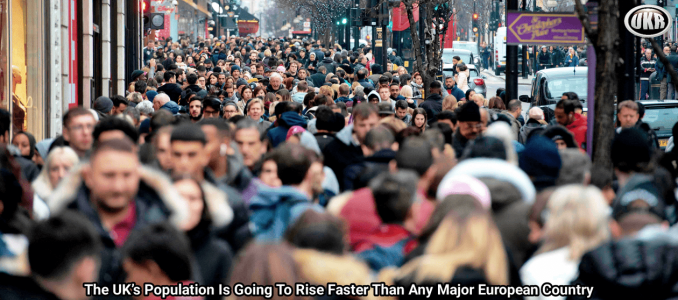
Major news today – The UK’s population is going to rise faster than any major European country.
There are 69.6 million people in Britain now, ignoring all the illegals we don’t know about, and that will rise to 74.3 million by the end of the century.
That’s an increase of 6.8 per cent
Cumulative net migration to the UK will total 14.3 million by the end of the century – now get this…
That is almost double the population rise for France and just under a quarter that on Germany.
Let’s visualise this.
France is 2.23 times the size of Britain, so it’s more than twice the size. Germany is roughly one and a half times the size of the UK.
So, we’re going to cram all these people into our little island.
Any guesses what this is going to be caused by?
Yes. Mass immigration.
Now people say the UK population would fall by over a quarter to below 50 million by 2100 – roughly what the population was in 1950 without mass immigration because the birth rate is falling.
But I think there’s a basic, fatal flaw in those figures.
Immigration puts a strain on everything: Housing, NHS waiting times, school places, crime.
Foreigners account for up to a quarter of all sex crime convictions.
Look at what it’s doing to your tax bill.
Literally this time yesterday I was talking to you about that fact it costs us £1bn-a-month to pay universal credit for foreign people living here.
GB News: continue reading
See Related Article Below
The cost of mass migration has been concealed from the public
The migration-debt trade should be dropped before it finally blows up
Every now and again, news stories collide in a way that casts new light on an old problem. This week, it was the release of data that showed 1.3m foreign nationals claiming Universal Credit, and a Reform councillor begging for more visas for low-skill, low-wage migrants to keep care homes in her constituency open.
British migration policy is covered with a veil of ignorance. If you try to find out what the costs of our approach actually are, you frequently find the data isn’t collected, isn’t analysed or isn’t published. Yet the benefits are. They manifest in the Government facing lower pressure for wage rises in care homes, higher tax takes and higher aggregate growth.
One way of looking at this is as incompetence: the state is carrying out a huge social and economic experiment without tracking the results.
An alternative is to say that the Government doesn’t want to know, because migration has become a way to push debts into the future without freaking out the bond markets.
Britain’s citizens are entitled to state care from cradle to grave, with most of the costs at the late end. This means the Government needs to pay out pensions, provide social care through local authorities with very little money and staff schools and hospitals. And it needs to do so at a budget price in order to avoid unpopular tax increases.
There are only three ways it can do this.
The first is to be ruthlessly efficient, invest in capital equipment, restructure organisations, and squeeze every last drop of effort out of public sector workers. Obviously, this is a non-starter.
The second is to borrow money, rack up debts and push the cost into the future. This has been, and remains, a favoured option – with the Government running a deficit in all but 13 years since the end of the Second World War. But there are limits, and as Rachel Reeves has found, the bond markets are increasingly uneasy over the scale of UK spending.
Which brings us to migration. Look at the composition and scale of the inflow over the last few years, and the impression is that of a state which is trying to hold down borrowing today by piling up spending obligations in the future.
Migration is used to suppress the cost of services the Government pays for by circumventing demands for wage rises, and to ward off predictions of lower growth by pumping up workforce projections.
[…] In the long run, the bills come due. Workers who stay in Britain become eligible for benefits. They have children who go to schools. They get old, they get sick and they retire. And the cost of providing their healthcare, pensions and social care begins to creep up.
OBR modelling suggests that a low-wage migrant arriving at 25 will pose a net cost to Britain of about £187,000 by the time they hit 65. Should they live to 85, that cost rises to £769,000, and by the age of 90 it exceeds £1m.
Even migrants earning average wages become less attractive – about a quarter of those aged 25 today will live to 95 or older, by which point their lifetime fiscal contribution has flipped to be heavily negative.
The core of the problem is that the British state is very large. Unadjusted for household size, it’s not until the 70th percentile of the population – an income of about £62,000 per year – that households become net contributors to the public finances. Everyone else is taking out more than they’re putting in. And as a result, a good chunk of migration ends up simply adding to the net extractors in the long run.
Then there are the dependants. The MAC analysis for all health and care workers used figures of roughly 0.5 adult dependants and 0.6 child dependants. If the adults also work in low-skilled professions, and the children live UK average lives, then they will probably cost another £64bn over their lifetimes.
The Telegraph: continue reading

••••
The Liberty Beacon Project is now expanding at a near exponential rate, and for this we are grateful and excited! But we must also be practical. For 7 years we have not asked for any donations, and have built this project with our own funds as we grew. We are now experiencing ever increasing growing pains due to the large number of websites and projects we represent. So we have just installed donation buttons on our websites and ask that you consider this when you visit them. Nothing is too small. We thank you for all your support and your considerations … (TLB)
••••
Comment Policy: As a privately owned web site, we reserve the right to remove comments that contain spam, advertising, vulgarity, threats of violence, racism, or personal/abusive attacks on other users. This also applies to trolling, the use of more than one alias, or just intentional mischief. Enforcement of this policy is at the discretion of this websites administrators. Repeat offenders may be blocked or permanently banned without prior warning.
••••
Disclaimer: TLB websites contain copyrighted material the use of which has not always been specifically authorized by the copyright owner. We are making such material available to our readers under the provisions of “fair use” in an effort to advance a better understanding of political, health, economic and social issues. The material on this site is distributed without profit to those who have expressed a prior interest in receiving it for research and educational purposes. If you wish to use copyrighted material for purposes other than “fair use” you must request permission from the copyright owner.
••••
Disclaimer: The information and opinions shared are for informational purposes only including, but not limited to, text, graphics, images and other material are not intended as medical advice or instruction. Nothing mentioned is intended to be a substitute for professional medical advice, diagnosis or treatment.
Disclaimer: The views and opinions expressed in this article are those of the author and do not necessarily reflect the official policy or position of The Liberty Beacon Project.


Leave a Reply