

The Weaponisation of Anti-Terror Laws, State Tyranny, and the Digital ID Threat
TOM ARMSTRONG
The misuse of anti-terrorism laws in Britain has become one of the defining scandals of our political age. These laws, sold to the public in the wake of real atrocities, have mutated into all-purpose instruments of state control. We were told that they were designed to track terrorists and prevent mass violence. But, like the lies were are now being told about digital ID, the intention was always to use them to justify the detention, harassment, and intimidation of political dissidents, independent journalists, and critics of government policy.
The detention of individuals such as Tommy Robinson, George Galloway, Richard Medhurst, Craig Murray, and Kit Klarenberg under anti-terrorism laws should alarm anyone who values the fundamental liberties that distinguish a free society from a totalitarian one. Their cases are not outliers, not mistakes. No, they are symptomatic of a broader trend in which the British State has learned to use the rhetoric of “safety” and “security” as camouflage for repression.
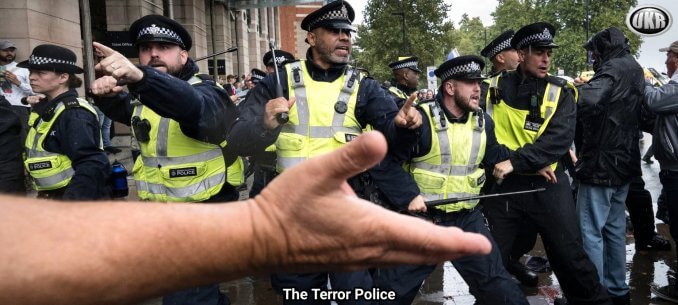
What makes this so dangerous is its creeping normalisation. The public is told that these men are “controversial,” that their views are “extreme,” and that extraordinary powers are therefore justified. But the measure of a free society is not whether it protects the speech of those who mouth platitudes; it is whether it protects the inconvenient, the unpopular, and the radical. Once we allow terrorism statutes to be applied to journalists and politicians whose only “crime” is opposition, we erase the line between democracy and despotism. The police, once imagined as neutral servants of the public, now operate more and more like an enforcement wing of the State’s ideological boundaries—a Gestapo in modern dress, wielding paperwork instead of truncheons, but no less effective in suppressing dissent.
One of the most disturbing aspects of these detentions is the near-total absence of rights for the accused. Under anti-terror legislation, the basic safeguards that protect citizens from state oppression are deliberately stripped away. Detainees can be compelled to answer questions, criminalised for remaining silent, and forced to surrender personal data without recourse to legal protections. The ancient right to silence, once a cornerstone of British justice, is suspended, replaced with an obligation to incriminate oneself or face further punishment. In such a setting, the presumption of innocence collapses, and the citizen stands naked before the State: guilty until proven compliant.
Throughout history, governments have seized upon crises, real or manufactured, to consolidate powers they would never otherwise have been granted. The Reichstag Fire in 1933 was exploited by Hitler to push through the Reichstag Fire Decree, effectively suspending civil liberties under the pretext of combating terrorism and sedition. Stalin, likewise, deployed the language of “counter-revolutionary” threats to justify purges and mass arrests and, like Starmer at the Labour Conference, casting critics as traitors and enemies of the people. Even in ostensibly democratic nations, emergency measures have been habitually abused. During the Red Scare in the United States, McCarthyist hysteria turned accusations into convictions, and “national security” became a cudgel with which to destroy careers and silence opposition.
Britain’s present abuse of anti-terrorism laws belongs firmly in this lineage of state tyranny. It is a repetition of the old, cynical tactic of weaponising fear to destroy dissent. Only the language changes. Where once it was “counterrevolutionaries” or “witches” or “enemies of the people,” today it is “terrorists” and “extremists.” But the logic is identical; any who challenge the ruling order must be delegitimised, silenced and, if necessary, criminalised.
Consider the absurdity of men like Craig Murray, a former diplomat, or Kit Klarenberg, a journalist exposing uncomfortable truths about the security state, being dragged into interrogation rooms under terrorism provisions. Their “weapons” are words, their “plots” are publications, their “conspiracies” are simply challenges to official narratives. Meanwhile, real acts of violence, grooming gangs, knife epidemics, and systemic failures in policing go unaddressed. The State is not protecting the people; it is protecting itself. It is not interested in truth; it is interested in control.
The hypocrisy is staggering. Successive governments justify their surveillance and policing powers by invoking the need to prevent bombings, shootings, and coordinated atrocities. Yet when such horrors do occur, as in Manchester or London Bridge, the same State apparatus proves lethargic, incompetent, or cowardly. Where it shows vigour, energy, and ruthless efficiency is in silencing inconvenient political speech. The inversion of priorities could not be starker: terrorism laws fail at fighting terrorism but excel at terrorising dissent.
Into this already dangerous mix now comes the looming spectre of digital ID systems. Promoted under the same tired slogans of “safety,” “convenience,” and “security,” these schemes represent nothing less than the mechanisation of state control over the individual. A digital ID is not a neutral tool; it is a tracking device, a tether between the citizen and the State’s databases, a mechanism for conditioning participation in economic and social life on obedience.
If the police already abuse terrorism powers to intimidate journalists, imagine what will follow once every citizen’s access to banking, healthcare, travel, and employment can be throttled or revoked with the click of a bureaucrat’s mouse. A dissident could find not only their articles suppressed, but their bank accounts frozen, their ability to travel curtailed, their very existence rendered unviable. The COVID-19 lockdowns offered a preview: “vaccine passports” were not simply about health; they were a proof of concept for conditional citizenship. Digital ID takes that template and hardwires it into the architecture of everyday life.
The chilling reality is that the infrastructure of tyranny is being built in plain sight. Anti-terror laws provide the pretext for targeting individuals. Digital IDs provide the machinery for punishing them. Together, they amount to a system where the State no longer needs to imprison its critics; it can simply erase them from economic and social participation. No jackboots required, just algorithms, databases, and the convenient fiction of “public safety.”
The defenders of these policies will scoff, as they always do, that such fears are “paranoid,” “exaggerated,” or “conspiratorial.” But history testifies otherwise. Every authoritarian system begins with incremental steps, justified by emergencies. Habeas corpus did not vanish overnight; it was whittled away. Free expression was not abolished in a single decree; it was suffocated under layers of regulation, surveillance, and intimidation. Today it is terrorism powers used against journalists; tomorrow it will be digital IDs switched off for “non-compliance.” The question is not if, but when.
And make no mistake: those who dismiss these concerns on the grounds that they “have nothing to hide” are the midwives of tyranny. Free speech is not for the comfortable majority; it is for the embattled minority. Rights are not gifts from the State, but bulwarks against it. Once surrendered, they are almost impossible to reclaim.
The backlash against these abuses must therefore be uncompromising. It is not enough to say, “I don’t agree that anti-terrorism laws should be used this way, but Tommy Robinson is a racist,” or “but George Galloway is a self-important blowhard socialist” That “but” is the thin end of the wedge used to crack all dissent. If the State can silence one, it can silence all. The principle is universal: the defence of free speech and due process is indivisible, or it is nothing.
Silence, in the face of these encroachments, is complicity. Everyone, journalist and citizen, who fails to speak up is laying the groundwork for their own silencing. Every citizen who shrugs because they feel unaffected is endorsing the creation of a system that will eventually ensnare them. The history of tyranny teaches us that repression does not stop at the first victim; it spreads, metastasises, and consumes all in its path.
If Britain is to avoid the fate the corrupt, treacherous Establishment has planned we must rediscover the spirit of liberty that once animated its political culture. Magna Carta was not drafted for the convenience of kings; it was wrested from them by a people unwilling to be ruled without restraint. The Bill of Rights of 1689, the Chartists, universal suffrage, all were born of struggle against the State’s impulse to dominate. Our age demands the same courage.
The misuse of anti-terrorism laws against critics of the State is not an aberration. It is the logical expression of a system that has come to see its own people as the enemy. This is not a future to await passively. It is a present reality to resist actively. For if we fail all we have to look forward to is high-tech feudalism. The time for complacency is over. The time for determined unyielding resistance is now.
See Related Article Below
The police are behaving like an occupying force
Our national flags should not be seen as dangerous or a provocation
Do British police see the nation’s flags as a threat? Protestors in Newcastle have been asking that question after two incidents took place during protests in the city centre on Saturday. Both were filmed and shared widely on social media.
One video shows a teenage girl standing exuberantly on a picnic table while waving a Union flag. A female police officer appears to tell the girl to climb down. Then a male officer wearing a blue “police liaison” tabard snatches the flag from the girl and crushes it into a ball. He leaves the area, apparently without returning her property, although a Northumbria Police spokesperson told me that the flag was returned later.
The other video features a man carrying an England flag on a pole. A group of police liaison officers confront him, with one telling him to “put your flag away until you get [to the protest] then”, before stating that “there’s conditions in place” which mean he can only fly the England’s flag in “designated areas”. On the video, locals can be heard expressing astonishment that Palestine flags are being freely flown by counter-protesters.
Nick Tenconi, Ukip leader and Turning Point UK chief operations officer, who was leading Saturday’s demonstration, is outraged, saying: “We live in a country filled with two-tier policing aimed at demonising patriots. We saw a Union flag snatched from a young girl, meanwhile the counter-protesters waving the Palestinian and Communist flags never have them snatched by the police”.
Northumbria Police said that it is “aware of video clips circulating online in relation to an officer removing a flag from someone during protest activity in Newcastle yesterday”, before going on to say that it “is important that these are put into context” and that “when a small number of people became close to a much larger protest group, action was taken to de-escalate tensions and help ensure the safety of all present”.
The police also acknowledged the other incident, saying they “are aware of a further video of someone being asked to lower a flag until they had reached the designated protest zone”. The spokesperson seemed to acknowledge that these officers may have overstepped their duties, saying Northumbria Police “will be reviewing what happened to identify any potential learning” and that they “recognise the right to lawful process” which they “will uphold”.
It’s worth pausing to consider what these incidents reveal. Some police officers believe that waving the flag of the United Kingdom might cause “tensions”, and that these risks are so serious that they justify snatching a child’s property. They also believe that the England flag is so provocative that they have a right, or even a duty, to ensure it is only flown in certain “designated areas”. In even plainer terms, the police force of the British state are treating the British and English flags as though their display is a threat to public order. This is astonishing. To fear a nation’s flags like this is more like the behaviour of an occupying force, than the police of a democracy..


Leave a Reply