

JOHN SURTEES
The Territorial Support Group was created in January 1987, and it has never escaped the shadow of its predecessor, the Special Patrol Group. The SPG was disbanded after the killing of Blair Peach in 1979 and a long record of accusations of brutality, racism, and (changing) political bias. The TSG was supposed to be a fresh start, a disciplined, centrally controlled unit that would provide the Metropolitan Police with a mobile public order resource without repeating the worst abuses of the past. Yet the same criticisms that dogged the SPG have followed the TSG for four decades, and for many the unit has become a visible emblem of state power turned against dissent.
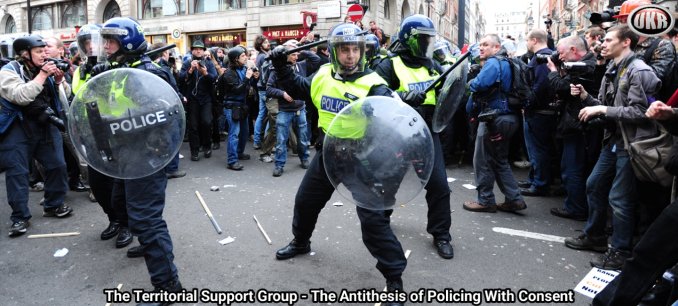
The purpose of the TSG was always clear. The Metropolitan Police wanted a squad that could be deployed rapidly to any part of London, one trained to handle large crowds, violent disorder, or situations where ordinary local officers were thought to lack the capability or the will to act decisively – and a squad that no connection with local people. To achieve that goal, the TSG was built around large vans that could deliver squads of officers in full protective kit directly into a flashpoint. When these vans arrive, they disgorge officers clad in helmets, carrying long batons and shields, ready to push, corral, or disperse crowds. This is the very opposite of community policing or policing with consent. It is the image of force, and that image has defined the TSG’s reputation from the start.
Officers do not join the TSG at the beginning of their careers. They apply after experience in regular borough policing. It attracts aggressive sorts who relish a fight, so long as they are the best equipped for one. Those selected undergo specialist training in public order tactics, rapid deployment, searching, and advanced driving. They rehearse riot-control scenarios and refresh their training regularly to ensure readiness. Supporters argue this professionalism makes them effective and disciplined. Critics argue it fosters a “paramilitary” mentality in which confrontation is normalised and the public, especially the patriotic white working class, are viewed as adversaries. The truth of that charge is borne out not just in perception but in a long history of controversies and tragedies.
The most infamous of these remains the death of Ian Tomlinson during the G20 protests in London in April 2009. Tomlinson was not part of the demonstration. He was simply trying to make his way home when he was struck and shoved to the ground by a TSG officer. He collapsed and died shortly after. Early police statements lied, but video footage taken by bystanders revealed the truth. The public was outraged. The Independent Police Complaints Commission was forced to investigate. The incident became emblematic of everything long alleged about the TSG: violent tactics, a culture of impunity, and dishonesty in the aftermath.
That protest produced many more complaints, with demonstrators and journalists describing how TSG officers kettled crowds for hours, struck out with batons, and treated peaceful citizens as threats to be pushed around at will. Reviews were conducted, recommendations were made, but little changed. That pattern has become familiar. Every major protest in London, especially patriotic anti-establishment ones, has seen the TSG deployed at the front line. Each time, footage emerges of aggressive tactics, and each time official investigations result, at best, in minor adjustments rather than structural reform.
It’s important to note that the TSG has been willing to use excessive violence in any context, against any group of demonstrators. The 2011 riots are a case in point. With unrest spreading across London and beyond, the unit was deployed on a massive scale. Some hailed their effectiveness in regaining control. But many felt brutalised, describing indiscriminate force and a siege-like atmosphere. The riots themselves were unjustifiable, but the TSG’s role was again one of force applied from above rather than policing by consent.
In more recent years, the events of 2020 and 2021 have altered the perception of the police even among those who had previously supported them. During the Covid-19 lockdowns, ordinary citizens who wished to protest against restrictions, many of them conservative, religious, or simply concerned for their freedoms, found themselves confronted by TSG carriers and helmeted officers. Peaceful demonstrators were kettled, arrested, or dispersed with force. Elderly citizens and families attending anti-lockdown rallies were treated as if they were rioters. By contrast, when other demonstrations aligned with progressive causes were held, policing was far more accommodating. For those who once instinctively supported the police, this double standard was a revelation. The police are not now neutral arbiters of order. They have become selective enforcers, aligned with political power. The TSG, in its unmistakable kit, symbolised this shift more clearly than anything else.
Environmental demonstrations have further reinforced the point. Groups like Extinction Rebellion and Just Stop Oil have engaged in highly disruptive tactics, blocking roads and interrupting daily life. The TSG has been deployed to clear them, but the manner of its engagement has varied. Sometimes officers have seemed strangely passive, standing by while protestors block traffic. At other times, when public pressure demanded tougher action, the TSG moved in with overwhelming force. To many observers this inconsistency showed that the TSG’s role is not governed by law or principle but by political calculation. They can act with ferocity when the state wills it, or they can stand back when the state finds it convenient. Either way, they serve power, not the public.
Oversight mechanisms have consistently failed to address these issues. The Independent Office for Police Conduct and its predecessor the IPCC have investigated numerous complaints, but few cases result in real accountability. The Mayor’s Office and London Assembly inquiries produce reports and recommendations, yet little changes. From the outside it appears that these structures are designed more to defuse public anger than to hold the TSG to account. Each new scandal follows the same cycle: outrage, investigation, recommendations, forgetfulness, and then repetition.
For conservatives who once admired the police as defenders of order, the cumulative effect has been profound. The police are no longer seen as neutral guardians of peace but as enforcers of conformity. The TSG embodies this change. It is centrally controlled, deployed without local accountability, and trained for confrontation. When its carriers appear, it is not a sign that the police are there to serve but that the state has chosen to impose its will. For those who value free speech and the right to protest, the TSG has become the clearest symbol of suppression.
The question today is not whether the TSG is necessary for public order but whether public order itself has become an excuse for the suppression of free expression. Repeatedly, protests that challenge the government or defy the prevailing consensus are met with the same sight: TSG vans, helmets, shields, and batons. The message is unmistakable. Where dissent arises, the TSG will be sent to contain it. Where ordinary citizens gather to express discontent, the TSG will enforce silence. The state does not fear disorder. It fears disobedience.
In the end, the Territorial Support Group is more than a police unit. It is a symbol of how far policing in Britain has drifted from the ideal of policing by consent. Born from the ashes of the SPG, it was meant to draw a line under the abuses of the past. Instead, it has carried them forward. Its very existence reminds us that the state prefers control to freedom, obedience to dissent. For those who once looked to the police as allies of liberty, the lesson is now unavoidable. The carriers and the helmets are not there for our safety. They are there to remind us of who is in charge.
John Surtees
Editor’s Note: I asked John if he knew about the Territorial Support Group referred to by Paul Sutton in his article on the 13 September demonstration and, if so, would he write about them. To my surprise the normally reluctant former soldier and officer with Northumbria Police, immediately put pen to paper, or fingers to keyboard, and sent me this. Thanks John, it’s very informative.

••••
The Liberty Beacon Project is now expanding at a near exponential rate, and for this we are grateful and excited! But we must also be practical. For 7 years we have not asked for any donations, and have built this project with our own funds as we grew. We are now experiencing ever increasing growing pains due to the large number of websites and projects we represent. So we have just installed donation buttons on our websites and ask that you consider this when you visit them. Nothing is too small. We thank you for all your support and your considerations … (TLB)
••••
Comment Policy: As a privately owned web site, we reserve the right to remove comments that contain spam, advertising, vulgarity, threats of violence, racism, or personal/abusive attacks on other users. This also applies to trolling, the use of more than one alias, or just intentional mischief. Enforcement of this policy is at the discretion of this websites administrators. Repeat offenders may be blocked or permanently banned without prior warning.
••••
Disclaimer: TLB websites contain copyrighted material the use of which has not always been specifically authorized by the copyright owner. We are making such material available to our readers under the provisions of “fair use” in an effort to advance a better understanding of political, health, economic and social issues. The material on this site is distributed without profit to those who have expressed a prior interest in receiving it for research and educational purposes. If you wish to use copyrighted material for purposes other than “fair use” you must request permission from the copyright owner.
••••
Disclaimer: The information and opinions shared are for informational purposes only including, but not limited to, text, graphics, images and other material are not intended as medical advice or instruction. Nothing mentioned is intended to be a substitute for professional medical advice, diagnosis or treatment.
Disclaimer: The views and opinions expressed in this article are those of the author and do not necessarily reflect the official policy or position of The Liberty Beacon Project.


