

JOANNA GRAY
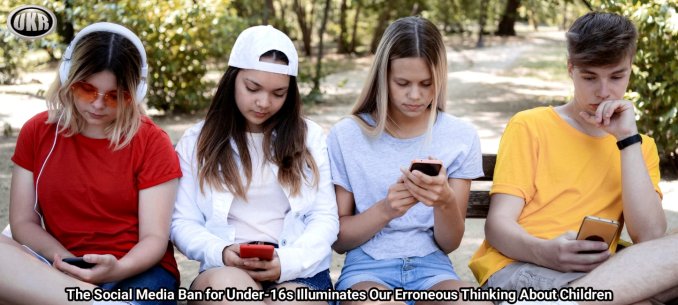
Is a potential social media ban for the under-16s the ultimate nanny state interference, the beginning of a full-blown censorship state, or a sensible decision to protect tech-addled children? It is probably all of the above. More uncomfortably, it throws much needed light on society’s misunderstanding about what it is to be a child, and even worse, parental neglect on a scale no-one is really prepared to admit.
The contemporary approach to children seems to be based on the idea that children are adults in small bodies. This has manifested in all sorts of monstrous ways. The most egregious is when police and social workers involved in the rape gangs suggested that children were able to ‘give consent’ to sexual activity. Not far behind is the foundational idea in the transgender ideology, that the thoughts of children concerning their sex are to be believed and acted upon. Gillick competency within medicine is the idea that certain children can drive their own treatment if they demonstrate sufficient understanding. Plans are afoot to let 16 year-olds vote in General Elections as they already can in local elections in Wales and Scotland. The age of criminal responsibility is 10.
These are extreme examples but the adultification of children is widespread and pernicious. At many schools, children are renamed students or learners. In medical and social work they even have their own acronym: CYP (children and young people). While ‘child-centred’ education and social work sounds great, it creates a mindset whereby children are deemed the best judges of what is best for them.
And yet neuroscience and most of British history until 1969, when the age of majority was lowered to 18, has it that the adult brain is not fully formed until the early to mid-20s. Victorian novels are filled with frustrated sons who couldn’t get their hands on their inheritance until, in some cases they were 30. When my parents went to university, the age of majority was still 21 and universities acted in loco parentis. Students were served three hot meals a day and their single-sex halls were overseen by some sort of matron.
Discussions about the potential social media ban happen in the context of this wider understanding of what it is to be a child. Is our above understanding right? I believe not: children and teenagers are in no way small adults. The change from an immature state of a human infant to a highly organised, specialised and functionally mature state of an adult is long and slow, and more closely maps on to pre-1969 ideas of adulthood than today’s.
The fact that some children look physically adult and can function reproductively does not follow that they are therefore adults. Brain maturation comes later, and with a fully formed brain comes impulse control, the ability to think and plan for long term, emotional regulation, and the capacity for complex decision-making. It is no surprise that with the general adultification of children we find that was once understood to be the natural behaviour of children is now diagnosed as ADHD, autism or a general mental health complaint. Boys of 13 for instance are expected to behave like the middle-aged women who teach them.
While there is a recognition of the physical immaturity of children – they are not allowed to smoke, vape or buy alcohol for instance – this is not sufficiently matched with similar recognition of mental maturity. If the brain immaturity of children is properly recognised again then a broader discussion is required about how parents and society care for children. If children are actually children, and not voters, or CYP, or students, or learners, or young adults, but children, then perhaps their parents need to take more active involvement in their care. And this is where things have the potential to get ugly.
I bumped into someone I hadn’t seen for a while the other day. “How are the children?” I asked. “Oh,” he sighed, “Just the usual, trying to get them off their screens, Roblox, Fortnite and all that.” I found it difficult to know how to respond. I imagine he expected me to say, “Yeh, I know, it’s a nightmare.” I rapidly changed the subject. But I did want to say, “They’re only nine and 11 your children, they are children, you are the adult. If you suspect they are being damaged by this activity, put a stop to it.” But of course, this attitude goes against our current social mores which insist children know best and who are we, their parents, to infringe their fundamental human rights to do what they like? I can’t be the only one who found it strange that Molly Russell’s father blamed his 14 year-old daughter’s suicide on social media rather than his ability to properly oversee her use of it.
If, however, we do recognise honestly that children are children and deserve to be treated as such, the ramifications could be dramatic. Suddenly nurseries from the age of three months might not look like such a good idea, school even at four seems a bit strange, independent living and full-on drinking culture at 18 perhaps not ideal, voting only when the frontal lobes have fused and complex thinking kicks in. The disappearance of all screens at home and in school would be the easy bit.
Joanna Gray is a writer and confidence coach.
This article (The Social Media Ban for Under-16s Illuminates Our Erroneous Thinking About Children) was created and published by The Daily Sceptic and is republished here under “Fair Use” with attribution to the author Joanna Gray

••••
The Liberty Beacon Project is now expanding at a near exponential rate, and for this we are grateful and excited! But we must also be practical. For 7 years we have not asked for any donations, and have built this project with our own funds as we grew. We are now experiencing ever increasing growing pains due to the large number of websites and projects we represent. So we have just installed donation buttons on our websites and ask that you consider this when you visit them. Nothing is too small. We thank you for all your support and your considerations … (TLB)
••••
Comment Policy: As a privately owned web site, we reserve the right to remove comments that contain spam, advertising, vulgarity, threats of violence, racism, or personal/abusive attacks on other users. This also applies to trolling, the use of more than one alias, or just intentional mischief. Enforcement of this policy is at the discretion of this websites administrators. Repeat offenders may be blocked or permanently banned without prior warning.
••••
Disclaimer: TLB websites contain copyrighted material the use of which has not always been specifically authorized by the copyright owner. We are making such material available to our readers under the provisions of “fair use” in an effort to advance a better understanding of political, health, economic and social issues. The material on this site is distributed without profit to those who have expressed a prior interest in receiving it for research and educational purposes. If you wish to use copyrighted material for purposes other than “fair use” you must request permission from the copyright owner.
••••
Disclaimer: The information and opinions shared are for informational purposes only including, but not limited to, text, graphics, images and other material are not intended as medical advice or instruction. Nothing mentioned is intended to be a substitute for professional medical advice, diagnosis or treatment.
Disclaimer: The views and opinions expressed in this article are those of the author and do not necessarily reflect the official policy or position of The Liberty Beacon Project.


Leave a Reply