


The self-defenestration of Sir Keir Starmer
HENRY HILL
In politics, as indeed in most things, it is very seldom a good idea to concede your opponents’ premises whilst asking the voters to reject their conclusions. For all that, it remains very common.
For it example, it was for some 20 years the only strategy employed by successive British governments to try and stave off the SNP. Time after time, act of parliament after act, professedly unionist politicians would make great show of what latest chunk they were carving off the United Kingdom. Unsurprisingly, conceding the central tenet of their case over and over again did not weaken the Nationists.
The same thing happened with Brexit, when David Cameron talked himself into a corner on a referendum and then found himself facing a steep uphill struggle to overcome the accumulated effect of his and his party’s posturing on Europe.
Now, Sir Keir Starmer looks to be once again teeing himself up for a command performance in the traditional ritual suicide of a British political consensus: opening the Overton Window real wide and then hurling oneself out of it.
That he made that immigration speech at all is significant; there may be no feeling behind the movement of a weathervane, but it does tell you where the wind is blowing. And parts of it were solid enough – the “nation of strangers” line, for example – to imply that some advisor or other believes it, at least.
But this is not a government that is grabbing the migration bull by the horns. It would be too dramatic a shift for an already unhappy Labour Party even if the Prime Minister and Cabinet were completely sold on it, which they are not.
Instead, what we are likely to see over the next few years is an incremental collapse of the status quo on immigration as a worried and reactive government makes piecemeal interventions which concede the premises of a new regime, but fails to follow the implications of its policies through to their conclusions.
Consider one example about which we wrote last month: the Home Office’s decision to start publishing league tables of foreign national offenders by country of origin. In itself, collating this data is simply pointless busywork on the part of the Government; the critical question is what do ministers do with it?
The logical next step – and what the people who advocated for this policy actually want – is for the information to be factored into the broader immigration regime, for example when setting visa policy. But even though Starmer has now opened the door to a more nationally-selective visa regime, there has been no commitment to use the data he has now tasked the Home Office with publishing.
What happens next is predictable enough: once this data starts coming out, Reform UK (or perhaps, in a happier world, even the Conservatives) start capitalising on it. Eventually, the Prime Minister makes some sort of policy on the basis of it. But he will arrive at that place with the minimum possible credit, because he visibly had to be dragged there.
Nor is that close to the end of it. My colleague Tali Fraser yesterday set out many more cases of where the British State could collect data on immigration, but doesn’t (or in some cases, more suspiciously, has stopped). Having sold the pass on the crime statistics, it will be very difficult for Starmer to resist the understandably-energised campaigners on the rest of it – and every dataset published will have its own policy implications.
That’s the tricky thing about data collection, at least by the state: it seems neutral, but it never is. Anything can be grist to some campaigner or other, and a political class of generalists and humanities graduates (of which I am one) is too easily bewitched by anything which can be put in a graph, however specious.
So the interesting thing about a state is which data it does and doesn’t collect. It says a lot about the UK (albeit nothing you didn’t already know) that the government mandates utterly tedentious “gender pay gap” reporting, which tries to present the mere fact of different employment patterns as a priori evidence of discrimination, but very little on the impact of immigration.
Likewise, it is no coincidence that the various devolved governments have made a point of changing how they collect data on things such as public service performance to make cross-border comparisons difficult or impossible to make, and past time HM Government mandated it be collected in a uniform manner. Such a policy would be difficult for the Nats to oppose – it sounds so neutral! But it would not, of course, be so.
But the biggest problem facing Starmer, and everyone else who finds themselves entrenched around this country’s collapsing immigration consensus, is the reason that nothing has been done about it before: it involves difficult trade-offs.
Remember, as I wrote on Friday, that the reason the Conservatives never managed to get sustainably ahead of Nigel Farage on immigration is that they never tried to. Instead, the invariable practice was to put a right-winger (real or nominal, viz. Priti Patel) in the Home Office to sound beastly and then let the Treasury, Business, and Education departments endlessly bid up the numbers.
More immigration is the policy equivalent of another hit for an opiod addict: it’s easy, it’s painless in the short term, and it postpones all your problems to another day. And like opiod addiction, it is a spiral, where the hits get shorter and shorter as the long-term toll gets more intense.
But the cruel irony is that the deeper you are into that spiral, the harder going cold turkey gets. The pain and misery of withdrawal is very real. In this case, we have an economy which has geared itself around the mass import of labour (or of clients, in the case of universities).
Employers (who responded to the creation of the Shortage Occupation Scheme by pleading more and more shortages) do not want to pay higher wages, or reinternalise the costs of training their workforce, no more than universities want to admit that there is no economically-viable or -useful way to put half of British school-leavers through a model of tertiary education evolved in the last century to cater to a single-figure percentage of each age cohort without the exponential import of students.
Meanwhile the Treasury, greatest and most terrible of all Whitehall powers, will never be sold on the logic of wasting 18 years gestating a taxpayer when you can just import one ready-made. Not only do you get a warranty on its access to public funds and save on all the schooling, but it avoids another labour unit (which we might call a parent) being taken off the GDP treadmill too!
Not for nothing do hold-out advocates of the status quo maintain that the ease with which the state can import-substitute the next generation of its own people is a very good thing indeed.
In each case, the alternative to hitting the “more immigration” button is initiating some extremely complex and difficult policy debates. Arrayed against any minister who tries will be energetic and well-funded lobbies, armed not only with more- and less-spurious charts but a knack for exploiting politicians’ greatest weakness: a deep unwillingness to be the bad guy in a meeting.
So good luck to the Prime Minister. Really. The course-correction upon which he has embarked is the right one. But I suspect the outcome of leaning this far out of the Overton Window will be his looking up at someone else’s grinning face from the very hard landing which awaits him beneath it.
This article (The self-defenestration of Sir Keir Starmer) was created and published by Conservative Home and is republished here under “Fair Use” with attribution to the author Henry Hill
See Related Article Below
Starmer’s Immigration Pledge: Token Gesture To Stave Off Populists
Shaving 100,000 off the figure will do little to address the genuine concerns felt by a majority of Brits
This post was republished with permission from Remix News
In response to growing electoral pressure from Reform UK and off the back of less-than-impressive local election results, U.K. Prime Minister Keir Starmer has vowed to finally radically reform Britain’s immigration system — but was accused of parroting right-wing rhetoric in a desperate attempt to stave off the populists.
At a press conference on Monday, the Labour leader outlined the details of a white paper designed to reduce net migration by the end of this parliamentary term in 2029.
It is worth noting that practically every British government in power this century has made such a pledge, yet net migration continues to run at astronomical levels compared to those witnessed prior to Tony Blair’s arrival in Downing Street back in 1997.
Starmer slammed the previous Conservative administration for further opening Britain’s borders despite vowing to do the opposite.
“In 2023, [net migration] reached nearly 1 million, which is about the population of Birmingham, our second largest city. That’s not control – it’s chaos,” he said.
This is my promise to British people:
Every area of our immigration system will be tightened up, so we have more control.
And migration numbers will fall. pic.twitter.com/iw5CnjxDUG
— Keir Starmer (@Keir_Starmer) May 13, 2025
Of course, net migration running at 1 million actually means the number of people coming to Britain every year is even higher — actual immigration into Britain exceeded 1.2 million in 2023, as cited by the House of Commons Library.
“Nations depend on rules – fair rules,” Starmer continued. “Sometimes they’re written down, often they’re not, but either way, they give shape to our values. They guide us towards our rights, of course, but also our responsibilities, the obligations we owe to one another. Now, in a diverse nation like ours, and I celebrate that, these rules become even more important. Without them, we risk becoming an island of strangers, not a nation that walks forward together.”
We’ll mark your actions, not your words, and so far you’ve done nothing. https://t.co/46gwjRV8GL
— m o d e r n i t y (@ModernityNews) May 14, 2025
The “island of strangers” line was picked up among both the right and left-wing press, striking a resemblance to a line once used by one Enoch Powell, a British nationalist and former Conservative government minister who was revered by many on the right (and berated by many on the left) for warning about the dire consequences mass immigration would bring to Britain.
Speaking about mass immigration in his famous ‘Rivers of Blood’ speech in 1968, Powell said,
For reasons which they could not comprehend, and in pursuance of a decision by default, on which they were never consulted, they found themselves made strangers in their own country.
Naturally, left-wing commentators in Britain — many of whom joined the Labour party under far-left leader Jeremy Corbyn but who have now grown tired of what they call Starmer’s “Red Tory” policies — noted the similarities between Powell and Starmer’s language.
Corbyn’s former right-hand man, John McDonnell, led the charge in attacking the Labour prime minister for “reflecting the language” of Powell, while Labour backbench MP Olivia Blake claimed the use of such a phrase could “risk legitimizing the same far-right violence we saw in last year’s summer riots.”
Those “riots,” of course, were instigated by the brutal murder of several young girls who were stabbed to death by the son of Rwandan immigrants, Axel Rudakubana, while they attended a Taylor Swift-themed dance class in Southport, north-west England.
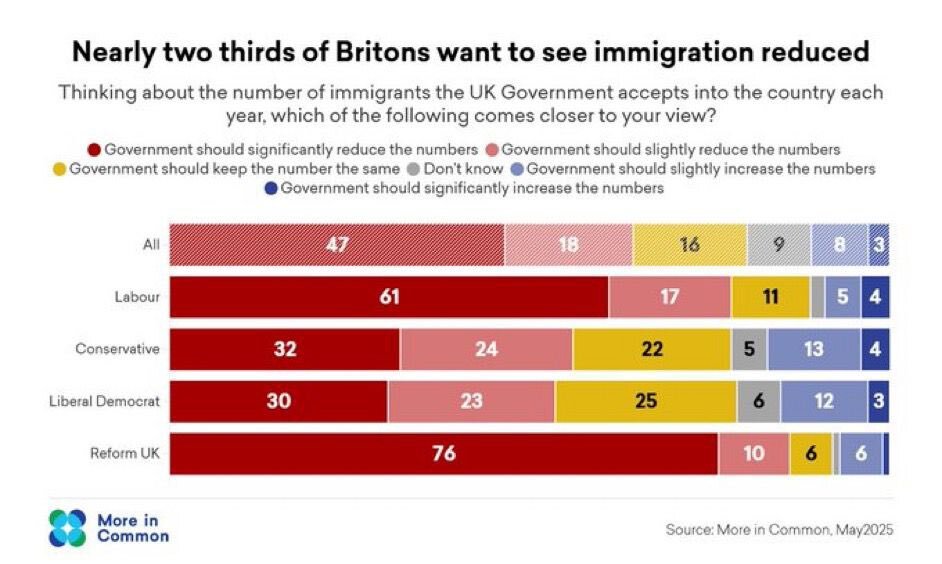
.
On Tuesday, Starmer’s official spokesperson “completely rejected” the comparison drawn in the speeches, insisting the prime minister “absolutely stands behind the argument he was making that migrants make a massive contribution to our country, but migration needs to be controlled.”
So, how exactly does Starmer plan to reform Britain’s immigration policy? Well, the white paper proposes raising skill and English language requirements, extending the timeline for settled status from five to ten years, and introducing stricter enforcement.
The goal, it says, is to prioritize migrants who contribute economically, reduce pressure on housing and public services, and ensure immigration serves the national interest. The system will link visa access to investment in British workers, making settlement a privilege earned through contribution.
The U.K. Home Office estimated the policies could lead to a 100,000 drop in net migration per year by 2029 — which frankly, is a drop in the ocean to what the British people expect when they talk about lowering immigration.
For reference, the former Conservative administration under David Cameron talked about decreasing net migration to the “tens of thousands” for over a decade, while the party’s time in government actually saw it rise to nearly 1 million.
The reality is that, even if Starmer was serious about measures to mildly reduce net migration, the figure would still be running at unsustainable levels and be wholly unacceptable to the vast majority of Brits who want genuine reform on the issue.
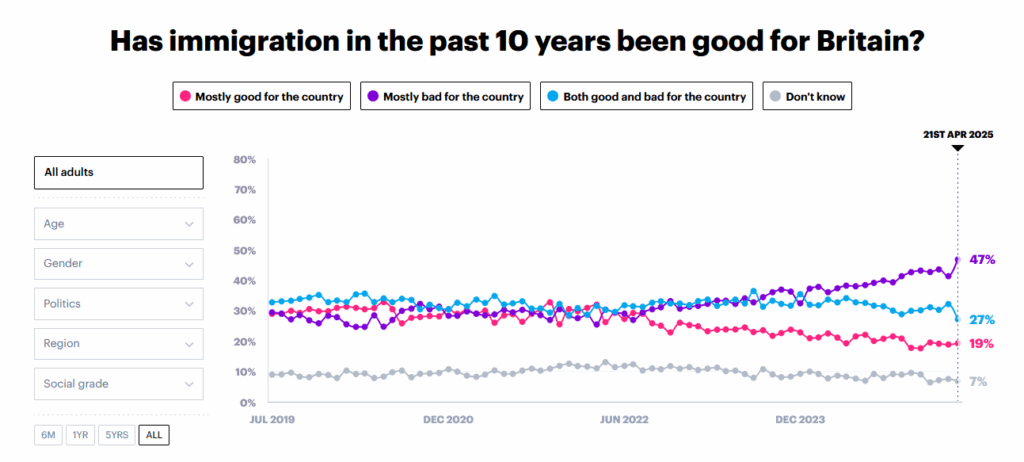
YouGov’s tracker poll on whether immigration into the U.K. has been good or bad for the country over the past decade — last updated in April — shows 47 percent believe it has been bad compared to 19 percent who think it has been good. That 47 percent is the highest ‘bad’ has been since the tracker started in 2019.
.
And this sentiment is what Reform UK is looking to exploit. The party’s populist leader, Nigel Farage, immediately dismissed Starmer’s speech as a token gesture that he not only cannot deliver, but deep down has no desire to deliver.
Taking to X, Farage posted a video of Starmer from his time in opposition, where he called upon Labour to make the case for the “benefits of migration and the benefits of free movement,” also known as open borders.
Starmer is a hypocrite who believes in open borders.
Here he is making the case for freedom of movement just a few years ago.
Nobody believes a word he says. pic.twitter.com/D2JBUxT740
— Nigel Farage MP (@Nigel_Farage) May 12, 2025
The Reform UK leader called Starmer a “hypocrite,” and insisted his government would not do what it takes to control Britain’s borders.
“Only Reform UK will leave the European Convention on Human Rights (ECHR) and deport illegal migrants,” Farage added.
In the minds of the British public, Farage’s party is best placed to tackle mass immigration, with 27 percent of respondents to a YouGov poll published yesterday backing Reform UK to handle the issue effectively — nearly three times more than the 10 percent that trusts Labour.
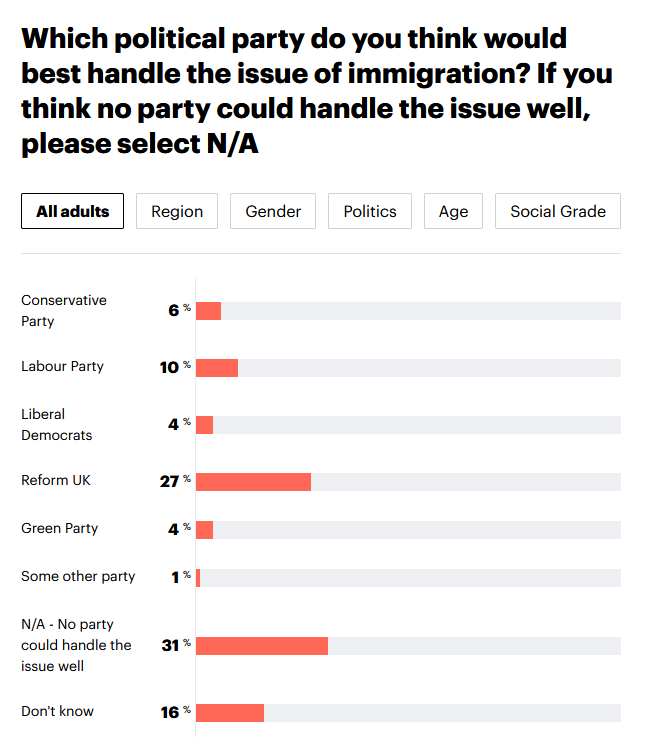
However, after years of mistruths and Brits witnessing the direct opposite of what they were promised by elected politicians on the matter, huge skepticism exists among the people — nearly half of all respondents believe that either no party can handle the issue well, or do not know who can do so.
Your support is crucial in helping us defeat mass censorship. Please consider donating via Locals or check out our unique merch. Follow us on X @ModernityNews.
SOURCE: Modernity News

••••
The Liberty Beacon Project is now expanding at a near exponential rate, and for this we are grateful and excited! But we must also be practical. For 7 years we have not asked for any donations, and have built this project with our own funds as we grew. We are now experiencing ever increasing growing pains due to the large number of websites and projects we represent. So we have just installed donation buttons on our websites and ask that you consider this when you visit them. Nothing is too small. We thank you for all your support and your considerations … (TLB)
••••
Comment Policy: As a privately owned web site, we reserve the right to remove comments that contain spam, advertising, vulgarity, threats of violence, racism, or personal/abusive attacks on other users. This also applies to trolling, the use of more than one alias, or just intentional mischief. Enforcement of this policy is at the discretion of this websites administrators. Repeat offenders may be blocked or permanently banned without prior warning.
••••
Disclaimer: TLB websites contain copyrighted material the use of which has not always been specifically authorized by the copyright owner. We are making such material available to our readers under the provisions of “fair use” in an effort to advance a better understanding of political, health, economic and social issues. The material on this site is distributed without profit to those who have expressed a prior interest in receiving it for research and educational purposes. If you wish to use copyrighted material for purposes other than “fair use” you must request permission from the copyright owner.
••••
Disclaimer: The information and opinions shared are for informational purposes only including, but not limited to, text, graphics, images and other material are not intended as medical advice or instruction. Nothing mentioned is intended to be a substitute for professional medical advice, diagnosis or treatment.
Disclaimer: The views and opinions expressed in this article are those of the author and do not necessarily reflect the official policy or position of The Liberty Beacon Project.


ILLEGAL immigration. Starmer seems to be above the law. ILLEGAL.