

The return of race
Maybe Englishness can be learned, but can being English?
FREDERICK EDWARD
Of all the talking points destined to render you persona non grata at a nice dinner party or equivalent, that of race ranks about the highest. It is perhaps the surest thing of all to make sure you are never again invited over for a spot of middle-class hobnobbing, even more socially deleterious than exposing oneself at the dining table or cleaning one’s toenails with the host’s best silverware.
That is, to say, discussion of race under certain circumstances. Whilst having grown up in an era where stating ‘I am colour-blind’ was the most definite marker of moral rectitude, such quaint notions have fallen into abeyance amid a clamour to racialise each aspect of our lives.
Race is simultaneously everywhere and nowhere. A bit like God, in that sense, although the left would naturally beat back any comparisons to anything as ‘irrational’ as religion.
It has been, until late, broadly denied that white people exist. Naturally they do as a mere physical fact – acknowledged like the presence of a stinking fart in a poorly ventilated room – but regards culture, history and the rest, they are effectively non-existent: unless, of course, you are acknowledging whitey’s various historical and ongoing sins. In this instance, whitey can be summoned as a sociological scapegoat.
All achievements of Western civilisation are put down to others: a brown rainbow of talent is, invariably, responsible for each invention erroneously attributed to a white-skinned devil. At its more entertaining fringes, such a mindset extends to assertions that various historical whiteys like Shakespeare are, in fact, black. At its more mundane and every day, people of darker hues are held as responsible for ‘building’ Britain after our second go at a World War, and that without such an influx of bus drivers and nurses we would still today be sitting amid the ruins of the Blitz.
Naturally both assertions are preposterous. Yet in a world in which preposterousness is a valuable currency, such baseless claims can be shamelessly made by race grifters of all sorts.
To return to foecally-inspired comparisons, I do not think myself alone in regarding the topic of race as something unpleasant – like discussing a bowel movement or the consistency of one’s stools with a co-worker. Perhaps there are moments, in extremis, where broaching such a topic necessary, but on the whole it is undesirable.
Such a stance, however, has long hamstrung ol’ whitey. An intellectual environment which precludes the acknowledgement of one’s ancestors other than in a voice of unrepentant hostility, and a society which has elevated ethnic self-flagellation to the highest virtue has led headlong into the increasingly disastrous political landscape of our modern day.
As such, it is increasingly the case that discussions of race – and with it, nationality – have re-emerged. With discussions about whiteness banished to the realms of the political proscription for many decades, the veritable pressure cooker is the is starting to blow in real time.
There is good cause for this. There are tracts of this country where the native Anglo-Saxon is not a minority but entirely absent. Take a walk down the high streets of many towns and you will be unlikely to see a single pale face. We are demanded to believe that all these people, despite living in ghettoised communities, will soon be as English or British as someone with a direct line of ancestry to Anglo-Saxon England. On the whole, however, people remain unconvinced.
Articles have begun to emerge discussing this issue. A recent talk entitled ‘How to save England’ has made minor media waves due to an audience member’s assertion that being English had something intrinsically to do with one’s ancestry. Robert Tombs, in attendance, pooh-poohed such a notion, claiming that Englishness can be learned. One attendee wrote a good summary, noting that the attendee’s statement had the effect of “a dam breaking: suddenly, thunderous applause and whoops filled the 200-seat lecture theatre.”
Of all political issues, that of race is one which most greatly divides the generations. My observation is that is the young who are more insistent on asserting an ethnically determined, and thus exclusive, principle of identity. This can be easily explain by them being the ones who witnessed the history defining turbo-transformation of many parts of the country in real-time and who had to live in closest proximity to its after-effects. The negative consequences of mass migratory flows – the unaffordability of housing, competing with the many thousands of foreign graduates for jobs, the necessity of living in ‘diverse’ areas – these are all sobering reminders of the fact of rapid change, and which stand in resolute contrast to the pleasant, self-congratulatory beliefs of previous generations.
Not to say that the public have previously been wholly in favour of mass migration. We all know that at every chance given, the British electorate voted against more immigration. However, I still believe that the conception of belonging now differs generationally.
This makes intuitive sense, too. I speak personally when I say that, say two decades ago, my view on Indian migration was largely positive: growing up, the Indians I went to school with were the children of doctors, dentists and accountants, and most of them held similar professional ambitions. Today, the Indians I generally see in London work menial jobs and are far less assimilated than previous waves. The Indian doctor has given way to the surly minimum wage customer service worker, dishing out chips at Burger King.
This generational divide once again broke at another talk I recently attended. The issue discussed was how to fix the sorry state we’re in. Given the enormity of the impending catastrophe, we were reduced to being advised to write to our local councillors. You have to start somewhere, I suppose, but many in the room felt we were past such a stage, given the relentless failure and disappointment of putting faith in the ‘democratic’ process.
One young chap spoke up and put the cat among the pigeons. It was, he stated, impossible for such solutions to work given that the demographic transformation of the country was so far gone. It was, he believed, time to reassert the right of the Britons to inhabit their own lands. Foreign criminals and those unwilling to integrate should be sent packing.
Within moments he locked in a war of words with a Boomer who stated that defining what it is to be ‘British’ is effectively impossible and therefore shouldn’t even be attempted. As Dr Tombs believes, this older gentleman held the formerly ubiquitous view that an identity is learnable and can be acquired.
I remain unconvinced. We can simultaneously hold an ethnic and a civic identity. My being English does not preclude others from living in England, but it does mean that I have historical and emotional ties that others would not, and nor would I expect them to have. Were I to live in Japan, I may very conceivably speak excellent Japanese and be well integrated into Japanese culture, but to demand that I be considered Japanese would see me laughed out of the room – assuming that the forever polite Japanese were rude enough to do so. Ultimately, the country is theirs.
Maybe Englishness can be learned, but being English cannot.
Maybe under laboratory conditions where a very small trickle of people enter the country, and who are selected on their ability to assimilate and their contribution to the furthering of the nation, then the formerly held notion of identity could have held and this discussion would not have been needed. As with any societal experiment, however, ours has been pushed too far. This is always the case: every revolution does not know where to stop and descends invariably into insanity.
As such, the necessary corrective will become all the more extreme. That extremity, however, is only in proportion to the damage inflicted upon the nation. Given that we Britons have nowhere else to go – nowhere else to call home should it here fall apart – it seems that a reassertion of our identity is all but inevitable.
This article (The return of race) was created and published by A Last Bastion of Sanity and is republished here under “Fair Use”
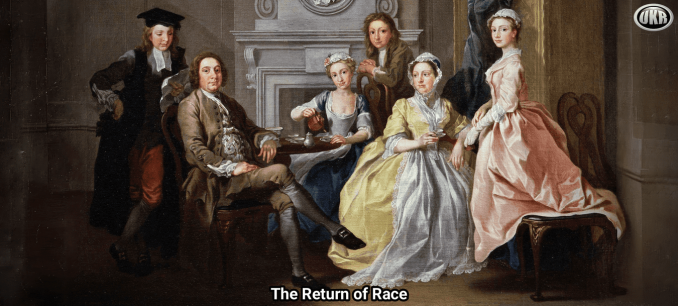
Featured image: Wikimedia Commons – Jonathan Tyler’s and his family by Francis Hayman

••••
The Liberty Beacon Project is now expanding at a near exponential rate, and for this we are grateful and excited! But we must also be practical. For 7 years we have not asked for any donations, and have built this project with our own funds as we grew. We are now experiencing ever increasing growing pains due to the large number of websites and projects we represent. So we have just installed donation buttons on our websites and ask that you consider this when you visit them. Nothing is too small. We thank you for all your support and your considerations … (TLB)
••••
Comment Policy: As a privately owned web site, we reserve the right to remove comments that contain spam, advertising, vulgarity, threats of violence, racism, or personal/abusive attacks on other users. This also applies to trolling, the use of more than one alias, or just intentional mischief. Enforcement of this policy is at the discretion of this websites administrators. Repeat offenders may be blocked or permanently banned without prior warning.
••••
Disclaimer: TLB websites contain copyrighted material the use of which has not always been specifically authorized by the copyright owner. We are making such material available to our readers under the provisions of “fair use” in an effort to advance a better understanding of political, health, economic and social issues. The material on this site is distributed without profit to those who have expressed a prior interest in receiving it for research and educational purposes. If you wish to use copyrighted material for purposes other than “fair use” you must request permission from the copyright owner.
••••
Disclaimer: The information and opinions shared are for informational purposes only including, but not limited to, text, graphics, images and other material are not intended as medical advice or instruction. Nothing mentioned is intended to be a substitute for professional medical advice, diagnosis or treatment.
Disclaimer: The views and opinions expressed in this article are those of the author and do not necessarily reflect the official policy or position of The Liberty Beacon Project.


Leave a Reply