

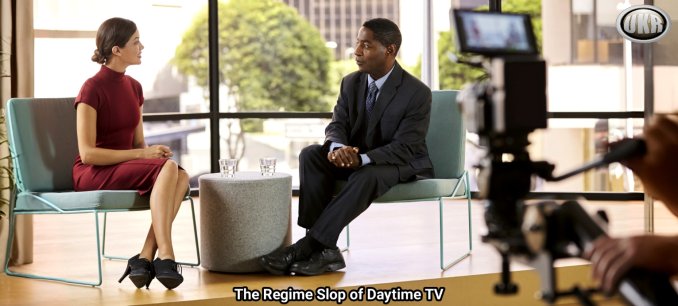
The regime slop of daytime TV
Establishment propaganda is being forced down the throats of the old, the ill and the unemployed
RHYS LAVERTY
Much is made in the media currently of Reform UK’s “daytime TV” aesthetic. This is shorthand for their supposed appeal to the salt of the earth white working-class types — the Sharons and the Deanos, with their plush grey front rooms, massive tellies, and even bigger L-shaped sofas, who like a few beers or a cheeky prosecco and know a nonce when they see one.
Andrea Jenkyns performing “Insomniac” in sequins, Jeremy Kyle toying with running as an MP, Nigel Farage coming third on I’m A Celeb in 2023 — it all adds up to what Gareth Roberts called a “glorious campness” which taps into the cheap and cheerful, slightly gaudy sensibilities of much of the British electorate, sensibilities which encompass prime time TV as much as daytime. Although I am solidly middle class myself, and don’t indulge in much terrestrial TV, daytime or primetime, these are very much my people, for whom I have a great deal of affection. I have close relatives who regard Jeremy Vine (broadcast every weekday on Channel 5 from 9:15 to 11am) as such unmissable telly that they record it on Sky+ so they can watch it back later.
The slop churned out by our terrestrial channels … serves as a form of regime propaganda far more often than many bourgeois right-wing reactionaries like to think
It is a comforting thought for the British right at present that there is a perfectly overlapping Venn diagram of those in the population who quietly consume hours of Good Morning Britain and Bargain Hunt and those who would vote for a sensible centre-right party that genuinely wants to stop the boats, massively reduce legal migration, and bury wokeism for good.
Yet the fact is that the slop churned out by our terrestrial channels, whether daytime TV or primetime evening reality shows, serves as a form of regime propaganda far more often than many bourgeois right-wing reactionaries like to think.
Far from being the great white hope, the daytime and primetime TV crowd have regime doggerel wedged down their necks as much as anyone. It just arrives in a certain low- to middle-brow format.
I have a name for it: slopaganda.
A perfect example is Channel 4’s Gogglebox. Like all TV series that claim to show “real people” and perhaps once did, it has long since transmogrified into a bizarre, self-aware kind of performance art which serves as a launchpad for astro-turfed influencers. Gogglebox’s rich tapestry of “real England” somehow seems to be universally in-step with the views of liberal Guardian readers or the kind of people who happen to produce Channel 4 shows. They deliver their verdicts on political news segments with all the authenticity of a Morse-code blinking hostage insisting to the cameras that he’s perfectly happy chained to his radiator.
Consider a clip from 2024, in which participants watched ITV news coverage of Lee Anderson being ejected from the Conservative Party for claiming that Sadiq Khan is under the control of Islamists. Khan branded this “racist”, and Anderson lost the Tory whip before joining Reform. Every single comment on Anderson, from a swathe of ostensibly working glass Goggleboxers from the length and breadth of the country, was overwhelmingly negative:
“He appeals to a certain voter demographic, doesn’t he?”
“How do you say that with confidence, please?”
“He’s refusing to apologise—what a knobhead!”
“Luckily, we’re clever enough to know that it’s wrong, but you’ll get people in this world that think ‘that’s fine!’”
“Surely we should not be rewarding people like that!”
My favourite, entirely unstaged line, delivered in a thick Northern accent: “I mean, we’re a multicultural society. You can’t be inciting hatred”. I was waiting for her to reel off the Five Fundamental British Values next, one finger at a time.
No one mentioned, of course, that Khan is the mayor of a heavily surveilled city in which “pro-Palestine” protestors can shout through their sunroof, in broad daylight and in the middle of the street, about killing Jews and raping their mothers and daughters, and have charges dropped due to lack of evidence.
Clever clogs among you might point out that original cast member Andrew Michael stood as a UKIP candidate in 2015, or how poshos Steph and Dom famously had a sit down with Nigel Farage in 2014. But these are the exceptions that prove the rule and were perhaps more tolerable to producers when Farage and Brexit still seemed like the butt of the national joke rather than a serious threat to the Establishment.
It’s easy to pick on Channel 4 though. Let’s consider ITV2, and the 2025 series of Big Brother, in which contestant Caroline Monk was publicly shamed by her fellow contestants, the showrunners, and the public for “misgendering” a fellow housemate. This is remarkable given that the show’s target audience (around 1 million viewers) are supposedly the anti-woke, daytime TV-watching would-be Reform voters. Even more remarkably, this seems to be the demographic of most of Monk’s fellow contestants, yet they come down on her like pigeons on a chip. It’s a strange experience to hear the word “heteronormative” delivered with disdain in a contemporary working-class brogue, but here we are. The scene was clearly a gift to progressive-minded producers: a real-time, organic show trial for uncouth middle-aged women like Caroline who think, controversially, that if “you don’t have a willy” then you aren’t a man.
Or how about Adil Ray and Kate Garraway’s derailed interview with 100-year-old veteran Alec Penstone on Good Morning Britain? After being hailed for his WW2 service in the 2025 Remembrance Day celebrations, Penstone veered wildly off-course, like some kind of Anti-Captain Tom, bent on destruction, shaking his head at the state of contemporary Britain and opining “the sacrifice wasn’t worth the result that it is now”. You could almost hear the producers bellowing in the presenters’ earpieces to “SHUT IT DOWN!” Garraway condescendingly smothered Penstone with shallow thankfulness and closed out the segment. (452 complaints to Ofcom).
The list goes on: The Traitors recently featured a gay contestant lending his voice to the highly spurious campaign to outlaw so-called gay conversion therapy; in 2024 the Antiques Roadshow refused to value an ivory bangle linked to the slave trade; Loose Women has spent a decade carrying water for men who pretend to be women.
The idea of daytime TV viewers as a quiet but radical moral majority who will ride to conservatism’s rescue at the ballot box is something of a comforting fairytale for young middle-class conservatives who rarely tune into the slopaganda themselves. The reality is much more mixed. If you think otherwise, you don’t know the difference between someone who reads The Sun and someone who reads The Mirror.
This is not to say there isn’t a genuine groundswell of support for serious changes to immigration and wokeism among the daytime TV crowd. Reform UK’s ever-surging polls and membership numbers can’t be argued with on that score. Neither can things like Reform UK pubs.
Despite the dominance of slopaganda, lowbrow TV still provides far more opportunities for the concerns of average Brits to break through than does, say, Radio 4. For instance, Rylan Clark (who is surely one of Britain’s daytime/primetime TV personae extraordinaire) ruffled a few feathers on This Morning last summer, when he remarked on the scandal of rolling out the red carpet for illegal migrants when so many Brits are struggling. But for once, he wasn’t tutted out of the room (despite 576 Ofcom complaints) and was praised by many for giving voice to what many feel is an intuitive, reasonable position. And Jeremy Vine, to his credit, features frank right-wing criticism of immigration on his show (though usually in a hilarious pitched battle against intensely left-wing opposition that reaches WWE levels of cartoonish antagonism).
So slopaganda cannot totally suffocate dissent. The rise of alternative media certainly gives many Brits better hopes than ever of escaping the narratives forced upon them by our elites, whether online, via things like Twitter, or on TV, via GB News (which has been beating Sky and BBC News in viewing figures for six months straight).
But the slopaganda is far more widespread than many would like to think. And we should likely expect it to intensify as the powers that be begin moving through the gears in their attempt to stop an upset at the next general election. In 2020, Rylan Clark might well have been shown the door for his comments on immigration. In 2025, he got away with it. But what will the slopaganda producers think in 2029? Maybe turn off the streaming services, unfurl that dusty aerial cable hanging out of the wall and coiled up in the corner, and tune in on a weekday morning to find out.


Leave a Reply