

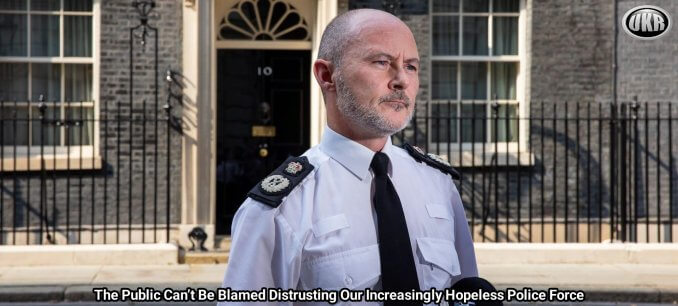
The public can’t be blamed distrusting our increasingly hopeless police force
Street thieves operate with relative impunity because the chances of a bobby on the beat turning up are nearly non-existent
A rare thing at which this Government is brilliant is creating an impression of uselessness about the well-being and security of the public. Illegal migrants surge into Britain, some of whom are criminals who attack women and commit robberies. Not content with that, our Prime Minister (though he has since retracted his enthusiasm) rejoiced at the legal entry of Alaa Abd El-Fattah, who not only has expressed his hatred for Zionists but what he called “white” people too.
This would be serious even were policing in this country effective in fighting the misery and danger such people bring, adding to our own degenerate criminal class: but it is not. Last week Gavin Stephens, a former chief constable who chairs the National Police Chiefs’ Council, advanced the theory that raising police numbers alone would not reduce crime. He wanted more advanced technological solutions, such as facial recognition cameras.
He might have added that, if more criminals were arrested, we would benefit from having more judges to try them, more courts re-opened to process them, a Crown Prosecution Service that does its paperwork on time so cases could proceed, and prisons to lock them up in; not to mention the will to deport criminal aliens at once. However, under the gormless rule of David Lammy at the Ministry of Justice, one might as well hope to turn on the tap and have champagne flow from it.
Mr Stephens justifies his point about the futility of the “mini-arms race” of increasing police numbers by arguing that increases of 20,000 officers under the last Conservative administration, and a promised 13,000 under this Labour one, make no difference. The public profoundly disagree.
Just before Christmas, when London’s West End teemed with shoppers, I walked from Marylebone to Covent Garden, through Oxford Street, Regent Street, Piccadilly Circus and Leicester Square one early evening, and did not see any police. The area has the highest incidence in the country of robberies, be they of smartphones, Rolexes or other high-value items. Perhaps I do the police a disservice; perhaps the area was saturated with plain clothes officers. I doubt it.
Also, shopping areas are plagued by shoplifters. Between 2015 and 2025 the number of such offences rose from 326,000 to 530,000, having risen by a fifth in the last year alone. Around 40 per cent of shoplifters get a month or less in prison. How on earth do our retailers, already punished by the idiotic taxation regime of this Government, survive?
Mr Stephens points, justifiably, to the huge amount of crime now committed digitally, and resources pumped into catching scammers and other fraudsters. But that does not alter the fact that many feel unsafe on the streets of London and other major cities, even in broad daylight. Street thieves and shoplifters operate with relative impunity because the chances of a bobby on the beat turning up are nearly non-existent. Sir Sadiq Khan, the Mayor of London, shrugs off criticism of crime in the capital, but in 2024 the Met caught only a dismal one in 19 robbers, one in 76 bicycle thieves and one in 179 pickpockets. So far, the Government has not held him, a Labour functionary, to account.
Unfortunately for Mr Stephens policing, like politics, is about perception. The public perceive phone snatchers and Rolex rippers getting away with it while the police are invisible. There is a vast anecdotage about stolen phones and cars with tracking devices being located by owners, but the police doing nothing to retrieve them and arrest the culprits. Shopkeepers are warned against apprehending criminals who walk in, fill their pockets or bags, and walk out. Sometimes the police catch them, mostly they do not, but it is too late: the economic and moral damage is done.
A clue to the Government’s warped priorities when it comes to protecting the public and upholding the law was given last week by Paul Ovenden, former director of political strategy to the prime minister. He said the El-Fattah case exemplified “the sheer weirdness of how Whitehall spends its time”, saying the Starmer administration had lost control of the civil service, which pursued an agenda either irrelevant to the needs of the public, or generally offensive to them.
The Telegraph: continue reading
Featured image: The Telegraph


Leave a Reply