

Structural Causes and Comparative Evidence
STEVEN BARNES
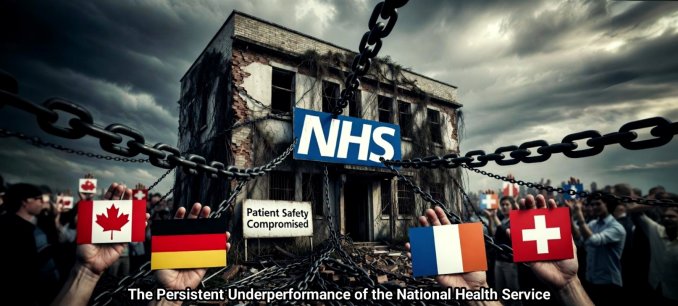
Recent analysis from the Global State of Patient Safety 2025 report, produced by the Institute of Global Health Innovation at Imperial College London and Patient Safety Watch, places the United Kingdom in the bottom third globally, 141st out of 205 countries, for deaths arising from adverse effects of medical treatment, with a rate of 1.8 per 100,000 population, exceeding that in Sudan (1.6 per 100,000). War torn Sudan has more than halved its figure over the past quarter-century, while Britain’s has deteriorated from 1.5 per 100,000. Within the OECD group of 38 mostly high-income nations, the UK ranks 21st for patient safety. The ranking draws on four key internationally comparable indicators: maternal mortality, neonatal disorders, treatable mortality (deaths from conditions such as sepsis, venous thromboembolism, and certain surgical complications that should be largely avoidable with timely intervention), and deaths due to adverse effects of medical treatment – that is, mistakes by doctors.
These figures form part of a wider pattern of inferior health outcomes relative to most developed economies. The OECD’s Health at a Glance 2025 reports the UK’s preventable mortality rate at 156 per 100,000 population, well above the OECD average of 145; while treatable mortality stands at 71 per 100,000. Had we matched Switzerland’s performance, using the latest comparable data from 2021, approximately 22,789 fewer deaths would have occurred in that year alone, equivalent to roughly 60 preventable deaths daily.
Surgical complication rates for procedures including coronary artery bypass grafting, hip or knee replacement (deep vein thrombosis), and abdominal surgery (sepsis) remain among the highest in the OECD for several indicators. Neonatal mortality has remained the same since 2017 while the OECD average has declined. Elective waiting lists for hospital treatment stood at 7.31 million cases in November 2025 (representing approximately 6.17 million individual patients), with around 154,000 waiting over a year. The 18-week Referral to Treatment standard has not been met nationally since 2015, with only about 62–65 per cent of patients seen within target. Cancer waiting times are similarly poor: the 62-day standard from urgent referral to first treatment was met in only 70.2 per cent of cases in November 2025 (target 85%), and the 31-day decision-to-treat standard in 91.7 per cent (target 96%). General-practice access remains constrained, with surveys and data indicating average waits for non-urgent appointments often exceeding two weeks in many areas, alongside rising reliance on telephone or online triage that frequently filters rather than satisfies demand.
Such outcomes are not anomalous but follow directly from the NHS’s foundational design as a centrally planned, tax-funded monopoly. Established in 1948 by the Attlee Labour government under Aneurin Bevan, the service nationalised existing voluntary and municipal hospitals, creating a tripartite structure of hospitals, general practice, and local authorities under direct ministerial direction. Bevan’s approach, candidly described in his own account as “stuffing mouths with gold” to secure consultant cooperation, ensured unified political control rather than incremental reform of pre-existing provision. The explicit aim was to consolidate state power over a key social service, aligning with broader socialist objectives of equality through central allocation rather than market or pluralistic mechanisms. This political construct prioritised ideological uniformity and Labour’s electoral base among working-class voters and trade unions over operational efficiency or patient choice.
Centralised, top-down management in socialist models predictably produces indifferent, bureaucratic organisations. Resource allocation occurs via political negotiation and formulae rather than price signals or competition, leading to rationing by waiting list rather than need or willingness to pay. Incentives for productivity are weak: staff receive salaries irrespective of outcomes, and providers face no threat of bankruptcy from inefficiency. Layers of administration from NHS England, integrated care boards, trusts, regulators such as the Care Quality Commission, absorb significant resources while diffusing accountability. Clinical decisions are increasingly shaped by national guidelines, targets, and audits, which can distort priorities (for instance, meeting four-hour A&E targets at the expense of appropriate triage). The result is a culture of risk aversion, defensive medicine, and procedural compliance over innovation or responsiveness. Empirical observation across socialist health systems, from the former Eastern Bloc to Cuba and Venezuela, reveals comparable patterns: chronic shortages, queueing, black-market supplements, and eventual reliance on user charges or private escape valves despite official prohibition.
Mass immigration has compounded these pressures; the NHS has served as an instrument for advancing multiculturalism. Net migration has driven most UK population growth since the 1990s, adding millions of residents whose healthcare utilisation falls upon the public purse. The NHS workforce relies heavily and deliberately on overseas recruitment, approximately 13–15 per cent of staff overall, rising to one in four nurses trained abroad, predominantly from India, Nigeria, the Philippines, and other low- and middle-income countries. While this addresses immediate vacancies it masks, again deliberate, domestic training shortfalls and incurs substantial recruitment, language, and integration costs. Higher fertility rates and differing morbidity profiles, such as those stemming from ‘cousin marriage’ among some migrant groups increase demand for maternity, paediatric, and chronic-disease services. Translation, cultural-competence programmes, and management of imported infectious diseases further strain finite resources.
Politically, the NHS has been portrayed as emblematic of multicultural success; “the world in one organisation”, with recruitment drives and diversity quotas framed as moral imperatives. This ideological overlay diverts focus from core clinical competence toward equity, diversity, and inclusion training, unconscious-bias modules, pronoun policies, and rainbow-badge initiatives. In extreme cases, such as aspects of gender-identity services (notably the Tavistock clinic, later disbanded following the Cass review), ideological capture demonstrably compromised evidence-based paediatric care. The organisation thus appears more devoted to signalling progressive values than to maximising throughput or safety.
Systemic inefficiency becomes evident even in brief contact. While many individual clinicians and nurses demonstrate dedication and skill, the organisation frustrates their efforts through outdated IT systems, bed shortages, corridor care, administrative overload and basic inefficiency. Patients encounter automated phone systems, triage delays, cancelled operations, and fragmented continuity. These frictions are structural, not personal failings.
Specific failures illustrate the consequences. The Liverpool Care Pathway for the Dying Patient (LCP), widely implemented until its supposed withdrawal in 2014 following the Neuberger review, exemplified target-driven distortion of care. Financial incentives linked to achieving LCP usage encouraged premature placement of patients on the pathway, often without adequate consent or family consultation. Deep sedation and withdrawal of artificial nutrition and hydration hastened death in non-terminal cases; the review described poor practice, “chemical cosh” administration, and a culture where prognoses became self-fulfilling. Estimates suggested tens of thousands were affected annually at peak.
High-profile criminality within the service further erodes confidence. Harold Shipman, a general practitioner, murdered at least 215 (and possibly 250) patients over decades through lethal diamorphine injections; systemic failures in death certification and cremation forms allowed continuation until 2000. Lucy Letby, a neonatal nurse, was convicted of murdering seven infants and attempting to murder seven others between 2015 and 2016; repeated clinical concerns raised by colleagues were dismissed by management, permitting ongoing harm. Her case has also raised doubts that she is being used as a scapegoat, to cover up deeper failings. Similar patterns appear in the cases of Beverley Allitt (four infant murders, 1991) and broader inquiries such as Mid-Staffordshire (hundreds of excess deaths from neglect, 2005–2009) and Morecambe Bay (maternal and neonatal failures). These incidents reveal common organisational pathologies: hierarchical deference, suppression of whistleblowing, focus on reputation over safety, and reluctance to “think the unthinkable” about malice within caring professions.
Comparative evidence underscores the avoidability of such outcomes. Switzerland operates a mandatory private-insurance system with competing insurers and provider choice; it achieves top OECD rankings on treatable mortality, low waiting times, high satisfaction, and efficient expenditure (approximately 11–12 per cent of GDP, outcomes superior to the UK’s similar share). Singapore combines mandatory Medisave accounts, competing public and private providers, and strict means-tested subsidies; it delivers excellent outcomes at roughly 4–5 per cent of GDP. Germany and the Netherlands employ multi-payer social-insurance models with competing sickness funds and hospitals; patients select providers and insurers, fostering innovation and responsiveness absent in monopoly systems. Norway, topping the 2025 patient-safety ranking, spends less as a percentage of GDP than the UK while delivering markedly safer care. These jurisdictions demonstrate that universal coverage is achievable without state ownership or central command, through regulated competition that aligns incentives with quality and efficiency.
The structural defects of the NHS resulting from its political genesis, socialist architecture, bureaucratic hypertrophy, demographic pressures from unmanaged immigration, and recent ideological distractions render sustained improvement improbable. Central planning cannot replicate the information-processing and motivational properties of markets. The state should therefore play no direct role in healthcare provision beyond perhaps a tightly circumscribed safety net for the indigent. The appropriate response is to scrap the NHS in its current form and replace it with a competitive system: competing insurers offering universal coverage via mandatory, income-related premiums; pluralistic providers (for-profit, non-profit, charitable); patient choice and portable funding; and minimal regulation focused on safety, information transparency, and contract enforcement. Such a model, evidenced abroad, would eliminate waiting-list rationing, restore clinical autonomy, incentivise productivity, and align resources with patient preferences. Until this fundamental redesign occurs, the observable data—higher iatrogenic mortality than Sudan, mediocre OECD outcomes, persistent scandals—will continue to reflect the inherent limitations of state monopoly provision.


