

Lessons from History and the Fragility of Modern Britain
TOM ARMSTRONG
Echoing Westminster and Whitehall the tame MSM is currently engaged in a very alarming Project Fear, with a cadre of influential figures from the anti-British establishment advocating confrontation, even war, with Russia. Think-tank strategists, media commentators, and politicians with allegiances aligned to Globalist ideologies frame the Ukraine conflict as a moral crusade and have resurrected the idiotic domino theory to demand ever-deeper UK involvement. Their rhetoric, laced with absurd invocations of democracy and deterrence, risks propelling us towards direct war with a nuclear superpower. A war we would almost certainly lose.
As we approach the end of 2025, the perils of such a path are profound, encompassing not just military defeat but societal collapse. Which is perhaps the Globalists main aim. This article dissects these dangers by comparing Britain’s resilience during the Second World War with our contemporary vulnerability. Central to this analysis is the Merchant Navy’s pivotal role. Once the backbone of our global sustenance, now perilously diminished, almost non-existent. In an age of erratic energy supplies thanks to the net zero lunacy, eroded agricultural self-sufficiency thanks to the EU, fake climate change fears and Labour spite, together with unreliable alliances, escalation could lead to rapid isolation, famine, and capitulation.
To fully appreciate the chasm between past strength and present frailty, look at the industrial and maritime miracles that defined Britain’s wartime prowess in the 1940s. The Second World War erupted in 1939, with Britain declaring war on Nazi Germany. By June 1940 Britain stood isolated, facing a continental juggernaut. Yet, this was no tale of inevitable doom; Britain’s manufacturing base was a colossus, employing over eight million workers in factories across the Midlands, Scotland, and the North, this sector was the engine of defiance.
Aircraft production exemplifies this industrial edge. From 1939 to 1945, British factories rolled out more than 131,000 aircraft, eclipsing Germany’s 119,000. Icons like the Spitfire and Hurricane, produced by firms such as Supermarine and Hawker, were not just technologically superior but manufactured at a relentless pace. Britain mobilised resources with ruthless efficiency, converting car plants and even furniture workshops into assembly lines. This output was crucial during the Battle of Britain in 1940, where the RAF repelled the Luftwaffe, preserving air superiority and averting invasion.
Artillery production mirrored this supremacy. Britain outpaced Germany in guns and shells by 1943, with the 25-pounder becoming a battlefield staple. Factories in Coventry and Birmingham churned out millions of rounds, supported by a vast network of suppliers extracting coal, steel, and chemicals domestically. This self-reliance contrasted sharply with Germany’s reliance on plundered resources from occupied territories, which proved unsustainable under Allied bombing campaigns.
Naval production was equally impressive. British shipyards, launched over 1,000 warships, which sustained the Royal Navy’s dominance, enabling operations from the Mediterranean to the Arctic. The RN in 1939 was a behemoth: 15 battleships, seven aircraft carriers, and hundreds of destroyers, cruisers and escort ships. It enforced global blockades, hunted submarines, and projected power across oceans. Yet the true, unsung hero, was the Merchant Navy, the civilian fleet that underpinned everything.
In 1939, Britain’s Merchant Navy was the world’s largest, with over 3,000 vessels aggregating 21 million gross registered tons, roughly a third of global shipping capacity. This fleet, crewed by hardy seafarers from a long tradition of resilience and resourcefulness, transported essential imports: wheat from Canada, oil from the Middle East and munitions from the United States. Pre-war, Britain imported 55 million tons of goods annually, including 70% of its food and nearly all its petroleum. The Merchant Navy made this possible, navigating treacherous routes with stoic resolve.
The Battle of the Atlantic (1939–1945) tested this lifeline to its limits. German U-boats sank over 3,500 Allied merchant ships, claiming 30,000 British merchant seamen’s lives, a mortality rate higher than any British armed service. Yet, the fleet endured. Convoy systems, escorted by RN destroyers and equipped with sonar and Hedgehog mortars, turned the tide. Innovations like the Liberty ships, designed in Sunderland and mass-produced there with greater productivity than the American yards usually given the credit, ensured that the convoys would continue. By 1943, monthly sinkings had dropped below replacements. Winston Churchill later confessed that the U-boat threat was “the only thing that ever really frightened me during the war.” Without the Merchant Navy, Britain would have faced mass starvation; rationing, introduced in 1940, was manageable only because imports continued, albeit reduced.
This maritime resilience drew on Britain’s imperial web: tea from India, beef from Argentina, rubber from Malaya. The fleet’s global reach allowed diversification of sources, mitigating blockades. Moreover, the Merchant Navy also enabled the exporting of British manufactures to allies and colonies, sustaining the war economy.
Contrast this with Britain’s position in 2025, and the decline is staggering. Deliberate deindustrialisation has eviscerated our manufacturing base. From our entry into what became the EU onward, policies favouring financial services over heavy industry led to factory closures and offshoring. Today, manufacturing employs just 2.6 million—down from eight million in 1939—and contributes a mere 9% to GDP. We produce niche high-tech items, like Rolls-Royce engines or BAE Systems’ submarines, but lack the scale for wartime surge production. In a conflict with Russia, whose military-industrial complex benefits from vast raw materials, Britain couldn’t replicate its WWII output. We’d deplete stockpiles rapidly, relying on imports that might never arrive.
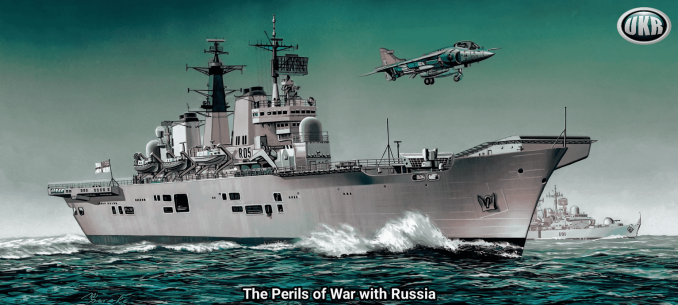
The Royal Navy’s degradation is equally alarming. From a 1939 fleet of 900 vessels, it’s shrunk to around 70, including two troubled Queen Elizabeth-class carriers prone to breakdowns. Submarines number just 10, frigates 11. Chronic underfunding; defence spending hovers at 2.3% of GDP, has led to ships being mothballed. Recruitment woes persist, exacerbated by a focus on social engineering: diversity initiatives, and a growing feeling that, as John Surtees said yesterday, the country the establishment is building simply isn’t worth fighting for. Recent scandals, like the Type 45 destroyers’ engine failures in warm waters, highlight vulnerabilities. Against Russia’s Kilo-class submarines or hypersonic Zircon missiles, the RN would struggle to secure even home waters, let alone the Atlantic.
However, an equally existential threat stems from the Merchant Navy’s virtual disappearance. Once the world’s premier, our flagged fleet now comprises fewer than 500 vessels, with a tonnage around 10 million, paltry compared to Panama’s 300 million or China’s burgeoning armada. Many “British” ships fly flags of convenience (Liberia, Marshall Islands) to avoid punitive taxation and excessive regulation, and are mostly owned by foreign conglomerates like Maersk or MSC. Few of the crews are British. Some British ships even have Russian crews. In wartime, these could be withdrawn or neutralised without obligation to the UK.
The Merchant Navy’s importance transcends mere statistics; it is the sine qua non of our island existence. Britain imports 40% of its food calories, 50% of its energy, and critical inputs like fertilisers (90% imported) and pharmaceuticals. Our economy runs on just-in-time logistics: supermarkets hold three days’ stock; fuel depots, a week’s supply. In a war with Russia, this fragility would be exploited ruthlessly. Russia’s submarine force, over 60 boats, including the stealth Yasen-class, could interdict shipping lanes from the Greenland-Iceland-UK gap to the Western Approaches. Long-range Kalibr cruise missiles, launched from the Black Sea or Baltic, could strike ports like Southampton or Immingham.
Historical parallels abound. In WWII, U-boats nearly succeeded; today, with fewer ships and advanced threats like underwater drones, disruption would be swifter. A blockade could halt 90% of imports within weeks. Food shortages would ensue: bread prices quadruple, fresh produce vanishes. Rationing returns, but without WWII’s domestic buffers. Our farming sector, deliberately depleted by policies prioritising environmental goals over output, produces only 60% of needs. EU-era subsidies encouraged set-asides; net zero mandates promote rewilding and solar farms over arable land. Fertiliser costs, raised by the Ukraine war, have bankrupted farmers; livestock herds dwindle. The Dig for Victory campaign mobilised 1.4 million allotments in WWII; today, gormless greenery, urban sprawl and apathy limit such efforts. Councils are even trying to abolish allotments.
Energy vulnerability amplifies the crisis. Net zero policies, pursued with ideological zeal, have rendered supplies unreliable. Renewables constitute 40% of electricity, but wind farms falter on still days, solar on cloudy ones. Gas imports, via pipelines from Norway or LNG from Qatar, are exposed to sabotage. We’ve shut coal plants and delayed nuclear projects like Sizewell C. In war, Russian cyberattacks could cripple the National Grid, causing blackouts. Heating fails; industries halt; hospitals ration power. WWII Britain relied on domestic coal (200 million tons annually); today, we’re import-dependent, with North Sea oil deliberately depleted.
Alliances offer scant reassurance. In WWII, American Lend-Lease, ruthlessly exploitative though it was, provided $31 billion in aid (equivalent to $500 billion today), including 70,000 lorries and 11,000 aircraft. But contemporary America is fractured. Isolationism surges; Trump, who has stated that he thinks Europe has chosen to destroy its own civilisation, might well abandon NATO, viewing Europe as freeloaders. Even Biden-era support wavers amid domestic priorities. With China threatening US hegemony, American resources stretch thin. Convoys across the Atlantic? Unlikely, given America’s own merchant fleet woes and Russian anti-access/area-denial capabilities.
The anti-British establishment ignores these realities, peddling myths of British exceptionalism while undermining sovereignty. They echo Chamberlain’s appeasement critics but overlook that Putin, unlike Hitler, faces internal constraints: a GDP smaller than California’s, demographic decline, and Ukrainian quagmire. Escalation risks hybrid warfare, disinformation, assassinations, infrastructure attacks, or nuclear brinkmanship. For Britain, the costs are asymmetric: Russia endures sanctions; we face existential strangulation.
To avert disaster, we must rebuild. Encourage re-industrialisation. Revive shipbuilding with incentives for British-flagged vessels; stockpile six months’ essentials; reform agriculture for self-sufficiency; accelerate nuclear and fracking for energy security. Diplomacy, not provocation, should guide policy, engaging Russia as a potential partner.
In sum, the perils of war with Russia are terrifying, rooted in our lost maritime and industrial might. The Merchant Navy’s eclipse symbolises this decline: without it, we’re adrift, vulnerable to starvation and defeat. As in WWII, survival demands realism, not rhetoric. Let us heed history before it’s too late. But then, the Establishment must know all this, so unless they really do want a war and the consequent cull – quite possible with these lunatics – it’s all a charade, a fraud, a con like almost everything the government does these days, designed to cause fear strong enough to allow our real enemy, the British ruling class, to further increase their control and consign our freedoms to history.

••••
The Liberty Beacon Project is now expanding at a near exponential rate, and for this we are grateful and excited! But we must also be practical. For 7 years we have not asked for any donations, and have built this project with our own funds as we grew. We are now experiencing ever increasing growing pains due to the large number of websites and projects we represent. So we have just installed donation buttons on our websites and ask that you consider this when you visit them. Nothing is too small. We thank you for all your support and your considerations … (TLB)
••••
Comment Policy: As a privately owned web site, we reserve the right to remove comments that contain spam, advertising, vulgarity, threats of violence, racism, or personal/abusive attacks on other users. This also applies to trolling, the use of more than one alias, or just intentional mischief. Enforcement of this policy is at the discretion of this websites administrators. Repeat offenders may be blocked or permanently banned without prior warning.
••••
Disclaimer: TLB websites contain copyrighted material the use of which has not always been specifically authorized by the copyright owner. We are making such material available to our readers under the provisions of “fair use” in an effort to advance a better understanding of political, health, economic and social issues. The material on this site is distributed without profit to those who have expressed a prior interest in receiving it for research and educational purposes. If you wish to use copyrighted material for purposes other than “fair use” you must request permission from the copyright owner.
••••
Disclaimer: The information and opinions shared are for informational purposes only including, but not limited to, text, graphics, images and other material are not intended as medical advice or instruction. Nothing mentioned is intended to be a substitute for professional medical advice, diagnosis or treatment.
Disclaimer: The views and opinions expressed in this article are those of the author and do not necessarily reflect the official policy or position of The Liberty Beacon Project.


