

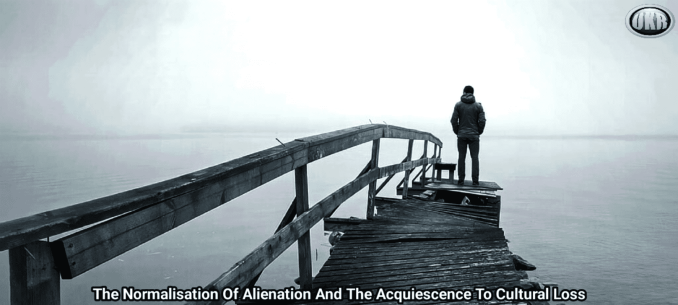
There is a reason why you rarely read about alienation
FRANK FUREDI
When in the 19th century thinkers such as Hegel and Marx began to develop their ideas about alienation and Durkheim developed the idea of anomie the problem they discussed resonated with the times.
For Hegel alienation related to the issue of consciousness and the barriers that stood in the way of the development of self-consciousness. He claimed that individuals were alienated from their selves and their own creations which they perceived as alien objectified entities. The focus of Marx was the wage labour-capitalist relationship where he claimed that workers became alienated from the product of their labour and became estranged from their own humanity.
Durkheim’s concept of anomie referred to the breakdown of moral norms leading to a situation where the absence of a system of meaning and guidelines for behaviour fostered a climate of disorientation and alienation.
In different ways Hegel, Marx and Durkheim sought explain the social and cultural underpinnings of the sensibility of powerlessness experienced by people in the modern world. In the 21st century this sensibility has if anything intensified and the condition of social disintegration has become a fact of life. The fragmentation and atomisation of everyday life has become deeply entrenched throughout society. The decline of the family and community ritual and customs such as marriage, the erosion of working-class organisations and community self-help institutions has endowed the experience of powerlessness with a great intensity.
Arguably the condition of alienation has become so pervasive that some commentators regard it as a fact of life not worthy of note. At the same time sections of society have become resigned to it. and a crisis of
Until recently the disruption of community life through the experience of cultural loss possessed entirely negative connotations, as did the condition of estrangement and of alienation. The erosion of relations of solidarity in a world where people became estranged from one another and from their community was regarded as a corrosive phenomenon that profoundly disoriented members of a community. From this perspective alienation was experienced as a condition to be overcome.
Historically the sense of separation and estrangement that was associated with alienation was regarded as damaging to the human soul by virtually every section of the cultural and political establishment. Terms like alienations, anomie and estrangement were widely used to capture the meaning of what was perceived as a distressing condition within which people found themselves. This condition of spiritual or cultural homelessness continues to plague western societies. Indeed, the mood of cultural insecurity – reinforced by the upheavals to people’s lives caused by globalisation and mass migration – has if anything intensified the sense of homelessness.
However, attitudes regarding the condition of alienation have changed. Amongst sections of the ruling elites alienation is regarded as a fact of life that must be accepted. Some of them do not perceive the different manifestations of an alienated existence such as the sense of homelessness and cultural loss and deracination as a big deal. In recent decades the cosmopolitan advocates of globalism tend to respond to people’s concern with cultural loss with contempt. They claim that alienation with its connotation of separation and disconnection from community is an outdated problem. People’s aspiration for cultural connection and boundedness to others and to a distinct community is often dismissed as a symptom of an unhelpful nostalgia for a world that has ceased to exist.
Paradoxically whereas historically, it was the Left that regarded alienation as a serious problem today it is mainly national populists who are in the forefront of challenging the prevailing zeitgeist of cultural insecurity and cultural loss.
It appears that sections of the cultural establishment have little stake in maintaining the cultural bonds that connect people to the customs and traditions of pre-existing generations. They have become disconnected from their community and nation and are not bothered by living the life of deracinated individuals. The unbounded spirit which they exude signifies their indifference to the cultivation of solidarity and community and national identity. They claim that we live in a post-traditional world where the self is ‘made’ rather than passively inherited. From this standpoint people who attach importance to the maintenance of cultural security are dismissed as inflexible and old-fashioned individuals who insist on living in the past. People’s quest for a home is typically dismissed as constituting a refusal to face up to the consequences of a rapidly changing society.
It is important to note that until relatively recently ‘homelessness’ – the loss of physical and social anchors that define people’s identity- was regarded as a source of distress and psychological pain. Concern with the feeling of not belonging, of being disconnected from oneself and the world was a central theme of literature and philosophy. In recent times attitudes towards cultural security and national identity have become more polarised and ambivalent.
As the American theologian Rusty Reno noted, some say that ‘homelessness is an intrinsic feature of modernity’ while others contend that ‘homelessness and disquietude are the inevitable price of technological progress and free markets’.[i] The fatalistic tendency to normalize homelessness and alienation serves to reconcile people to the condition of deracination. In effect the willingness to acquiesce to the condition of homelessness divests the home of its moral content.
One reason why populism is so thoroughly demonized by the ruling elites is because of the importance it attaches to the homeland. Critics of populism dismiss its ‘ideology of home’ as representing an illusory ‘vision of a lost homeland’, which ‘represents nostalgia for a reconstructed past and, in turn, provides a sense of security against the perceived loss of identity’.[ii] From this perspective the attempt to cultivate a sense of belonging and find meaning in a homeland is always illusory
Yet the quest for a home is not so much an exercise in nostalgia as an attempt to create and consolidate the foundation for the exercise of solidarity. In the first instance, national populism aims to ensure that the national home serves as a focus for people’s loyalty and exercise of solidarity. What critics label as populism’s ‘ideology of home’ simply represents an attempt to overcome the condition of cultural insecurity through the forging of strong bonds within the familiar setting of a homeland. In contrast, the love of nation or the love of home is not a sentiment that resonates with the worldview of cosmopolitan idealogues.
The particularity of place serves as the precondition for the possession of a sense of belonging. This is a point that national populism fully grasps, since people’s sense of existential security emerges within the boundary of a particular place.
The delegitimization of the home
From the standpoint of the dominant cultural narrative those who are concerned with Home and Homeland or Nation are insecure and closed-minded individuals who fear facing up to the demands of a changing world. Just as the valuation of the Home has become associated with conservative minded individuals so too has a preoccupation with alienation become linked to inflexible and backward-looking people who cannot face a constantly changing world. Consequently, anxiety about the consequences of alienation has shifted from the old Left to National Populists.
In his discussion of the shift in attitude towards cultural loss, the University of California historian Martin Jay, cannot hide his contempt for those who still take their homeland seriously. He wrote that,
‘In short, alienation in the second decade of the 21st century has not actually faded away as a descriptor of human distress. Rather, it has become most visible in the anxiety of those who bemoan the transformation of a beloved homeland into an unrecognisable nation of aliens’[iii].
Jay believes that in the contemporary era, traditional attachment to homeland has no inherent virtue. He asks, ‘but in an era of fluid modernity, defined by incessant change, why should sameness and identity be preferred over otherness and difference?’
From Jay standpoint the distinction drawn by members of a ‘beloved homeland’ between themselves and strangers is underpinned by the ideology of exclusion. He observed;
‘What if hospitality to the alien was privileged over the imperative to defend the homeland against alleged intruders? Accepting the stranger within, the other in the self, could then be credited as a sign of maturity. The weakening of the discourse of alienation reflected these changes in the cultural climate’[iv].
From this standpoint the traditional discourse on alienation needs to yield to a supposedly enlightened narrative where there is no homeland to defend. Thus, the qualitative distinction between people whose family has inhabited a community for generations and a recently arrived migrant is all but extinguished.
For cosmopolitan critics, people’s strong emotional bonds to territory makes little sense. They often discuss national borders as an arbitrary invention that has little moral significance. The American philosopher, Martha Nussbaum not only asserts that the act of taking national borders seriously is irrational, it also smacks of ‘false moral weight and glory’. Indifferent to the particularity of an individual and his cultural connections, cosmopolitan campaigners dismiss these attributes as of little import. ‘The accident of where one is born is just that, an accident; any human being might have been born in any nation’, declares Nussbaum.[v]
The assertion that people’s origin has no special significance deprives joint membership of a community of any meaning. In effect, people become dispossessed of any special claims on their community or homeland. They become detached and uprooted from a world that they imagined as their own and lose all moral ties or rights to the territory they inhabit. This sensibility implicitly affirms an alienated existence as normal state.
Yet for billions of ordinary people attachment to a land, to a space bounded by a border is integral to their sense of security. The mobile and globalist class of professionals and managers adopt a very different attitude to borders and sovereignty than the people whose everyday life is bounded to their community’s territory. That is why they are not at all sympathetic to those who are not prepared to acquiesce to an alienated existence.
The refusal to acquiesce to an alienated existence marks the first step towards the restoration of the sense of belonging to a home that you genuinely feel is your own. It is the first step in the very human quest for solidarity.
[i] Reno, R. (2019) Return of the Strong Gods Regnery Gateway
[ii] See Elçi E. (2022) ‘Politics of Nostalgia and Populism: Evidence from Turkey’, British Journal of Political Science. Vol. ;52(2):697-714.
[iii] Martin Jay ‘A History Of Alienation’ https://aeon.co/essays/in-the-1950s-everybody-cool-was-a-little-alienated-what-changed
[iv] Martin Jay ‘A History Of Alienation’ https://aeon.co/essays/in-the-1950s-everybody-cool-was-a-little-alienated-what-changed
[v] Nussbaum, M. (2002) For Love of Country?, Beacon Press, p.7
This article (The Normalisation Of Alienation And The Acquiescence To Cultural Loss) was created and published by Frank Furedi and is republished here under “Fair Use”

••••
The Liberty Beacon Project is now expanding at a near exponential rate, and for this we are grateful and excited! But we must also be practical. For 7 years we have not asked for any donations, and have built this project with our own funds as we grew. We are now experiencing ever increasing growing pains due to the large number of websites and projects we represent. So we have just installed donation buttons on our websites and ask that you consider this when you visit them. Nothing is too small. We thank you for all your support and your considerations … (TLB)
••••
Comment Policy: As a privately owned web site, we reserve the right to remove comments that contain spam, advertising, vulgarity, threats of violence, racism, or personal/abusive attacks on other users. This also applies to trolling, the use of more than one alias, or just intentional mischief. Enforcement of this policy is at the discretion of this websites administrators. Repeat offenders may be blocked or permanently banned without prior warning.
••••
Disclaimer: TLB websites contain copyrighted material the use of which has not always been specifically authorized by the copyright owner. We are making such material available to our readers under the provisions of “fair use” in an effort to advance a better understanding of political, health, economic and social issues. The material on this site is distributed without profit to those who have expressed a prior interest in receiving it for research and educational purposes. If you wish to use copyrighted material for purposes other than “fair use” you must request permission from the copyright owner.
••••
Disclaimer: The information and opinions shared are for informational purposes only including, but not limited to, text, graphics, images and other material are not intended as medical advice or instruction. Nothing mentioned is intended to be a substitute for professional medical advice, diagnosis or treatment.
Disclaimer: The views and opinions expressed in this article are those of the author and do not necessarily reflect the official policy or position of The Liberty Beacon Project.


Leave a Reply