

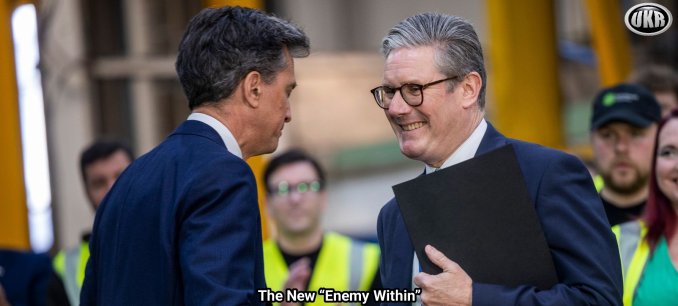
The new “enemy within”
Britain needs clear thinking and cheap energy
MAURICE COUSINS
During the 1970 general election campaign, Enoch Powell delivered a speech in Birmingham in which he warned that Britain was under attack from what he called “the enemy within”. This enemy, he said, was not a physical adversary but a moral and intellectual one. It operated through ideas, slogans and intimidation rather than armies and violence.
Its weapon of choice was purely linguistic. By “asserting manifest absurdities as if they were self-evident truths”, elites dissolved the public’s confidence in its own capacity to reason. The result was paralysis. Ordinary people began to mistrust their senses, defer to official narratives and police their own speech. He warned: “In the end, it renders the majority… incapable of self-defence by depriving them of their wits and convincing them that what they thought was right is wrong, what they thought was real is unreal.” This was the same pathology that George Orwell had described a generation earlier in Politics and the English Language: the corruption of language as the corruption of thought.
There was, Powell argued, one defence The spell could be broken only by freedom of thought, speech and conscience: by “plain truth and common sense, asserted loud and clear, whoever denies, whoever jeers, whoever demonstrates.”
Ever since reading Dominic Sandbrook’s histories of the 1970s, I have had the strange feeling, following the 2024 election, that we are living inside one of his chapters. Each day brings a fresh flash from either State of Emergency or Seasons in the Sun. The names may have changed, but the atmosphere is unmistakable. It is the same blend of drift and quiet despair. And now, as in that earlier age, the same sense of economic unreality coming from within the establishment.
I was reminded of Powell’s “enemy within” speech this week after reading Professor Sir Dieter Helm’s latest essay on British energy policy. Helm, Oxford economist, former government adviser and hardly a radical, accused ministers of presiding over an energy system that is “not cheap, not home-grown and not secure”. It was his second broadside in a week. In a recent podcast, he went further, predicting that the government would eventually have to renege on renewable contracts if we ever wish to return to economic competitiveness.
What struck me was not only the substance of Helm’s arguments but the reaction to them. They were treated less as a policy critique than as an event, a breach in the wall. Within energy policy circles, experts spoke of it as a “major intervention”, even a heresy, not because his facts were wrong but because it has become politically incorrect to state them aloud.
That reaction tells its own story. A figure as conventional and credentialled as Helm is received as a renegade for pointing out that Britain’s energy policy is a joke. The issue is no longer whether he is right but that he has broken a spell. To note that thermodynamic and economic reality has failed to conform to political rhetoric has become, somehow, an act of defiance.
This is precisely the mechanism Powell described: the transformation of an empirical question into a moral one, where dissent becomes vice and truth-telling becomes transgression.
For most of the post-war period, Britain’s energy debate was broadly sane. Policy arguments turned on cost, security and reliability. That changed with the Climate Change Act of 2008, when energy policy expanded its ambitions and drifted from realism into idealism. Since the crisis of 2021–22 it has broken from reality altogether. The mantra that renewables are “cheap, clean and secure” has been repeated so insistently within professional and elite circles that it has hardened into a form of dogma, “repeated by DESNZ, the Climate Change Committee, the National Energy System Operator and Ofgem, and reinforced by the ‘Mission’ inside DESNZ,” as Helm observes.
Take the absurdities he lists. Britain tells itself that building more offshore wind and solar farms will make energy “home-grown”, yet the turbines, blades, panels and finance come from abroad. Ministers insist that renewables are “cheap”, even as Britain now needs “twice the capacity of generation and twice the grid capacity to produce the same output, in addition to a host of batteries, and pumped storage, plus lots and lots of imports.” Westminster insiders, including many respected journalists and business leaders, declare that the transition will make Britain “secure”, while the country becomes dependent on imported components, Chinese critical minerals and physically vulnerable pipelines, electricity cables, LNG ships and gas terminals.
As Helm drily notes, “just keep saying it again and again, stick it on every press release and government document, rely on those with a vested interest in the public buying it to come to the aid of its proponents.” None of it adds up, and everyone knows it, but the ritual must be maintained.
Two centuries ago, a Frenchman understood something that Britain appears to have forgotten. In 1824, the young engineer Sadi Carnot, the father of thermodynamics, wrote that the destruction of Britain’s navy would be less fatal than the loss of her steam engines, for to lose them would be to “dry up her sources of wealth, ruin all on which her prosperity depends, in short annihilate that colossal power.” Carnot grasped that Britain’s strength lay not in its fleets or armies but in its command of energy. France, still nursing the wounds of defeat, recognised that to destroy Britain’s engines would be to destroy Britain itself.
The nation that once powered the world is unlearning the very logic of power
Today, no foreign power needs to lift a finger. We are doing the work ourselves, dismantling our energy system not through invasion but through the slow internal corrosion of reason, policy and will. Where Carnot imagined Britain’s enemies attacking her steam power from without, we have invited the same assault from within. The nation that once powered the world is unlearning the very logic of power. The consequence is not only economic decline but the erosion of national purpose.
A country that cannot power itself cannot govern itself. That logic still holds. As Rachel Reeves searches for a way to ease the cost-of-living crisis, revive productivity, restore growth and repair the public finances in the upcoming Budget, she must begin by bringing reason back to Britain’s energy policy. None of those objectives can be realised while energy remains costly and insecure. But to do that she will ultimately need to defeat the enemy within.
This article (The new “enemy within”) was created and published by The Critic and is republished here under “Fair Use” with attribution to the author Maurice Cousins
Featured image: ntd.com


Leave a Reply