

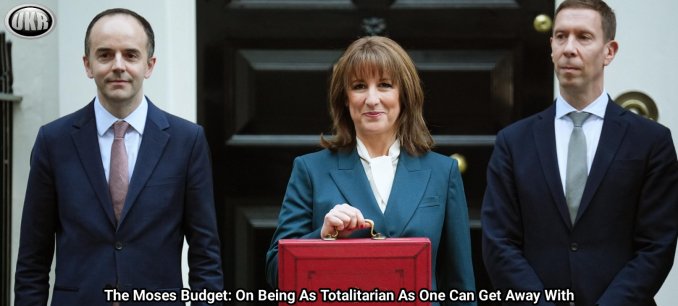
The Moses Budget
On being as totalitarian as one can get away with
DAVID MCGROGAN
[T]he best tyrant would consider his fatherland his private property which he would naturally administer according to his own discretion.
Leo Strauss, On Tyranny
Today, as we half-listened to the Chancellor’s budget statement (one of the big political events of the calendar here in Britain, when the government’s budget is set for the following fiscal year), a colleague made an interesting remark to me. He is close to retirement and as Guardian-reading and Tory-loathing as the next academic. But even the ‘normie’ left now at least partially get it: ‘They’re just trying to punish people for doing the right thing,’ he said.
What he meant by this was that the Chancellor appeared to be, as ever, singling out the kind of ordinary person who tries their best to act prudently. An increase in tax on income from savings. A reduction in the amount that one is permitted to save tax-free each year (from £20,000 to £12,000). A tax (or the bringing to an end an exemption, which amounts to the same thing) on ‘salary sacrifice’ pension schemes. A freeze on income tax thresholds until 2031, so that inflation-busting pay increases are more likely to lead to employees entering higher tax brackets. And so on. Measure after measure that appear designed to come down hard on aspirational (forgive me for using this awful word) ‘strivers’.
However, my colleague’s comment needed finessing. Because, of course, the ‘right thing’ is in the eye of the beholder, and when one looks at the content of the budget – more spending on welfare; more taxes on those who work, save and invest – a fairly clear message is sent that, in the eyes of the government, working, saving, and investing are not the right thing. They are in fact the wrong thing. One should be discouraged from doing them. They are not what government wishes to incentivise. What the government wishes to incentivise is receiving handouts.
This may at first glance seem odd, but is entirely predicted – and, indeed, shown to be almost inevitable – by a thinker whose work I have attempted to summarise before, Anthony de Jasay. De Jasay describes the modern state as being, at any given moment, characterised by a drive to be as ‘totalitarian as it can get away with’. The modern state has no extrinsic justification for its existence – no spiritual, cosmic, or natural reason for being. The only justification modern people will recognise for the existence of state authority is its relationship to what happens in the here and now: does it satisfy wants, and promote welfare?
This means, obviously, that the state must be seen to promote welfare. And it can only do this through making choices between groups as to whom it ought to prioritise. Different groups in society have different preferences, and these will conflict. It is therefore impossible for the state to please all of them, and it follows that it has to choose some to please and, inescapably, others to displease.
Politics in modernity, then, is a matter of cobbling together a coalition of groups to form a majority, and prioritising its preferences against the minority, chiefly by direct or indirect wealth transfers from the latter to the former. And from this basic starting point, the pattern becomes entrenched. Due to the well-known phenomenon of welfare-dependency, there is a natural tendency for demands for redistribution to increase. And therefore, whenever a government – a set of ‘tenants’ of the state institutions – is in power, it is at the margin much more likely to be outflanked by a rival promising to spend more than one promising to make cuts. This in turn produces a drift towards ever greater wealth transfers from taxpayer to welfare-recipient, evident in almost every corner of the globe one cares to look over the past, say, century and a half.
It is important to make clear that de Jasay was not making an argument about rich versus poor. Rich people, and especially business owners, are just as likely to be recipients of welfare as the poor – it is just that the redistribution happens through a different means when the recipient is rich (coming in the form of beneficial tax arrangements, subsidies, and so forth).
And it is also important to make clear that de Jasay was well aware that in reality we do not tend to simply see Peter being robbed to pay Paul all the time. Instead we tend to see Peter and Paul both being robbed in different ways, with the theft offset by benefits of whatever kind, and the balance between robbery and redistribution being the important thing in any individual case. (Each of us, for instance, in Britain at least, both pays taxes in various ways but also receives, say, a state pension, free medical treatment through the NHS, and so on.)
No: the point is much more subtle and important than political tub-thumping, and it is that the modern state’s incentives are always to take more and more control of society’s resources. It does not particularly matter whether or not politicians are ideologically driven, or are socialists or Marxists or liberal democrats or anything else; it is that the essential character of the modern state – which, to repeat, has no spiritual, cosmic, or natural reason for being – drives it inexorably to grow. And it grows not just nominally but as a proportion of the economy (and, of course, of culture and society too) as the cycle of welfare-dependency and redistribution intensifies. There will be road bumps – Margaret Thatchers, even George Osbornes – but that is always the direction in which things eventually go.
De Jasay was also careful to make clear, though, that there is a natural break on governments becoming too big too quickly. His emphasis was on the state becoming, as we have seen, as totalitarian as it can ‘get away with’. Total ownership of resources brings economic collapse, and a 100% tax rate makes for revenue of 0. Even Lenin was made to understand this; even Pol Pot was made to understand it. The situation therefore evolves into something much more like brinkmanship. The pressure is always to grow in size, but by exactly how much, and in which direction, is where old fashioned qualities like prudence, skill and cunning come in. It is possible for politicians to do very stupid, and even, on occasion, very good, things. Human life is complicated and nothing is settled. But in conditions of political hedonism – when the connection between state authority and divine or cosmic order, or underlying nomos, has broken down – the pattern of ever greater redistribution will in the long run play out.
This, of course, means that, since the state is always being as totalitarian as it can get away with, it will take on as much of society’s resources as it can get away with. And this in turn means that it will tax as much as it can get away with, too. This is all plainly evident in Reeves’s budget, of course. But it also means that, presumptively, the state will reduce autonomy to the degree it can get away with doing so, too. The freer people are, the more they control their own resources, and the harder redistribution becomes.
Ideally, then, individuals should have no control over their own resources at all and property should all be owned by the state. In practice, this never happens, or at least never happens sustainably. But, again, it is the direction of travel that is important. The state grasps towards total ownership and hence complete extinction of autonomy of ownership. It does so only in respect of, to repeat, what it can get away with at any given moment. It does so, however, all the same.
This should all put us in mind of Moses, once more. Regular readers will know that I have spent considerable time discussing Machiavelli’s use of Moses as an example to illustrate the mentality of the ‘modern’ prince, who uses his ‘own arms and ability’ to found his state. (The latest piece on this idea is here.) The modern ruler always comes on stage cold, being unable to say that God put him there, that he represents the natural aristocracy, and so on. And he must therefore always be in a position, like Moses, to make a plea to be able satisfy the people’s desires – to find them figuratively as slaves so that he can liberate them from Egypt. He must always be in a position to declare, implicitly or explicitly: follow me and I will give you freedom and sustenance in the Promised Land. And he must always be in a position to show by his ‘own arms and ability’ that he can achieve this. He must therefore always work to construct the population as weak and slave-like and incapable of governing itself, and to construct himself as the necessary means by which this awful enervation is remedied.
Yet the ruler must also, as de Jasay emphasises, display virtù, or ‘virtuosity’ – he cannot merely treat the population as, literally, slave-like. He must be like Moses, but, again, only to the extent he can get away with it. He has to give the population their due. And this means that he must always tread carefully. He edges towards paternalism with every passing day. But this is a very slow and careful process – he makes no sudden movements.
Over time, the dynamic between ruler and ruled shifts. The former becomes gradually more Moses-like, the latter, more slave-like. And – you can likely see the direction in which this is going – at the margins more slave-like qualities are cultivated in the ruled. Doing things like saving and investing and paying into a pension are designed to make individuals more (at least financially) secure, and therefore, by implication, less reliant on the state. These are behaviours that, in other words, make one less slave-like. For the Moses-like ruler, however, that will never do. And he will therefore seek to make these behaviours happen less. He will discourage them where he can. He will work to spin them not as the right things to do, but the wrong.
In Britain we are going to find out in the coming years just how totalitarian it is possible for our rulers to get away with being, as fiscal and indeed physical reality come a-calling. One does not hold one’s breath that Sir Keir Starmer, Rachel Reeves and their ilk possess the Machiavellian virtù necessary to strike the balance effectively. But this is the position that we find ourselves in as modernity itself reaches a kind of denouement: trusting in the dubious abilities of a class of very mediocre Moses’ to guide us to a nonexistent Promised Land.
This article (The Moses Budget) was created and published by News from Uncibal and is republished here under “Fair Use”


Leave a Reply