

The Met’s dishonesty over Non-Crime Hate Incidents
The organisation’s much trumpeted decision to stop investigating NCHIs hasn’t changed a thing
PAUL BIRCH
A version of this article appears in spiked!
When Britain’s largest police force, London’s Metropolitan Police, declared its intention to stop investigating Non-Crime Hate Incidents (NCHIs), many of us breathed a very small sigh of relief. The move, brought about by the Graham Linehan debacle, we thought, would put significant pressure on other police forces to follow suit, and it seemed to be a rare victory for free speech advocates.
NCHIs are those perceived to be motivated, in whole or in part, by hostility or prejudice towards someone’s particular characteristic. These are recorded by the police, often without the individual’s knowledge and, while they do not amount to a criminal offence, they can still have a tangible impact on a person’s life. For example, an NCHI being recorded against an individual could be revealed during an enhanced DBS check, meaning that person could be denied a career or voluntary opportunity. Even an NCHI resulting from a misunderstanding could appear during such checks.
It will be remembered that comedy writer Linehan had been arrested by armed police at Heathrow Airport on the 1st September 2025, on ‘suspicion of inciting violence’ in posts on X. The Crown Prosecution Service (CPS) later dropped the case against him after a significant public outcry and the intervention of the Free Speech Union.
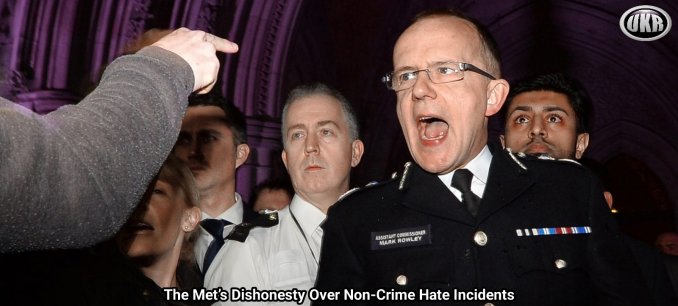
This led to the Met Police Commissioner Sir Mark Rowley urging the government to “change or clarify” the law. He said he recognised “concern caused by such incidents given differing perspectives on the balance between free speech and the risks of inciting violence in the real world”.
Rowley appeared to suggest that his officers had no choice but to arrest Linehan, but that is simply not the case. Despite being increasingly hemmed in by bureaucracy and ‘key performance indicators’, officers can still use their discretion. It would have been inconceivable they were unaware of Linehan’s public profile, and so his arrest must have been signed off at a very high level. It would have been a conscious decision of a senior officer to have Linehan arrested on the whim of a mischievous trans activist.
Commissioner Rowley has history when it comes to allegations of two-tier policing, and he can often be found hiding behind legislation. After the Hamas atrocity in Israel on the 7th October 2023 and the commencement of the seemingly endless ‘pro-Palestinian’ marches in London, he cited inadequate legislation when officers seemed to ignore banners and chants which, it was alleged, breached those laws.
However, the optimism which greeted the Met’s announcement regarding NCHIs appears to have been somewhat premature. Yes, it is true that they will no longer actively investigate them. This is a positive development, as such actions have represented a clear misuse of police resources. The mere presence of a police officer at the door, questioning someone about a social media comment or even a casual conversation, has had a chilling effect on free expression. Spiked’s recent film ‘Think Before You Post’ perfectly highlights this.
But while the Metropolitan Police no longer investigates NCHIs, it still records them. Those whose details are entered onto Met intelligence indices due to NCHIs will, in all likelihood, be unaware of the fact, and they might only ever find out after they fail to land a job which required a greater degree of vetting. Many will probably never realise that their information is sitting on the same databases as those of street robbers, sex offenders and drug dealers.
The emergence, in recent years, of ‘hate crime’ units across UK policing means that the pressure to record NCHIs will not be diminishing any time soon. Such units are often staffed by officers who understand that inclining outcomes towards the ‘progressive’ view of things can only assist with their careers. Overzealousness is the watchword (on the whole, pronouns in email signatures have passed policing by, but not in hate crime units – where the ‘right on’ logos below signatures are often longer than the emails themselves).
Since the Met Police announcement on the 20th October 2025, figures reveal that the recording of NCHIs has actually risen. From the 1st August until the 20th October, the Met was recording NCHIs at an average rate of 50 per week. The very next week the number increased to 58. There is no requirement for any concrete evidence of ‘hate’ for an NCHI to be logged; only the perception of hate by another person and a loosely defined belief by the police that the incident could pose a risk of future crime or significant harm.
But if they are no longer to be investigated, what is the point of recording them at all? Well, the Met says that NCHIs continue to provide “valuable pieces of intelligence to establish potential patterns of behaviour or criminality”. In other words, they will continue to record them because somebody might go on to commit a crime. So why aren’t we all on there then? The concept, that in the United Kingdom in the 21st century, someone can be burdened with a police record for expressing lawful opinions, is deeply disturbing. But this has become a routine aspect of policing.
Such is the concern around Non-Crime Hate Incidents, that the original architect of them, the notoriously woke College of Policing, released a report in October 2025 outlining some possible reforms. But the policing of ‘non-crimes’ cannot be reformed. The practice should only ever be abolished; anything else is only tinkering.
Despite there being widespread debate in the country regarding the assault on free speech, the fact that the Met has actually increased the number of recorded NCHIs since its announcement demonstrates that it was merely a minimal concession intended to appease critics while maintaining the overall system. The Metropolitan Police is wholly beholden to the cultural elites.
This article (The Met’s dishonesty over Non-Crime Hate Incidents) was created and published by Paul Birch and is republished here under “Fair Use”
Featured image: Getty Images


Leave a Reply