

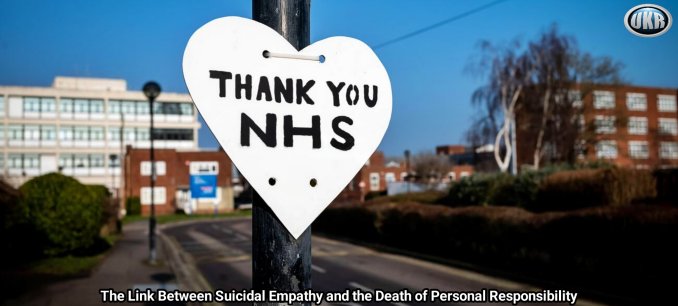
Suicidal ‘compassion’ thrives once personal responsibility dies.
JUPPLANDIA
I just wanted to talk briefly about the pernicious effects of the postwar Welfare State and of how these are fundamentally linked to modern political errors and current ideological insanities.
To some extent this is familiar territory. Most of us on the Right are aware that welfare doesn’t really help people, not in any medium to long term way. What it does for individuals is to trap them into dependency on the State, to rob them of individual agency, and to reward self-harming patterns of behaviour like a refusal to work or a tendency to engage in non-loving and non-lasting relationships. Sometimes it directly funds addictions in the name of curing them. Unlike work, it never provides a route out of the poverty it is supposed to be addressing, but rather locks people generationally into low income households and low income experiences. We all know this and there are endless studies and articles confirming it.
We know too that the same applies to foreign aid. Black African critics of western foreign aid to Africa have pointed out that it ends up rewarding African governments that are corrupt and dictatorial. These regimes can keep stealing from their people or governing in corrupt and wasteful fashions, while being propped up by a constant flow of largesse from the West. Just as individuals are locked into dependency by personal welfare within a western nation, so too are Third World states locked into dependent relationships and continuing poverty by supposed support from the West.
All this is obvious, in the same way it is obvious that fully grown man children living in the basement of their parents home without paying rent and without working haven’t engaged as adults in the real world. What is provided by excessive support is not the opportunity to be better and achieve more, but a reason to not even try, a poisoned gift that sates a temporary need but hooks the user on a lifelong debilitating craving and a permanent reduction of their individual capacities.
The British writer Theodore Dalrymple has written extensively and perhaps better than anyone else on this issue with welfare, as outlined here:
“Theodore Dalrymple, a British physician and conservative author, presents a critical view of the welfare state, particularly as practiced in England and other Western European nations. He argues that the welfare state, while providing material necessities such as shelter, food, healthcare, and entertainment, has a profoundly corrupting effect on the human personality. According to Dalrymple, this system fosters a culture of dependence, where individuals come to view state benefits not as acts of generosity but as entitlements, leading to a lack of gratitude and a sense of moral and spiritual emptiness. He describes this condition as “poverty in soul,” contrasting it with the material deprivation seen in countries like Africa, where poverty is defined by the daily struggle to secure basic needs.
Dalrymple observes that doctors from impoverished nations such as India and the Philippines, who initially admire the comprehensive care provided by the UK’s welfare system, often reverse their opinion after a few months of working in England. They come to see the welfare state as creating a “miasma of subsidized apathy” that blights the lives of its beneficiaries. This shift in perspective is linked to a perceived lack of gratitude and a sense of entitlement, where individuals treat the labor of others as a right rather than a privilege. He attributes this mindset to an ideological change in which benefits are no longer seen as gifts but as due, eroding the social fabric and self-respect.
He further contends that the welfare state, combined with a certain cultural ethos, has led to social devastation in Britain, worse than the conditions he witnessed in Africa. This degradation, he argues, is not solely caused by the welfare state but is exacerbated by it, particularly when it fosters a sense of nihilistic alienation and resentment, especially among marginalized groups. Dalrymple also criticizes affirmative action and other government programs aimed at ameliorating underclass conditions, arguing that they often result in condescension and deepen existing hatreds rather than improve outcomes.
While acknowledging the economic challenges of modern capitalism, including the creation of financial bubbles and the decline of small businesses, Dalrymple views the welfare state as a neo-corporatist system that benefits large bureaucracies and corporations more than ordinary citizens. He sees the welfare state as a barrier to social mobility and a contributor to a rigid, resistant social order, where fear of the future leads to protectionism and a retreat from openness. In his view, the welfare state undermines the dignity of work and the moral imperative to contribute, ultimately weakening the social capital necessary for a functioning society.”
Much of this is presented in Dalrymple’s 2001 book, Life at the Bottom: The Worldview that Makes the Underclass, which has just been reissued in a new edition this year. Dalrymple is the nom-de-plum of Anthony Malcolm Daniels, a qualified psychiatrist, and his attitudes to the Welfare State are drawn directly from hands on experience working within its most beloved and fawned over manifestation, the National Health Service. The essays and commentary on welfare in Life at the Bottom are in fact reflections that border on being case studies because they all draw heavily on the author’s experiences treating patients and inmates in Birmingham hospitals and prisons during the 1990s.
The provision of welfare is of course the great moral claim of the leftists and progressives of our age, and the extension of the purposes of the State into areas once covered by the Church or by individual and private charity curiously reflects the point in time at which formal religious feeling really started to collapse. That is, Britain began its embrace of State provided ‘care’ precisely at the point where Britain started abandoning its churches and its formal structures of religious belief. The decline in church attendance mirrors, in opposite, the rise in State interventionism, and it’s often been remarked that worship of the NHS has become, especially for the most atheistic among us, a sort of secular national cult whose worshippers demand ever more extensive donations. Despite obviously and increasingly sclerotic bureaucratic failings, despite long waiting times and poor outcomes (particularly for cancer patients) the NHS has more and more been described as if it is sacred and holy.
This worship of the NHS, the Welfare State and socialist models of care has grown, expanded and thrived relentlessly through even alleged periods of austerity, long periods of Conservative control of government, and multiple strained periods of national recession and hardship. For decades now no allegedly rightwing politician has dared to contemplate ending the NHS. Instead, both main parties have accused the other of ‘betraying the NHS’, and both have boasted about ringfencing NHS money or increasing the already vast sums spent on it. The NHS has grown to be, after pension provisions (another form of welfare) the most voracious, demanding and impossible to assuage part of government spending. Narrowly defined health spending counts for 18% of all government spending, but the NHS as a whole (including related services and building and maintenance costs) covers 40% of public spending. When capital spending and annually managed spending is also included, this rises to nearly half of all public spending.
The common experience of this vast State managed enterprise is not a good one, with there being obvious gaps in the quality of care provided by State hospitals and private ones. The Care Quality Commission, the UK’s health regulator which assesses the performance of the NHS Hospital Trusts, has produced a long series of critical reports. According to the latest of these, nearly half of all hospitals in England are rated as ‘inadequate’ or ‘requiring improvement’. 2024 analysis found that 49% were substandard in their care provision and facilities. In London, 68% of hospitals were rated as failing to meet required standards, with other two thirds (25 out of 37 hospitals) considered inadequate or requiring improvement. For the most common of all potentially fatal conditions, cancer, the UK NHS has a long record of failure:
“The UK ranks poorly in five-year survival for several major cancers, including lung, colon, rectal, pancreatic, stomach, and liver cancers, with survival rates often among the lowest in the developed world. For instance, the UK ranks as low as 28th out of 33 comparable countries for lung and stomach cancer survival, and 26th for pancreatic cancer. Five-year survival for these less survivable cancers averages just 16% in the UK, significantly below international benchmarks.”
Yet the experience of long delays, poor cancer treatment, dirty or unsanitary hospitals, long waiting lists and failed outcomes is not reflected in much public comment on the NHS. The failed State system is reinforced by both huge public spending and demanded public piety. In Britain it is common for anyone critical of this system to be accused of being heartless, uncaring, or greedy. Junior doctors go on strike and receive pay rises far in excess of other public workers, but the demanded moral position is that we should all support them when they deny care to improve their salaries. Bizarre public displays of orchestrated NHS worship have included the ‘I Support the NHS’ badges, stickers, banner, profile frames and labels in 2020, the banging of pots and pans ritual in the same COVID period (while hospitals were closed to the public), and, before that, Danny Boyle’s truly fetishistic 2012 London Olympic opening ceremony section on the NHS:
All of this emphasises that in the UK the NHS became a substitute religion just as the State became a substitute Mother, Father and Church. One must worship the socialist idea of the State being the best placed provider of all solutions for all problems, even as the State manages its vast budgets with less competence than the most reckless private spender. The State hasn’t acted as a fiscally responsible adult for 80 years, almost never generating a surplus and not once being out of severe debt, and with balanced budgets long consigned to memory. But at the same time it’s taken on the burden of paying for the children of both citizens and, increasingly, non citizens when the parents are incapable of doing so.
It’s acting as everybody’s daddy, when it cannot itself behave responsibly.
Of course the prioritisation of emotive hysteria, emotional blackmail and a religious morally policed faith in the State and faith in the NHS, the tendency of describing critics of any of it as lacking compassion and humanity, is proof of a flip side to the paychological impacts of welfare described by Dalrymple. Because the Welfare State doesn’t just hook the citizen or welfare recipient on a debilitating and enervating drug of ‘free money’ that costs him or her all agency and self respect, it also hooks the agents of government on the virtue signalling drug of ‘compassion’ at the expense of others.
It doesn’t just infantilise the citizen on benefits. It infantilises the providers of benefits, who become slobbering, unthinking, emotion and slogan driven Idiot Patrons incapable of perceiving the rottenness at the heart of the system they are administering. They cannot see, or refuse to acknowledge, that the reason doctors and nurses vote for them is because they pay their salaries. They call vested interest like this noble and altruistic, when really their constant promise to extend and extend welfare or grow and grow the NHS is simply a crooked patronage scheme bribing public workers and welfare recipients for their vote. The paychological impact on the leaders of the State, on the politicians and administrators, is as bad as the impact on dependent receivers of this alleged compassion. It denies them the cognitive ability to look at end results honestly, to break the cycle of huge spending, huge debt and poor outcomes, or to think rationally rather then emotionally about public spending as a whole.
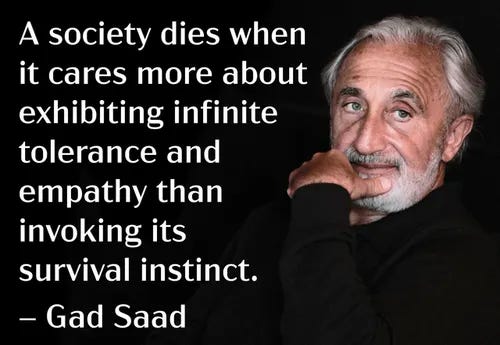
And here is where it links to Gad Saad’s concept of suicidal empathy.
The people who retain an ability to perceive where welfare goes wrong are the people most likely to retain a belief in individual responsibility. They are the people least likely to want to become trapped in dependency on the State (as either a welfare recipient or a vested interest employee). They are the most likely to keep the private sector going. They are the most aware of and insistent on their own responsibility for the choices that affect their lives. They are the strongest believers in individual liberty, and the strongest defenders of free thought, soeech and political choice. They are the people who retain independent critical thinking rather than trained ideological or emotional assumption.
And they are the people who recognise when ‘compassion’ is suicidal, when the largesse is going to the malign, when the system is funding things which have become objectively evil, when money is going to those who never paid in, when funds are stolen from the citizen and provided to the stranger, when the ‘generosity’ of the State (particularly to foreign causes or imported populations or radical and insane causes) is the slow genocide of the family, the responsible adult, and the nation.
When one defers all decision making to the State, when one fetishises the State as provider and parent, when one expects the State to govern all choices, one can no longer be a capable, responsible adult. The person with that worldview and that relationship with the State can’t be an independent human being or a responsible adult. They can’t make responsible political choices, because their answers are always deferred to the Stare or the Party or collectivist actions. They can’t be decent parents, because they don’t believe it’s their job to protect their child from outside comtrol and abuse-they are happy to surrender their own children and those of others to the not so tender mercies of State backed ideology. They can’t be decent friends, because all their friendship is conditional on you accepting the State and State broadcasting mandated positions that they mindlessly accept. And they can’t be adults making wise adult choices because that part of them has atrophied, replaced with compliance and short term moral drugs whereby their demand for your money is transformed into them being a good person, even though they don’t bother to do any good by their personal effort or expenditure.
Suicidal empathy is the obvious result of the denial of personal responsibility. Once you believe that individual agency means nothing, you can excuse any behaviour no matter how vile and provide it with assistance (because it’s the job of the State to assist) just as you can enact any tyranny no matter how vile too (because it’s the job of the State to decide). I saw this stunning example on social media, which prompted this post even though it’s a very different topic area:
“Have you ever been floating in the ocean next to a bombed, flipped little boat with dead engines, no fuel, no electrical, no radios (under water), no lights, your friends dead, bodies floating near by, in the middle of the open sea with waves, no food, no fresh water, hundreds of miles from land, and over a thousand miles from the US, possibly wounded, likely in shock — how were they going to even survive, not drown in the sea water, not die of thirst, can’t move anywhere — much less bring drugs to the US in a blown up boat…”
The above ‘sympathetic imaginings of the plight of a drug struggler’ was posted together with a lengthy criticism of the US policy on fentanyl traffickers and long quotes on maritime law. But it seemed to me a perfect example of this link. The person doing this is possessed of a suicidal empathy that immediately leads him to identify with South American drug traffickers, consider them entirely innocent, and imagine himself in their position. But this is linked to thinking that these people have no agency or responsibility of their own. They are blown up randomly, according to this poster. They somehow randomly found themselves on a high speed boat, heading to the US, packed with drugs. This was an innocent activity any of us could have been engaged in, because there’s no such thing as personal choice, accountability and responsibility. The only things that matter are what some recognised authority declares (and of course for such people internsyional authority always trumps national authority). What matters is not that these people were ferrying drugs that kill Americans (they have no personal responsibility) what matters is international maritime law.
Even if it results in defending murderous drug traffickers and vile criminal cartels responsible for tens of thousands of deaths, this person doesn’t retain the capacity to judge it morally as an adult individual. He must defer to what the authority asserts. Morality for him is codified already by the authority, and there’s no intrusion of individual thought or recognition of the real world nature of the ‘victims’ be is sympathising with.
It might seem that there’s a big difference between worshipping the NHS, giving welfare to third world savages or methadone to heroin addicts, and objecting to a stern policy on drug trafficking. But really all are united by the same mode of thought, or rather, the same incapacity to think. All require a suicidal empathy towards the malign or destructive group or person, assuming their innocence and the paramount nature of their rights. And all of them require a total denial of contextual reality and individual moral awareness, because one’s position on all these things defers to external authority and is a received opinion stamped with some form of official approval.
Suicidal empathy tells you that the welfare of the Other matters more than the safety of your own, while the complete denial of personal responsibility makes you the kind of person who can excuse drug traffickers, empathise with them, and do all of this in contented blindness because you’ve already deferred your moral choices to others.
Before we ever got insane enough to consider that violent drug traffickers aren’t responsible for their own deaths or the lives their drugs take, we paved the way by deciding that feckless adults aren’t responsible for their own lives or the children they have with others.
This article (The Link Between Suicidal Empathy and the Death of Personal Responsibility) was created and published by Jupplandia and is republished here under “Fair Use”

••••
The Liberty Beacon Project is now expanding at a near exponential rate, and for this we are grateful and excited! But we must also be practical. For 7 years we have not asked for any donations, and have built this project with our own funds as we grew. We are now experiencing ever increasing growing pains due to the large number of websites and projects we represent. So we have just installed donation buttons on our websites and ask that you consider this when you visit them. Nothing is too small. We thank you for all your support and your considerations … (TLB)
••••
Comment Policy: As a privately owned web site, we reserve the right to remove comments that contain spam, advertising, vulgarity, threats of violence, racism, or personal/abusive attacks on other users. This also applies to trolling, the use of more than one alias, or just intentional mischief. Enforcement of this policy is at the discretion of this websites administrators. Repeat offenders may be blocked or permanently banned without prior warning.
••••
Disclaimer: TLB websites contain copyrighted material the use of which has not always been specifically authorized by the copyright owner. We are making such material available to our readers under the provisions of “fair use” in an effort to advance a better understanding of political, health, economic and social issues. The material on this site is distributed without profit to those who have expressed a prior interest in receiving it for research and educational purposes. If you wish to use copyrighted material for purposes other than “fair use” you must request permission from the copyright owner.
••••
Disclaimer: The information and opinions shared are for informational purposes only including, but not limited to, text, graphics, images and other material are not intended as medical advice or instruction. Nothing mentioned is intended to be a substitute for professional medical advice, diagnosis or treatment.
Disclaimer: The views and opinions expressed in this article are those of the author and do not necessarily reflect the official policy or position of The Liberty Beacon Project.


Leave a Reply