


The hidden price of solar farms: new report warns battery costs will hit billpayers
UK SOLAR ALLIANCE
-
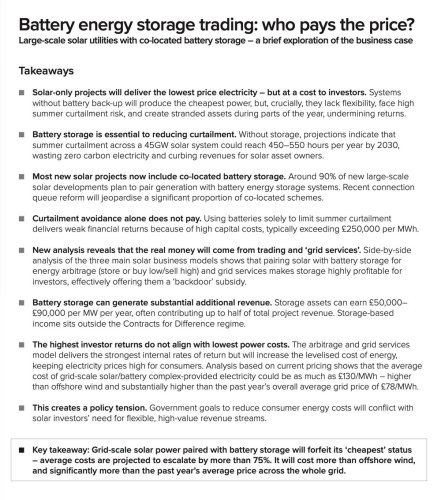
Electricity sold by commercial solar farms will cost far more than the average cost of power on the grid today
-
When battery storage is added to commercial solar, the myth of ‘cheap’ solar power collapses: costs will jump to around £130/MWh, some 75% above the headline figure and dramatically higher than the past year’s £78/MWh average grid price
A new report by a leading renewable energy policy expert reveals that the UK’s rapid expansion of large-scale solar farms could drive electricity prices even higher once the hidden costs and market incentives around battery storage are taken into account.
Read the Full Report here
Read Briefing Note here
Read Safeguard Issues here
Stop Oversized Solar
The UK’s solar power strategy is fundamentally flawed. It prioritises new solar ‘NSIP’ proposals on farmland on an unprecedented, colossal scale. These mega schemes – typically with the footprint of an international airport – are wrong on every level. That’s why rural community groups from across the country have come together to form Stop Oversized Solar.
We cannot support the sacrifice of good farmland for solar, which the government’s own data demonstrates is inefficient. We have serious concerns over the dubious economics of UK solar mega schemes, developer probity and international supply chains.
And we cannot stand by and witness the industrialisation of hundreds of thousands of acres of our countryside.
NSIP opposition groups
A number of individual NSIP opposition groups are behind Stop Oversized Solar. The campaign aims to highlight or expose the many issues with solar mega scheme proposals that span thousands of acres of farmland, and are often clustered alongside planned or existing solar sites, creating significant solar corridors or solar zones in key food-producing regions.
Many of the groups associated with the new SOS initiative are members of the UKSA, which remains an invaluable network and information hub for all community groups standing up to solar on farmland.
Stop Oversized Solar Community groups opposing Nationally Significant Infrastructure Project (NSIP) solar proposals in Anglesey, Bedfordshire, Buckinghamshire, Cambridgeshire, Kent, Lincolnshire, Norfolk, Northamptonshire, Nottinghamshire, Suffolk, Wiltshire and Yorkshire:
-
Block East Pye Solar
-
Claydons Solar Action Group
-
East Riding Against Solar Expansion
-
Fields of Glass
-
Grwp Cadw Tir Môn
-
Hands Off Our Marsh
-
Kingsway Solar Community Action
-
Mallard Pass Action Group
-
Say No to One Earth Solar Farm
-
Say No To Sunnica
-
7000 Acres
-
Springwell Solar Action Group
-
Stop East Park Energy
-
Stop Greenhill Solar
-
Stop Lime Down
-
Stop Mylen Leah
-
Stop Stamford Solar City
-
Villages Against Solar Threat
Media enquires to: [email protected]
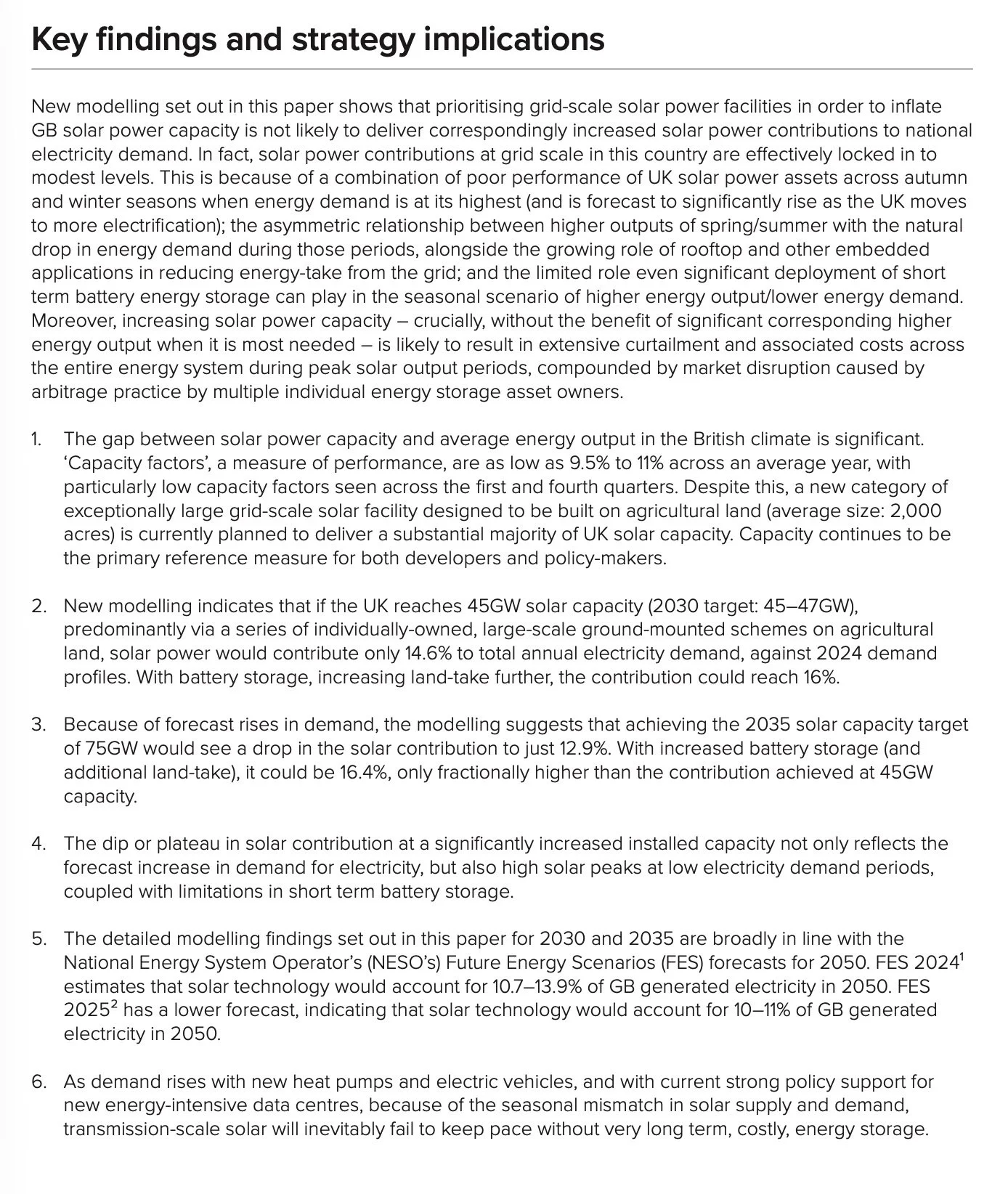
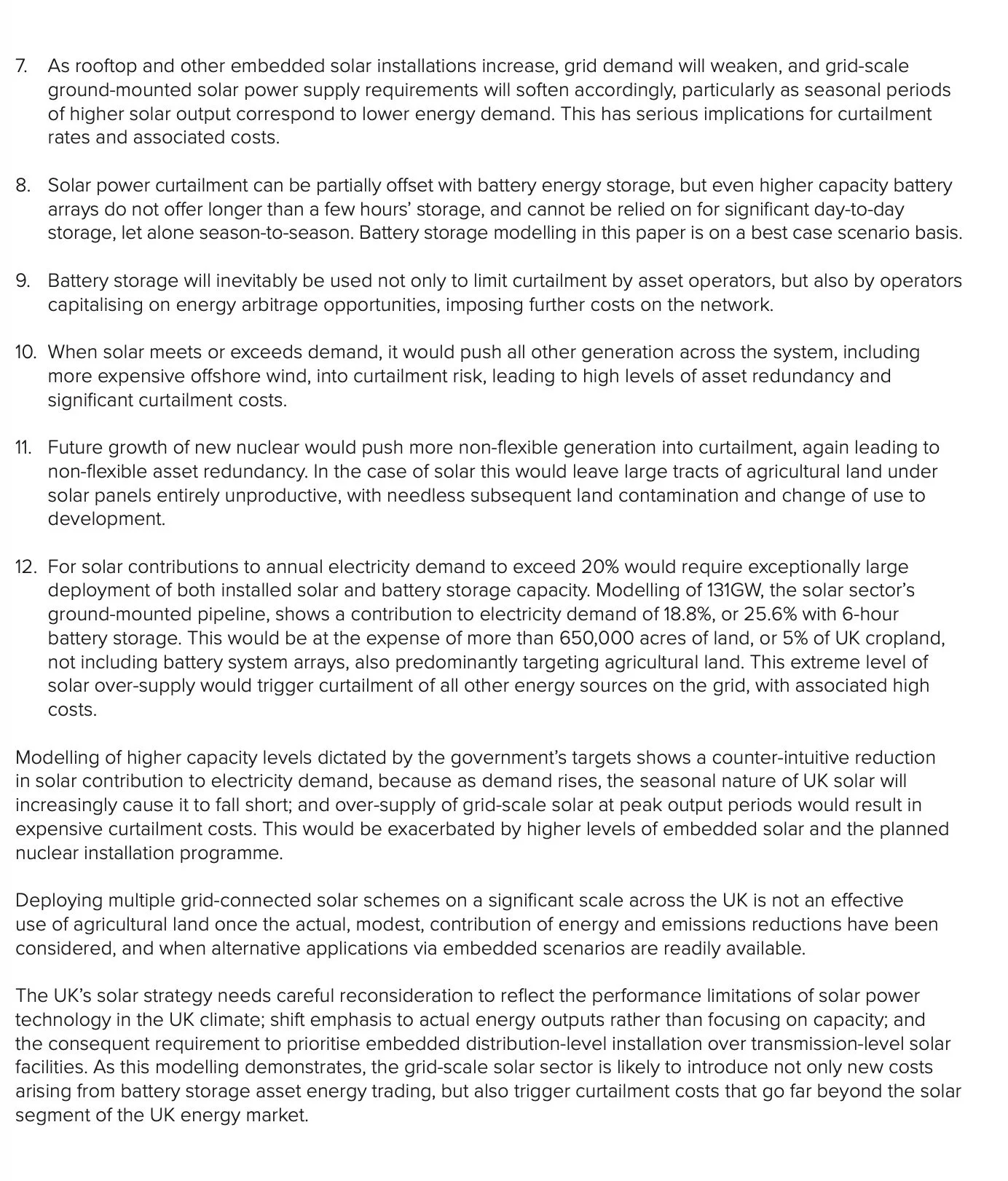
Modelling of GB grid-scale solar PV generation: impacts of the new category of solar power plant on the national energy system – Prof Tony Day
Download the full report here
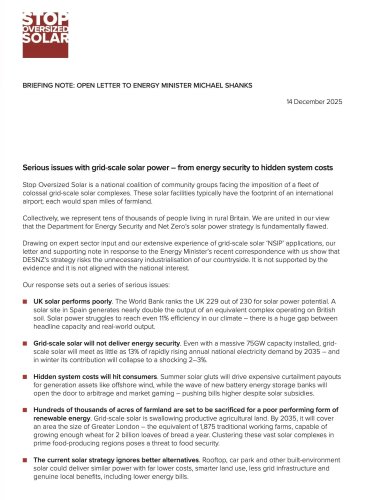
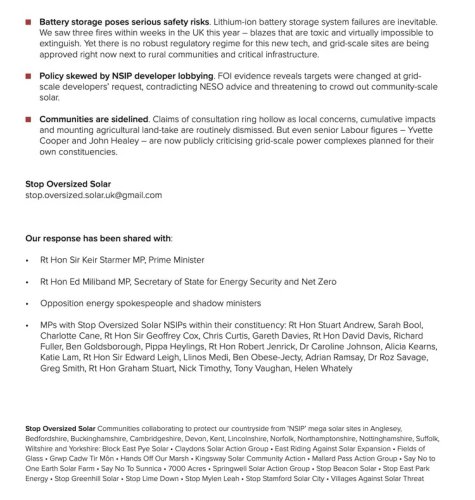
UK solar power: exposing the biggest land grab since the Enclosure Act of 1773
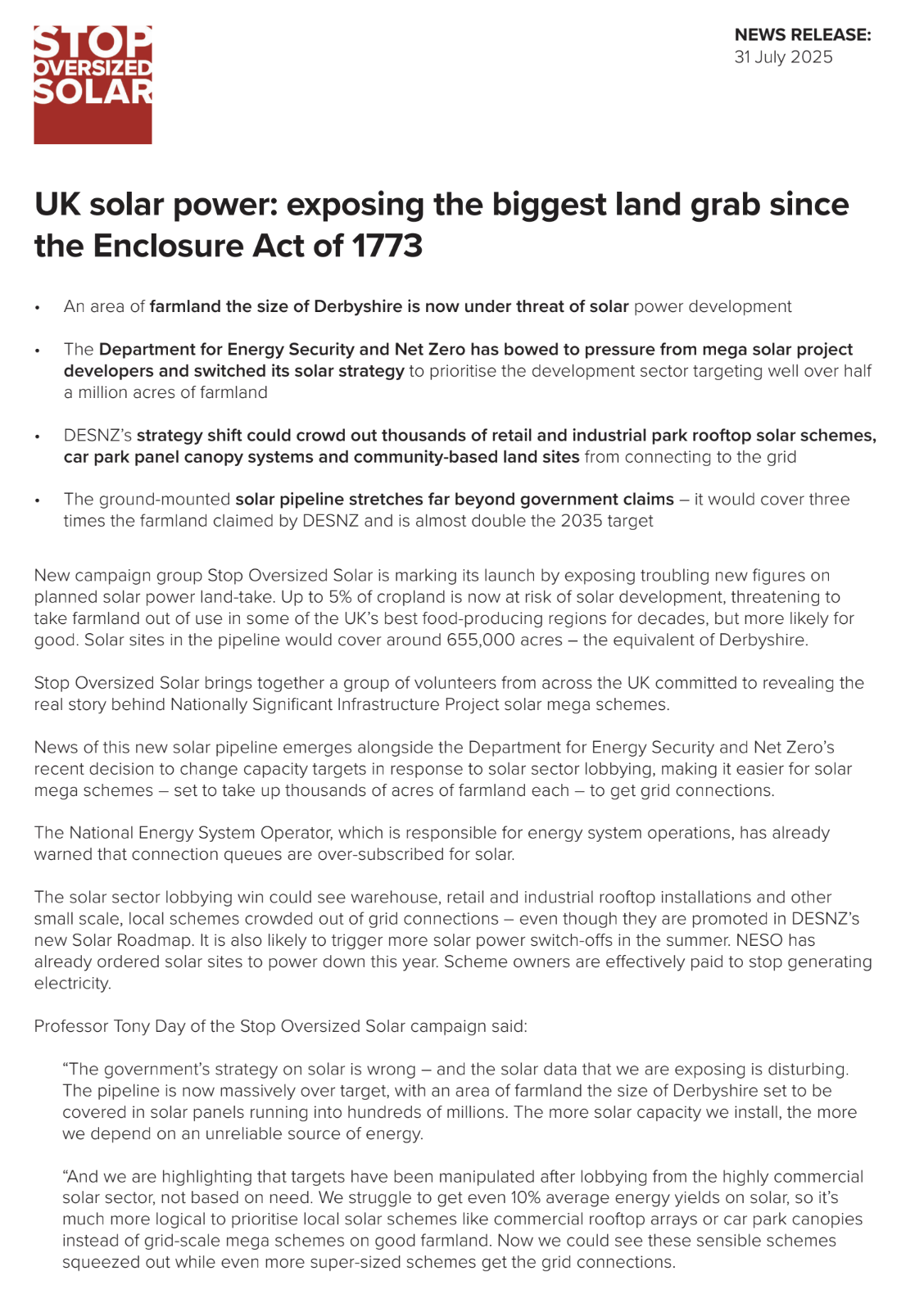
Download full press release here
Download full briefing paper here
What is an NSIP?
Nationally Significant Infrastructure Projects are large scale projects falling into five categories (Energy; Transport; Water; Waste Water and Waste). Examples include power stations; railways and major roads; reservoirs; harbours; airports; offshore wind farms and sewage treatment works – in other words, the kinds of large scale facilities that support the everyday life of the country.
Solar projects above 50MW in the UK are defined as NSIPs and therefore go through a more rigorous and lengthy approval process than a local planning application, with different decision makers.
The Planning Inspectorate (PINS) is the agency responsible for operating the planning process for NSIPs.
-
2025 – May – Latest list of NSIPS – here
-
2025 – January – Planning Reform Working Paper: Streamlining Infrastructure Planning – here
-
2024 – November – Planning Inspectorate Webinar – How to present at an Inquiry – here
How do I object to a proposal?
To object to a solar development submitted as a local planning application (under 50MW), contact the Planning Department of your local authority and quote the planning application number. The local authority will request comments are submitted within twenty one days. It is generally best to make your objections known as soon as possible.
To object to a solar development submitted as an NSIP (50MW or over), first put forward your objections to the developer during the statutory consultation phase, which must happen before they put forward their application. It is important to take this opportunity to give constructive feedback before plans are finalised.
Once the Planning Inspectorate is notified by a potential applicant of a proposed project, it will be added to the published Register of applications. During the pre-examination stage you will be able to register as an interested party via the Planning Inspectorate in order to give your views.
For more information read the transcript here. Whatever size application you are objecting to, it is important to keep your feedback objective and factual. Avoid personal opinion based purely on emotion in order to keep it constructive.
Role of a Local Authority in a NSIP Application
Petition
Introduce new restrictions on solar facilities to protect land and food security
Prohibit ‘mega solar facilities’ over 50MW on UK farmland; establish solar development preference hierarchies and regional density caps to help protect our natural landscapes, ensure food security, and conserve biodiversity.
Government policy must align net zero aims with food security and regional integrity. Establishing formal priorities for solar development on brownfields, rooftops, and lower-grade land, plus regional solar density caps, could help ensure energy targets are met without compromising rural landscapes or broader security interests.
SOURCE: UK Solar Alliance

••••
The Liberty Beacon Project is now expanding at a near exponential rate, and for this we are grateful and excited! But we must also be practical. For 7 years we have not asked for any donations, and have built this project with our own funds as we grew. We are now experiencing ever increasing growing pains due to the large number of websites and projects we represent. So we have just installed donation buttons on our websites and ask that you consider this when you visit them. Nothing is too small. We thank you for all your support and your considerations … (TLB)
••••
Comment Policy: As a privately owned web site, we reserve the right to remove comments that contain spam, advertising, vulgarity, threats of violence, racism, or personal/abusive attacks on other users. This also applies to trolling, the use of more than one alias, or just intentional mischief. Enforcement of this policy is at the discretion of this websites administrators. Repeat offenders may be blocked or permanently banned without prior warning.
••••
Disclaimer: TLB websites contain copyrighted material the use of which has not always been specifically authorized by the copyright owner. We are making such material available to our readers under the provisions of “fair use” in an effort to advance a better understanding of political, health, economic and social issues. The material on this site is distributed without profit to those who have expressed a prior interest in receiving it for research and educational purposes. If you wish to use copyrighted material for purposes other than “fair use” you must request permission from the copyright owner.
••••
Disclaimer: The information and opinions shared are for informational purposes only including, but not limited to, text, graphics, images and other material are not intended as medical advice or instruction. Nothing mentioned is intended to be a substitute for professional medical advice, diagnosis or treatment.
Disclaimer: The views and opinions expressed in this article are those of the author and do not necessarily reflect the official policy or position of The Liberty Beacon Project.


Leave a Reply