

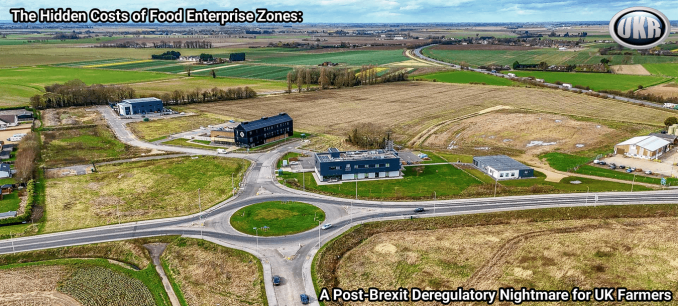
The Glossy Brochures Promise of FEZs: A Truss-Inspired Mirage? What the Hell are FEZs?
EUROPEANPOWELL
In 2015, Liz Truss, then-Environment Secretary, unveiled Food Enterprise Zones (FEZs) as a flagship initiative to supercharge the UK’s £100 billion food sector. Truss also went on to rollout 74 Secial Economic Zones (SEZs) and 12 Freeports with Rishi Sunak immediately after Brexit, Starmer’s Labour Party signed off with the Tories on the zones, and now promte them when they had previously and publicly rubbished the idea, oh and guess what who else loves free zones? Reform UK?
Backed by £830,000 in government funding, these 17 FEZs—from Cumbria to Cornwall—were sold as a rural renaissance. Local Enterprise Partnerships (LEPs) were offered grants of up to £50,000 to develop FEZs, with Local Development Orders (LDOs) streamlining planning to make it “simpler and cheaper” for food businesses to expand. The Greater Lincolnshire LEP hypes its South Lincolnshire FEZ as the heart of the “UK Food Valley,” a hub for agri-tech and manufacturing. North Somerset and West Lindsey’s websites brim with promises of jobs, innovation, and stronger local food chains. By December 2021, 17 FEZs were approved, with projections of over 10,000 jobs and millions in investment. The pitch is slick: FEZs will empower communities, boost food security, and make Britain a global food leader.
But this Truss-inspired vision is more mirage than masterpiece. Beneath the glossy brochures lies a deregulatory agenda exposing UK farmers to a flood of cheap US beef imports. Alarmingly, the National Farmers’ Union (NFU), representing over 46,000 farming businesses, has been conspicuously silent on FEZs, despite their potential to reshape British agriculture. This absence, at a time when farmers face existential threats, raises troubling questions about whether the NFU is asleep at the wheel—or worse, complicit in a system prioritising corporate interests over its members. Let’s dismantle the spin and expose the real cost.
Deregulation and the US Beef Invasion: Undercutting UK Farmers
Brexit has left UK farmers on shaky ground. EU subsidies once cushioned costs for land management and environmental standards, but the UK’s Environmental Land Management scheme, replacing the Common Agricultural Policy, prioritises green initiatives over direct production aid, leaving farmers financially exposed. Meanwhile, post-Brexit trade deals have flung open the gates to lower-standard imports, with US beef posing a particularly vicious threat.
A UK-US trade deal, finalised on May 9, 2025, axed a 20% tariff on US beef, granting American producers unfettered access to UK markets. While hormone-treated beef and chlorinated chicken remain banned, US beef—produced with lower welfare and environmental standards—undercuts British produce. The NFU has raised alarms about such imports, with President Tom Bradshaw warning they “could lead to products that would be illegal for our farmers to produce domestically” flooding shelves. Save British Food, in their National Food Strategy response, slams these deals for “undermining British farmers by allowing cheaper, lower-standard imports to dominate.”
Pre-Brexit, the UK was 86% self-sufficient in beef, importing 315,000 tonnes in 2019 to meet demand. Now, with tariffs gone, US beef—cheap thanks to industrial farming—threatens to erode this further. UK farmers, grappling with soaring costs for fuel, fertiliser, and feed, can’t compete. Save British Food’s critique of the UK-Australia deal warns of “a race to the bottom,” a trend the US deal amplifies. Posts on X, like one from note the NFU warned about trade deal risks a decade ago, yet the threat has materialised under its watch.
FEZs: Liz Truss’s Deregulatory Gamble
Truss’s FEZs were pitched as a boost for domestic production, with LDOs bypassing traditional planning hurdles to “streamline” development. The government claimed FEZs would foster local decision-making, but a 2020 consultation on planning reforms, including LDOs, faced criticism for reducing community input and favouring developers. These deregulatory tools often benefit large agribusinesses over small, sustainable farms. Posts on X voice public fears that FEZs enable “intensive farming, animal mistreatment, environmental pollution, and the squeezing out of smaller eco-friendly farms.” While these claims lack hard evidence, they reflect growing unease about Truss’s vision.
The South Lincolnshire FEZ, branded as a leader in the “UK Food Valley,” boasts 17 hectares of business space and University of Lincoln partnerships. But its focus on large-scale production risks marginalising small farmers who can’t scale up. North Somerset’s FEZ, with its FoodWorks innovation centre, leans toward corporate interests over community-led farming. By creating hubs for mass production, FEZs may make the UK market more attractive for cheap imports, as demand grows for low-cost food that local farmers can’t produce under stricter standards.
The NFU’s Troubling Silence
Given the stakes, the NFU’s silence on FEZs is deafening. A search of NFUonline.com for “Food Enterprise Zones” or “Enterprise Zones” yields no direct discussion, despite the organisation’s vocal stance on trade deals and food standards. This absence is troubling, especially as FEZs intersect with the NFU’s mission to “champion British agriculture and horticulture.” The NFU has a history of lobbying on issues like the Red Tractor scheme and food labelling, yet it appears to have overlooked FEZs, which could either bolster or undermine its members depending on their implementation. Critics, like the Ethical Consumer Research Association, have labelled the NFU an “English Agribusiness Lobby Group,” arguing it prioritises big agribusiness over small farms and environmental concerns. This perception gains traction when the NFU fails to engage with initiatives like FEZs that could tilt the playing field toward corporate giants.
The NFU’s inaction may reflect a broader disconnect. As one interviewee told Ethical Consumer, “We have an urban political elite. They don’t know about farming. So they just delegate to the NFU.” If the NFU isn’t scrutinising FEZS, who is advocating for small farmers against the deregulatory tide? Consumers, too, are left in the dark, unaware that FEZs could flood markets with lower-standard imports, undermining the high-welfare food they value.
Environmental and Social Fallout
The environmental toll is stark. US beef production often involves deforestation and higher emissions—Brazilian beef, for comparison, has a carbon footprint five times that of UK beef. Importing more US beef exports environmental harm, clashing with the UK’s climate goals. Save British Food calls this a “betrayal of British farmers and shoppers,” a view echoed by former food tsar Henry Dimbleby, who warned in April 2025 that such trade deals could “destroy rural communities” by prioritising quantity over quality.
Socially, the damage is profound. The loss of EU subsidies has pushed farmers to the brink—UK pork production fell 11% in 2023 due to supermarket price gouging and EU import competition. Now, with US beef flooding in, the outlook is grim. The BBC noted in January 2024 that new EU import controls might help UK farmers, but these do little against non-EU threats like the US, where lower costs and lax standards dominate.
The Bigger Picture: SEZs, Freeports, and a Deregulated Abyss
FEZs, born from Truss’s deregulatory fervour, are part of a broader post-Brexit experiment: 74 Special Economic Zones (SEZs) and 12 Freeports, many overlapping with FEZs. These zones offer tax breaks and relaxed rules to lure investment, but Save British Food warns they risk turning the UK into a “dumping ground” for low-standard imports. The government’s claim that FEZs will bolster food security—reiterated in 2015 with promises of local empowerment—falls apart. Post-Brexit, UK agricultural imports surged by $14 billion from 2021 to 2022, largely from non-EU nations like the US, China, and Brazil. Domestic farmers, meanwhile, are abandoned in a deregulated market, with Truss’s FEZs as a testing ground for policies that prioritise corporate profits over rural livelihoods.
A Call to Action
Food Enterprise Zones, championed by Liz Truss with £50,000 grants and streamlined planning, promised a rural renaissance but delivered a deregulatory disaster. The influx of US beef, enabled by post-Brexit trade deals, is a direct assault on UK farmers already reeling from lost EU subsidies. The NFU’s silence on FEZs is a betrayal of its 46,000 members, leaving farmers and consumers exposed to a system that favours cheap imports over local resilience. If the government and the NFU care about food security, they must prioritise local producers, enforce strict import standards, and replace EU support with robust domestic funding. Otherwise, the UK risks its farming heritage and the sustainability of its food system.
This article (The Hidden Costs of Food Enterprise Zones: A Post-Brexit Deregulatory Nightmare for UK Farmers) was created and published by EuropeanPowell and is republished here under “Fair Use”

••••
The Liberty Beacon Project is now expanding at a near exponential rate, and for this we are grateful and excited! But we must also be practical. For 7 years we have not asked for any donations, and have built this project with our own funds as we grew. We are now experiencing ever increasing growing pains due to the large number of websites and projects we represent. So we have just installed donation buttons on our websites and ask that you consider this when you visit them. Nothing is too small. We thank you for all your support and your considerations … (TLB)
••••
Comment Policy: As a privately owned web site, we reserve the right to remove comments that contain spam, advertising, vulgarity, threats of violence, racism, or personal/abusive attacks on other users. This also applies to trolling, the use of more than one alias, or just intentional mischief. Enforcement of this policy is at the discretion of this websites administrators. Repeat offenders may be blocked or permanently banned without prior warning.
••••
Disclaimer: TLB websites contain copyrighted material the use of which has not always been specifically authorized by the copyright owner. We are making such material available to our readers under the provisions of “fair use” in an effort to advance a better understanding of political, health, economic and social issues. The material on this site is distributed without profit to those who have expressed a prior interest in receiving it for research and educational purposes. If you wish to use copyrighted material for purposes other than “fair use” you must request permission from the copyright owner.
••••
Disclaimer: The information and opinions shared are for informational purposes only including, but not limited to, text, graphics, images and other material are not intended as medical advice or instruction. Nothing mentioned is intended to be a substitute for professional medical advice, diagnosis or treatment.
Disclaimer: The views and opinions expressed in this article are those of the author and do not necessarily reflect the official policy or position of The Liberty Beacon Project.


Leave a Reply