

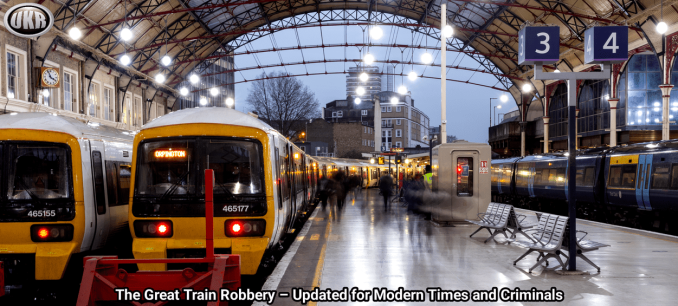
The Great Train Robbery – updated for modern times and criminals
PETER HALLIGAN
From the actual theft of £2.6 million to the white collar theft of more than a billion pounds in subsidies” over the past 60 years
Labour jacks fares by 10 per cent and FALSELY claim “first rail fare freeze in 30 years”.
“On 8 August 1963, a gang of 15 men executed the Great Train Robbery, one of the most audacious heists in British history. They hijacked a Royal Mail train traveling from Glasgow to London near Bridego Railway Bridge, Ledburn, England, just after 03:00. The gang uncoupled the two front carriages carrying high-value mail and cash, transferring 128 sacks of banknotes—worth £2.6 million (equivalent to £69 million in 2026)—into Land Rovers. They warned the postal workers not to contact police for 30 minutes before fleeing. The robbery was so bold that it captivated the nation and became known as “the heist of the century.”
Fast forward 60 years and socialists have replaced the train robbers but the size of the scam is a thousand times the size of the original heist and its’ all legal!
British Rail was first nationalised on 1 January 1948, following the implementation of the Transport Act 1947. On this date, the four major railway companies—the Great Western Railway, London, Midland & Scottish Railway, London & North Eastern Railway, and Southern Railway—were amalgamated into a single state-owned entity known as British Railways, which later traded as British Rail. This nationalisation was carried out by Clement Attlee’s Labour Government as part of a broader post-war programme to bring key industries under public ownership.
British Rail was broken up between 1994 and 1997 as part of the UK government’s privatisation programme. The process involved dismantling the state-owned British Rail into over 100 private companies, transferring rail infrastructure, rolling stock, and staff to private operators. The privatisation was completed by November 20, 1997, when British Rail was formally dissolved. “
RailTrack was a large component of British Rail – it collapsed ad its debt “restructured and written off plus Rail Track was given a government guarantee to keep on operating.
· Railtrack’s debt at collapse (2001): ~£3.5 billion.
· Debt assumed by Network Rail (2002): £7.1 billion (including accumulated liabilities).
· No direct write-off by the government—the debt was transferred and remains a public liability, now under government guarantee.
Railtrack, the company responsible for track and infrastructure, was sold at a low share price of £3.90 in 1996, and the government wrote off most of its debt to facilitate the sale. The process was rushed, and many assets were sold at bargain-basement prices due to concerns about finding buyers and political pressure. There is no clear documentation of the hundreds of millions of pounds In investment ad corporate banking fees paid to “float off” the 100’a of operating companies (including Railtrack).
Now the Labour government is “renationalising” the operating companies that form British Rail by refusing to renew their operating licenses.
Under the Passenger Railway Services (Public Ownership) Act 2024, the government plans to take over train operating companies as their existing contracts expire — a process expected to be completed by October 2027. This approach avoids paying compensation to private operators, which would have been required if contracts were terminated early. Instead of a one-time payment, the government expects to save approximately £150 million annually by eliminating payments to private operators, such as dividends and management fees.
The “renationalisation” was announced as policy in Labour’s 2024 general election manifesto – so it all looks “open and above board”.
Labour did not campaign actively n this promise, nor did it “cost” before and after scenarios. In short – it just made shit up and simply claimed it was a good idea with no evidence or analysis that could be subject to any scrutiny.
Here’s what we know of the “starting position”:
Great British Rail (GBR) is a newly proposed publicly owned entity set to be established in 2027, so it does not yet have a financial track record or weekly profitability data. As of now, the UK rail industry operates under a fragmented system of private Train Operating Companies (TOCs), Network Rail, and government subsidies.
Key financial insights from the current system:
· The rail industry requires a £9 billion annual subsidy to balance finances (2023–2024), up £5 billion from pre-pandemic levels.
· Passenger fares generated £7.72 billion in revenue from ordinary fares and £714 million from season tickets in 2022–2023.
· Despite high public subsidies, private TOCs have reported significant profits—e.g., FirstGroup earned £226.8 million in 2021–2022, and Avanti West Coast paid £11 million in dividends during the pandemic.
· Critics argue that the privatized model has led to low productivity, with train driver utilization at 40% (vs. 80% in the private bus sector) and maintenance staff spending only 35% of time on actual work.
Nine billion pounds ANNUAL subsidy required, to supplement 8 billion in ticket sales– an increase of five billion pounds since 2021!!! Another “black hole???
Revenue of SEVENTEEN BILLION POUNDS an increase from 12 billion I 2021?
British Rail does not need “nationalising” it needs “rationalising” – taking these ANNUAL SUBSIDIES onto th nation’s balance sheet is specious – typical socialist dogma – take a screw up – increase prices, spend lads more money and make everyone In the country pay via debt and taxes!
Legislation was passed in Parliament with little debate or challenge and no alternatives.
The Passenger Railway Services (Public Ownership) Act 2024 received Royal Assent on 28 November 2024, enacting the government’s manifesto commitment to bring passenger rail services into public ownership as a foundational step toward wider rail reform.
Key Provisions and Transitions
· The Act removes the presumption in favour of private sector franchising, making public sector operation the default when existing contracts expire.
· South Western Railway and c2c are the first services to transfer into public ownership, with contracts expiring on 25 May 2025 and 20 July 2025, respectively.
· Greater Anglia is next, expected to transfer in autumn 2025, followed by one operator roughly every three months, based on contract expiry dates.
· The government may accelerate transfers if an operator defaults on contractual obligations.
Governance and Oversight
· The organisation managing public sector operators has been renamed DfT Operator Ltd.
· The Office of Rail and Road will continue to oversee safety and performance.
· TUPE Regulations will protect employees’ terms and conditions during transfers.
· The government will monitor operator performance closely and will not hesitate to act on underperformance.
Future Reform and Great British Rail
· The Act paves the way for the establishment of Great British Railways (GBR), a public body to manage most passenger services and infrastructure.
· Future reforms will focus on modernising working practices, simplifying and making fares fairer, and improving service quality for passengers and value for taxpayers.
· A Railways Bill will be introduced to comprehensively reform the rail sector, including accountability mechanisms for GBR.
Public and Industry Response
· The Department for Transport welcomed the Act as a crucial step toward a more accountable and efficient rail system.
· Trade unions supported the move, calling it the “right decision, at the right time.”
· Private sector representatives and some political figures raised concerns about cost, efficiency, and whether nationalisation would improve service reliability or reduce fares.
The transition programme is underway, with full implementation expected by October 2027, when all current franchised contracts are projected to have expired.
The government has not guaranteed that all savings from nationalisation will be reinvested into improving services or lowering fares.
Here’s the financials of the new operating company, DfT Operator Limited (DFTO).
The 2024–2025 Annual Report highlights DFTO’s expanded role, including the planned transfers of c2c (from 20 July 2025) and Greater Anglia (from 14 October 2025) into public ownership, with DFTO now overseeing six train operating companies.
The report notes that DFTO reported revenue of £3,845.1 million for the year, up from £3,481.4 million in the prior year, driven by ticket sales across its operated services.
However, the entity recorded operating losses, reflecting ongoing costs, with significant subsidies from the Department for Transport (DfT) supporting operations—e.g., £672.5 million for Northern Trains, £414.5 million for Southeastern, and £88.8 million for LNER.
Over billion pounds of losses in just one year! Compare that to the £2.6 million proceeds from the original Great Train Robbery.
Enquiring minds want to know how much of the 10 per cent increase in ticket sales was the result of fare increases DESPITE THE CLAIM OF “FREEZING FARE INCREASES” for the first time in 30 years!
Here’s a link to DFTO’s books presented to Parliament In July 2025 around 6 months ago.
DFTO annual report and accounts 2024 to 2025
As always, the road to hell is paved with good intentions and the devil is in the detail.
In this case, the let’s examine the recent pay deal of the train drivers!
Pay Award:
UK train drivers accepted a 15% pay rise over three years, backdated and pensionable, following a deal reached with the Labour government in September 2024. The package consists of:
· 5% increase for 2022–2023
· 4.75% increase for 2023–2024
· 4.5% increase for 2024–2025
“quid pro quo”? train drivers belong to unions – notably ASLEF.
· ASLEF has a long-standing affiliation with the Labour Party, dating back to the party’s founding, and uses its political work to influence policy and ensure the party represents its members’ interests.
· The union has made multiple donations to the Labour Party since 2010, with the £100,000 donation in 2024 being one of the most recent, according to Electoral Commission records.
· Another significant donation of £159,000 was made over a two-year period, as noted in a commentary by Tim Worstall.
Those pay awards barely kept pace with inflation over those three years, but is hard to see how they will increase revenue and passenger satisfaction – let alone profitability. Every worker in the UK could make a similar “inflation-adjusted” pay claim of 15% AND MORE –(just as doctors have done).
I suspect that EVERY rail company – now “operating division” – will continue o tun-up losses that must be borne by British Rail and the taxpayer whenever it gets round to publishing its books, sometime in the next three years.
Until then we are running up enormous liabilities with “net zero” accountability or measures of “progress” towards customer service standards.
The Labour government claims it has frozen rail fares for the first time in 30 years. Price fixing is easy when you are a socialist!
“The Labour government has announced a historic freeze on rail fares in England for the first time in 30 years, effective from 2026. This move, part of Chancellor Rachel Reeves’ autumn Budget, will prevent regulated fares—such as season tickets, peak and off-peak returns between major cities—from increasing, saving commuters more than £300 annually on expensive routes. “
Not quite true!
From here:
Train fares rise despite Labour promise of freeze
“Ministers control so-called “regulated fares”, including peak-rate “anytime” tickets. They do not, however, control other tickets such as first class, advance fares and super off-peak tickets. Unlike regulated tickets, there are four review periods per year for the unregulated tickets, giving ample opportunity for train companies to raise their prices. Since July 2024, a number of fares have increased by more than 10 per cent along well-used routes operated by Great Western Railway (GWR).”
Onwards!
PLEASE take a paid subscription or follow/recommend my site to others you think might be interested. You may also donate via Ko-fi – (any amount three dollars and above here): https://ko-fi.com/peterhalligan
This article (The Great Train Robbery – updated for modern times and criminals) was created and published by Peter Halligan and is republished here under “Fair Use”

••••
The Liberty Beacon Project is now expanding at a near exponential rate, and for this we are grateful and excited! But we must also be practical. For 7 years we have not asked for any donations, and have built this project with our own funds as we grew. We are now experiencing ever increasing growing pains due to the large number of websites and projects we represent. So we have just installed donation buttons on our websites and ask that you consider this when you visit them. Nothing is too small. We thank you for all your support and your considerations … (TLB)
••••
Comment Policy: As a privately owned web site, we reserve the right to remove comments that contain spam, advertising, vulgarity, threats of violence, racism, or personal/abusive attacks on other users. This also applies to trolling, the use of more than one alias, or just intentional mischief. Enforcement of this policy is at the discretion of this websites administrators. Repeat offenders may be blocked or permanently banned without prior warning.
••••
Disclaimer: TLB websites contain copyrighted material the use of which has not always been specifically authorized by the copyright owner. We are making such material available to our readers under the provisions of “fair use” in an effort to advance a better understanding of political, health, economic and social issues. The material on this site is distributed without profit to those who have expressed a prior interest in receiving it for research and educational purposes. If you wish to use copyrighted material for purposes other than “fair use” you must request permission from the copyright owner.
••••
Disclaimer: The information and opinions shared are for informational purposes only including, but not limited to, text, graphics, images and other material are not intended as medical advice or instruction. Nothing mentioned is intended to be a substitute for professional medical advice, diagnosis or treatment.
Disclaimer: The views and opinions expressed in this article are those of the author and do not necessarily reflect the official policy or position of The Liberty Beacon Project.


Leave a Reply