

TOM ARMSTRONG
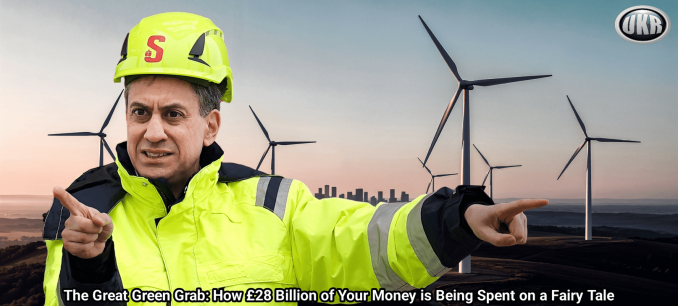
A lesson in lunacy: Picture the scene. It is a grey December morning in 2025, and the energy regulator Ofgem has just delivered the nation its latest Christmas present: permission for the electricity and gas companies to spend £28 billion of our money upgrading gas pipes and power pylons over the next five years. The press release is thick, of course, with the usual cant; “future-proofing,” “resilient,” “net zero by 2030”. The accompanying photographs show smiling ministers, wearing wholly unnecessary hard hats, standing in front of turbines the size of Big Ben. The average voter, already paying some of the highest electricity bills in the world, is supposed to cheer.
Do not cheer. What has just been announced is one of the largest acts of state sanctioned larceny in British history, dressed up as salvation. And it rests, from first brick to last, on a fantasy we are invited to accept without question: that the climate ‘emergency’ is so pressing that we must bankrupt ourselves to appease it. Suppose, just for a moment, that the emergency is a mirage – and it certainly is – and compound of hysterical computer models, grant-hungry academics, and politicians in search of a noble purpose and good jobs when they retire or get kicked out. From that vantage point, the £28 billion looks less like an investment and more like the greatest confidence trick ever played on a developed nation.
The money is not, as the propaganda insists, going to keep the lights on. It is going to rewire Britain for a fantasy in which the wind always blows, the sun always shines, and the gas taps can be turned off without anyone noticing. Seventeen billion pounds will be lavished on the gas networks – ironic, really, because the official religion insists gas is the devil – and the rest on electricity transmission. But then, the gas moguls are also part of the racket. New cables will march across Yorkshire and Lincolnshire, submarine links will be laid to drag power from wind farms floating in the North Sea, and vast concrete plinths will be sunk so that offshore turbines can be doubled, trebled, quadrupled in number.
All of this is required, we are told, because millions of us will soon be driving electric cars and heating our homes with electric heat pumps. Never mind that heat pumps cost £12,000 a pop and work badly in draughty Victorian terraces; never mind that the charging network is years behind schedule, ignore the new taxes on electric cars, and never mind that, on a still winter evening in 2030, the national grid will be praying for a breeze and begging the French for help. The plan must proceed, because the mendacious models say the world ends in twelve years (or eleven, or eight – the apocalypse is surprisingly flexible on deadlines).
The absurdity is almost artistic. We are spending billions to solve a problem that, even if it exists, on the Government’s own evidence Britain cannot materially affect. Our carbon emissions are roughly one per cent of the global total. Even if we shut down every factory, grounded every plane and returned to candlelight, the temperature effect by 2100 would be measured in hundredths of a degree – and that according to the very models whose past predictions have proved spectacularly inaccurate. Meanwhile China commissions two new coal plants regularly and India plans another 400. But Westminster, like a man flogging himself in the market square to atone for the sins of strangers, insists on leading the penance.
And penance it is. The average dual-fuel bill is already £1,717 a year, much higher than what the French pay, about triple the American rate and almost ten times higher than China’s. Policy costs – the green levies that pay for wind farms and solar panels – now make up a sixth of the typical bill. Ofgem’s £28 billion will add another £108 per household by 2031, and that is only the direct charge for the wires and pipes. The indirect costs are far larger: the subsidies that guarantee wind-farm owners £120 per megawatt-hour when the market price is £40; the “constraint payments” when the grid cannot cope and we pay turbines to switch off; the eye-watering expense of absurd carbon capture schemes that swallow a quarter of a power station’s output just to bury the fumes (which eventually escape).
The tragedy is that none of this is necessary. Gas is abundant, cheap and dispatchable. A new fleet of combined-cycle gas turbines could have been built for a fraction of the cost and would keep bills low for decades. Nuclear power, properly managed (as the French and Koreans manage it), is cheaper still over its lifetime. Instead, we have chosen the most expensive, least reliable energy mix in the developed world, and we have done so in the name of a theory that has survived more failed predictions than the Jehovah’s Witnesses.
The £28 billion is only the latest instalment. Add in Great British Energy’s billions, the Warm Homes Plan, the endless overruns at Hinkley and Sizewell, the carbon-capture white elephants, and you are looking at a trillion-pound programme by mid-century – three times the cost of Covid, shouldered by a shrinking number of bill-payers as industry flees to jurisdictions that have not taken leave of their senses. There is a peculiarly British Establishment masochism (or is it sadism?) to the whole spectacle. We are volunteering to make ourselves poorer, colder and darker in order to advertise our virtue to people who neither notice nor care. The rest of the world watches with a mixture of pity and amusement as we cover our hills with useless turbines and our seas with rusting monuments to hysteria.
One day, perhaps sooner than the modellers think, the public will ask the question that should have been asked years ago: if the climate is truly in peril, why are we the only ones prepared to freeze in the dark to save it? When that day comes, the £28 billion will stand as a monument not to foresight, but to one of the most expensive outbreaks of collective delusion in our island story.
Until then, keep an eye on your direct debits. They are about to go up again. And rebel.

••••
The Liberty Beacon Project is now expanding at a near exponential rate, and for this we are grateful and excited! But we must also be practical. For 7 years we have not asked for any donations, and have built this project with our own funds as we grew. We are now experiencing ever increasing growing pains due to the large number of websites and projects we represent. So we have just installed donation buttons on our websites and ask that you consider this when you visit them. Nothing is too small. We thank you for all your support and your considerations … (TLB)
••••
Comment Policy: As a privately owned web site, we reserve the right to remove comments that contain spam, advertising, vulgarity, threats of violence, racism, or personal/abusive attacks on other users. This also applies to trolling, the use of more than one alias, or just intentional mischief. Enforcement of this policy is at the discretion of this websites administrators. Repeat offenders may be blocked or permanently banned without prior warning.
••••
Disclaimer: TLB websites contain copyrighted material the use of which has not always been specifically authorized by the copyright owner. We are making such material available to our readers under the provisions of “fair use” in an effort to advance a better understanding of political, health, economic and social issues. The material on this site is distributed without profit to those who have expressed a prior interest in receiving it for research and educational purposes. If you wish to use copyrighted material for purposes other than “fair use” you must request permission from the copyright owner.
••••
Disclaimer: The information and opinions shared are for informational purposes only including, but not limited to, text, graphics, images and other material are not intended as medical advice or instruction. Nothing mentioned is intended to be a substitute for professional medical advice, diagnosis or treatment.
Disclaimer: The views and opinions expressed in this article are those of the author and do not necessarily reflect the official policy or position of The Liberty Beacon Project.


